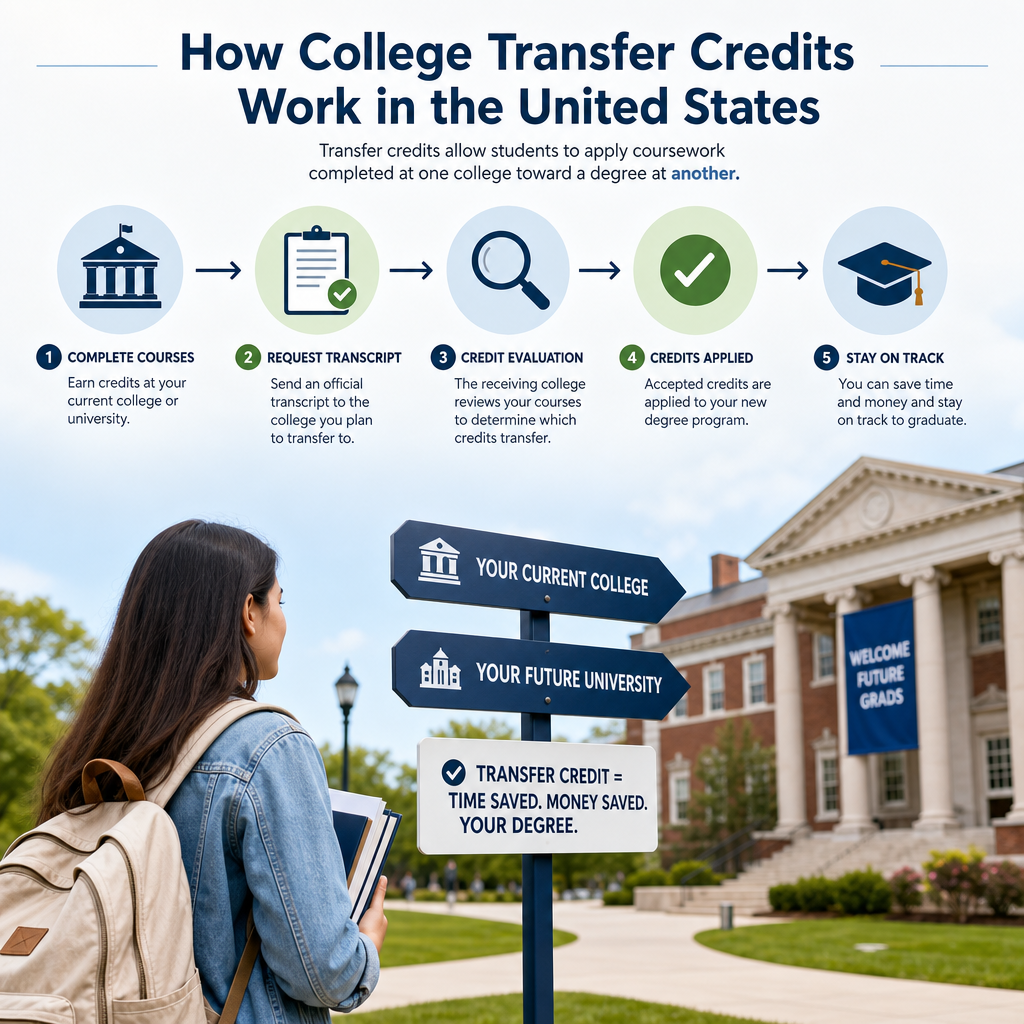
How College Transfer Credits Work in the United States
Transfer credits can help you continue your education without repeating classes, but each college decides which courses it will accept. Learning how transfer credits work in the United States can make it easier to save money, avoid surprises, and stay on track toward your degree.
By: Jennifer on July 24, 2026
Transferring colleges can be exciting, but it often comes with one big question: How college transfer credits work in the United States. Whether you are moving from a community college to a university, switching schools after a few semesters, or returning to finish a degree, understanding transfer credits can save you time, money, and frustration.
The short version: transfer credits are academic credits earned at one institution that another school may accept toward a new degree program. But the process is not automatic. Each college sets its own policies, and approval depends on factors like accreditation, course content, grades, and degree requirements.
If you are planning a transfer, knowing how the system works can help you make better decisions before you enroll in your next class.
What Are Transfer Credits?
Transfer credits are courses you completed at one college or university that another school agrees to count toward its own degree requirements. Instead of starting over, you may be able to bring in credits from general education classes, major prerequisites, electives, or even prior learning in some cases.
For example, if you took English Composition, College Algebra, or Intro to Psychology at your first school, a new college may accept those credits if the courses meet its standards.
Common Types of Transferable Credit
Transfer credit can come from several sources:
Traditional college coursework from regionally accredited institutions
Community college courses transferred to four-year universities
AP, IB, or dual enrollment credits earned in high school
Military training or experience evaluated for credit
Prior learning assessments for work or life experience, at some schools
Not every credit type transfers the same way, and some may count as elective credit instead of fulfilling a specific requirement.
How College Transfer Credits Work in the United States
When a student transfers, the receiving school reviews each course to decide whether to accept it. That review usually considers several things:
1. Accreditation of the Sending School
Accreditation matters a lot. Most colleges prefer or require credits from schools that are institutionally accredited, especially by recognized regional or national accreditors.
If your previous college is not accredited, the new institution may reject some or all of your credits.
2. Course Equivalency
A course must usually be similar in content, rigor, and learning outcomes to a comparable course at the new school. A biology class at one college may transfer as general biology, or it may only count as an elective if the content does not align closely enough.
3. Grade Earned
Most colleges require a minimum grade for transfer credit, often a C or better. Some schools accept C- in certain cases, while others are stricter. Pass/fail courses may transfer differently depending on the institution and program.
4. Relevance to the Degree
A course can transfer but still not apply to your specific degree plan. For example, a literature course may count as an elective but not as a required major course.
5. Credit Hours
The number of semester or quarter credits must also align. A three-credit course at one school may not map perfectly to a four-credit course at another, so the transfer may be partial or adjusted.
Why Transfer Credit Policies Vary So Much
One of the most confusing parts of transferring is that there is no single national rule for college transfer credits. In the United States, each institution creates its own policies.
That means:
One university may accept a course
Another may reject the same course
A third may accept it, but only as elective credit
This happens because colleges design their own curriculum, learning outcomes, and degree requirements. Even schools in the same state can have different transfer agreements and expectations.
Public, Private, and For-Profit Schools
Transfer policies can differ by school type:
Public colleges and universities often have clearer transfer pathways, especially within a state system
Private colleges may have stricter or more selective transfer review processes
For-profit institutions may not always transfer as many credits to other schools, so students should review policies carefully
How to Check Whether Your Credits Will Transfer
If you want the best chance of keeping your credits, start planning early. Before you register for courses, ask the receiving school how it handles transfer evaluation.
Steps to Take
Check accreditation
Make sure both schools are properly accredited.
Review transfer policies
Look for transfer admission pages, equivalency databases, or degree transfer guides.
Compare course descriptions
Save syllabi, reading lists, assignments, and catalog descriptions.
Talk to an academic advisor
Advisors can help you understand which courses are most likely to count.
Use transfer tools
Many schools offer online course equivalency systems or transfer articulation databases.
Documents That Help
Keep these materials in case a school requests them:
Official transcripts
Course syllabi
Catalog descriptions
Assignment outlines
Lab requirements
Proof of AP, IB, or CLEP scores
The more clearly you can show what a course covered, the easier it is for a college to evaluate it.
What Is a Transfer Articulation Agreement?
A transfer articulation agreement is a formal arrangement between two schools that spells out how credits move from one institution to another. These agreements can make transferring much smoother because they reduce guesswork.
For example, a community college and a state university may have an agreement saying that certain associate degree courses will count directly toward a bachelor’s degree.
Benefits of Articulation Agreements
Clearer transfer pathways
Fewer lost credits
Faster degree completion
Better academic planning
Lower overall tuition costs
If you know where you plan to transfer, look for a school with a strong articulation agreement or transfer pathway.
How Credits Transfer from Community College to a Four-Year School
Many students begin at a community college because it can be more affordable and flexible. In many cases, those credits transfer well to public universities and some private colleges.
A common example is the Associate of Arts (AA) or Associate of Science (AS) degree, which may cover general education requirements at a four-year school. However, transfer success depends on how closely the courses align with the bachelor’s program.
What Usually Transfers Well
English composition
College math
Basic science labs
Introductory humanities
Social science electives
What May Transfer Less Easily
Technical or career-specific courses
Specialized major classes
Courses with limited equivalent at the receiving school
Low-grade or pass/fail courses, depending on policy
If your goal is to earn a bachelor’s degree, ask whether your community college courses match the university’s lower-division requirements.
What Happens If a Course Transfers but Does Not Fit Your Degree?
This is a common situation. A course may appear on your transcript and count as transfer credit, but it may not satisfy a required class in your major.
In that case, the credit may be used as:
A general elective
An open elective
A free elective
Unused credit, if your program is highly structured
This is why students should not assume every transferred course shortens their time to graduation. A three-credit class can transfer and still not help much if it does not fit the degree map.
How AP, IB, and Dual Enrollment Credits Fit In
Transfer credit is not limited to college-to-college coursework. Many students enter college with credits earned in high school.
Advanced Placement (AP)
AP scores may qualify for college credit depending on the score and the receiving school’s policy. Some colleges grant course credit, some offer placement only, and others do both.
International Baccalaureate (IB)
IB credits are often accepted by many universities, but the amount of credit can vary by score, subject, and level.
Dual Enrollment
Dual enrollment courses, taken through an approved college while in high school, may transfer like standard college credits. These often have a strong chance of transferring if the courses come from an accredited institution.
Always verify whether the college treats these credits as direct equivalents, electives, or placement credit only.
Tips to Maximize Your Transfer Credits
If you are serious about preserving your academic progress, a little planning goes a long way.
1. Choose transferable courses early
If you know you may transfer, focus on widely accepted general education courses.
2. Stay above the minimum grade
A strong grade increases the likelihood that the new school will accept the course.
3. Save your syllabi
Course descriptions often are not enough. Syllabi show exactly what was taught.
4. Meet with advisors before enrolling
A short conversation can prevent costly mistakes.
5. Finish an associate degree when possible
In some cases, completing a degree before transferring can strengthen your credit package, especially under state transfer agreements.
6. Use official transfer guides
Some states and university systems publish detailed equivalency tables and degree maps.
Common Mistakes Students Make
Transferring credits can get complicated fast, especially when students assume all schools follow the same rules. Watch out for these mistakes:
Taking classes without checking transferability
Assuming online courses will always transfer
Ignoring grade minimums
Forgetting to confirm accreditation
Not saving course materials
Waiting until after enrollment to ask about credit evaluation
Assuming a course that transfers will automatically meet major requirements
Avoiding these errors can protect your progress and reduce the risk of repeating coursework.
What to Do If Your Credits Are Denied
If a school does not accept a course you expected to transfer, do not panic. You may still have options.
Possible Next Steps
Ask for a written explanation
Submit a course syllabus for reevaluation
Appeal the decision through the registrar or transfer office
Compare the course to another department course
Ask whether it can count as elective credit
Sometimes a course denial is final. Other times, additional documentation can change the outcome.
Frequently Asked Questions
1. Do all college credits transfer to another school?
No. Transfer credit depends on the receiving school’s policies, accreditation standards, course content, grade earned, and degree requirements. Even if a course transfers, it may only count as elective credit.
2. What grade do I need for transfer credits?
Many colleges require at least a C grade, though some accept C- or have different rules for specific programs. Always check the transfer policy of the school you plan to attend.
3. Can I transfer credits from a community college to a university?
Yes, and this is one of the most common transfer paths in the United States. Many community college courses transfer well, especially general education classes. Program-specific courses may be evaluated more carefully.
4. Will my AP or dual enrollment credits transfer?
Often, yes, but it depends on the school. AP, IB, and dual enrollment credits are commonly accepted in some form, but colleges may assign credit differently or use them only for placement.
5. What should I do if I want to transfer schools?
Start by checking transfer policies, confirming accreditation, and speaking with an academic advisor. Collect syllabi and transcripts early so you can maximize the number of credits that transfer.
Understanding how college transfer credits work in the United States can make the difference between a smooth transition and a frustrating setback. The key is to remember that transfer credit is not automatic. Each college reviews coursework based on accreditation, course content, grades, credit hours, and how well the class fits the new degree program.
If you are planning to transfer, take a proactive approach. Check school policies early, save your syllabi, talk with advisors, and use official transfer tools whenever possible. These steps can help you preserve more of the work you have already completed and avoid paying twice for the same education.
Transfer credit rules may seem complicated at first, but once you understand the basics, you can make smarter choices about where to take classes and how to build your academic path. Whether you are moving from a community college to a university or switching schools for a better fit, planning ahead will help you protect your time, money, and progress toward graduation.
Jennifer, M.Ed., holds a degree in Higher Education Administration, with
a focus on U.S. college financial aid, admissions policy, and student
support systems. She researches and writes about scholarships, federal
aid programs, and the college planning process to help students and
families make informed, well-supported decisions.