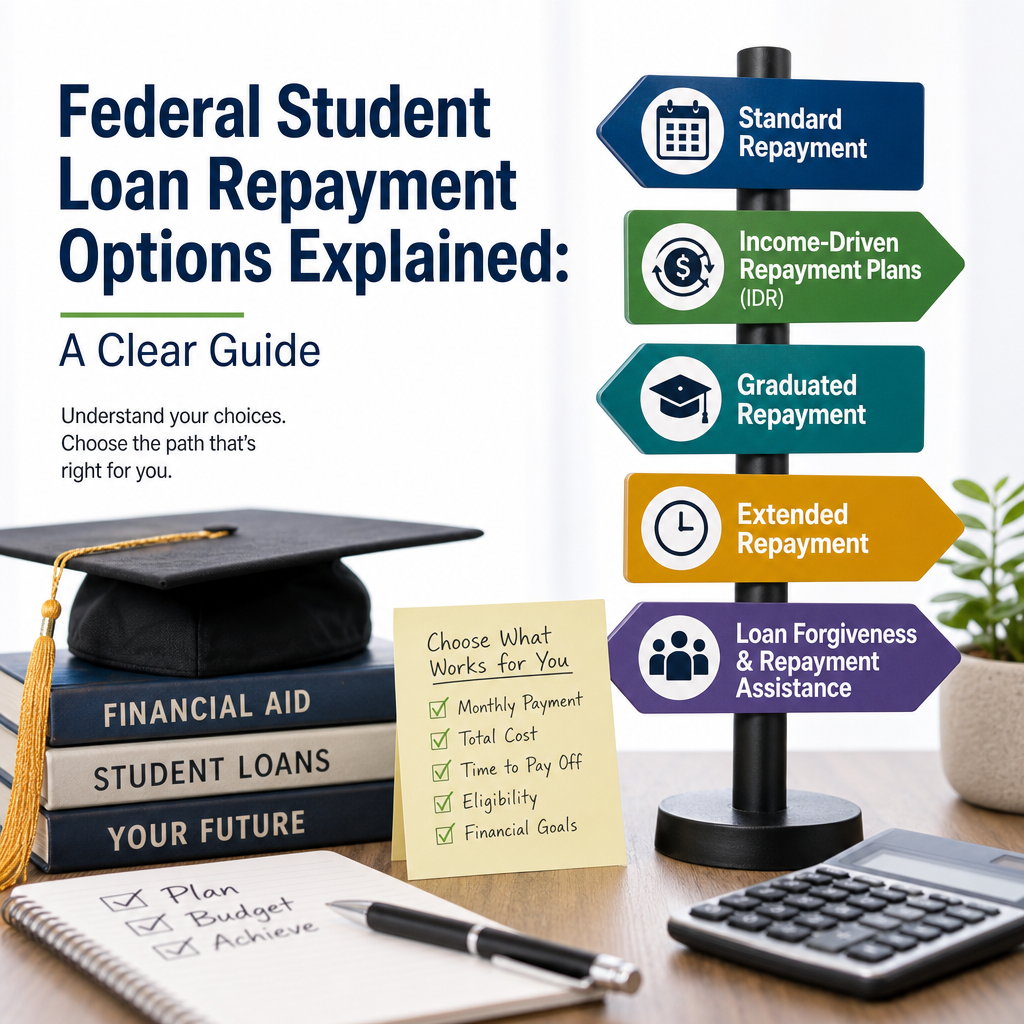
Federal Student Loan Repayment Options Explained: A Clear Guide
Understanding your federal student loan repayment options can help you choose a plan that fits your budget and long-term goals. From lower monthly payments to faster debt payoff, the right option can make repayment feel much more manageable.
By: Mary on July 23, 2026
Última atualização em: agosto 3, 2026
Choosing the right federal student loan repayment options can make a major difference in your monthly budget, long-term debt strategy, and overall financial stress. If you have federal student loans, you are not locked into a one-size-fits-all payment plan. In fact, the Department of Education offers several repayment plans designed to fit different income levels, career stages, and financial goals.
Whether you want the lowest possible monthly payment, a faster path to becoming debt-free, or a way to stay current during a tough financial season, understanding your choices is essential. This guide breaks down the most important federal student loan repayment options, how they work, and how to decide which one may fit your situation.
What Are Federal Student Loan Repayment Options?
Federal student loan repayment options are the plans and programs available to borrowers with U.S. Department of Education loans. These options determine:
How much you pay each month
How long repayment lasts
Whether your payments depend on your income
Whether interest may continue to build
What happens if your financial situation changes
The best repayment plan is not always the one with the lowest monthly payment. It depends on your income, loan balance, career path, and whether you qualify for forgiveness programs.
The Main Federal Student Loan Repayment Plans
Federal student loans generally offer two broad categories of repayment plans:
Standard and extended fixed-payment plans
Income-driven repayment plans
Each serves a different purpose. Let’s look at the most common federal student loan repayment options in more detail.
Standard Repayment Plan
The Standard Repayment Plan is often the default option for federal student loans. It spreads your loan payments over 10 years, though consolidated loans may have longer terms.
Best for:
Borrowers who want to pay off debt quickly
People with stable incomes
Borrowers who want to minimize interest over time
Why people choose it:
Fixed monthly payments
Predictable schedule
Usually the lowest total interest compared with longer repayment plans
Possible drawback:
The monthly payment can be higher than other options, which may feel difficult if your income is just starting to grow.
Graduated Repayment Plan
The Graduated Repayment Plan starts with lower payments and increases them every two years. It still typically ends in 10 years for most borrowers.
Best for:
Recent graduates who expect income to rise over time
Borrowers with low starting salaries
Why people choose it:
Lower initial payments
Can help bridge the gap early in your career
Possible drawback:
Because payments rise over time, this plan can become less comfortable if your income does not increase as expected. You may also pay more interest over the life of the loan than under the Standard Plan.
Extended Repayment Plan
The Extended Repayment Plan can stretch payments up to 25 years, depending on loan balance and eligibility. It may use fixed or graduated payments.
Best for:
Borrowers with large federal student loan balances
People who need smaller monthly payments
Why people choose it:
Reduces monthly payment amount
Offers more breathing room in a tight budget
Possible drawback:
Lower monthly payments usually mean paying more interest over time. This can make the loan more expensive overall.
Income-Driven Repayment Plans: A Closer Look
If your federal student loan payment feels too high compared with your income, income-driven repayment plans may be worth exploring. These plans base your monthly payment on your income and family size rather than only on the amount you owe.
For many borrowers, this is the most important category of federal student loan repayment options because it can create immediate relief.
Income-Based Repayment (IBR)
Income-Based Repayment (IBR) sets your monthly payment as a percentage of your discretionary income, with limits based on when you borrowed.
Best for:
Borrowers with limited income
People seeking a manageable monthly payment
Borrowers pursuing Public Service Loan Forgiveness or long-term forgiveness options
Important note:
Eligibility and payment rules can vary depending on when your loans were first disbursed. If your income changes, your payment may be recalculated.
Pay As You Earn (PAYE)
PAYE generally caps monthly payments at 10% of discretionary income for eligible borrowers.
Best for:
Borrowers with moderate or lower income
People who want income-based payments with a payment cap
Possible drawback:
Eligibility is limited. Not every borrower qualifies.
Saving on a Valuable Education (SAVE)
The SAVE Plan is the federal government’s newest income-driven repayment plan and has become a central option for many borrowers. It can lower monthly payments for eligible borrowers and has especially favorable terms for lower balances.
Best for:
Borrowers seeking the lowest possible income-driven payment
People with modest incomes relative to their loan balance
Borrowers who want protection from loan balance growth due to unpaid interest
Why people choose it:
Payments can be very affordable for many borrowers
Unpaid interest does not cause the balance to grow in the same way it can under other plans
It may offer a faster route to forgiveness for some borrowers with smaller original balances
Possible drawback:
Like all income-driven repayment plans, you must usually recertify your income and family size. Also, forgiveness timelines can vary depending on your original loan balance and loan type.
Income-Contingent Repayment (ICR)
Income-Contingent Repayment (ICR) is one of the older income-driven plans. It generally sets payments based on a formula tied to income and loan amount.
Best for:
Borrowers with Parent PLUS loans that have been consolidated into a Direct Consolidation Loan
People who do not qualify for some newer income-driven plans
Possible drawback:
ICR often produces higher payments than SAVE or PAYE, depending on the borrower’s financial situation.
How to Choose the Right Federal Student Loan Repayment Option
The best federal student loan repayment options depend on your goals. A plan that works well for a borrower with a high salary may be a poor fit for someone starting a nonprofit job or dealing with temporary financial hardship.
Ask These Questions First
Before choosing a plan, think through the following:
Can I comfortably afford the standard monthly payment?
Do I expect my income to increase soon?
Do I want to minimize total interest or minimize monthly payments?
Am I working toward forgiveness through Public Service Loan Forgiveness (PSLF) or another program?
Does my family size or household income make an income-driven plan more attractive?
A Simple Rule of Thumb
If you can afford it, the Standard Repayment Plan often saves money in the long run.
If you need lower early payments, the Graduated or Extended Repayment Plan may help.
If your income is limited or uncertain, an income-driven repayment plan can provide the most flexibility.
Federal Student Loan Repayment Options for Financial Hardship
Sometimes repayment gets harder because of job loss, reduced hours, medical bills, or other unexpected expenses. Federal student loans include several tools that may help in those moments.
Deferment
A deferment lets eligible borrowers temporarily pause payments. Depending on the loan type and deferment reason, interest may not accrue on some loans.
Common deferment reasons:
Returning to school at least half-time
Unemployment
Economic hardship
Active military service
Forbearance
A forbearance also allows you to temporarily stop or reduce payments, but interest usually continues to accrue.
Common reasons for forbearance:
Financial hardship
Medical expenses
Temporary unemployment
Administrative issues
Key difference:
Forbearance can be useful for short-term relief, but it may increase the total cost of your loan if interest keeps building.
Important caution
Deferment and forbearance are not long-term repayment strategies. They can buy time, but they should usually be used as a bridge while you return to a sustainable repayment plan.
Public Service Loan Forgiveness and Repayment Plans
If you work full-time for a qualifying government or nonprofit employer, Public Service Loan Forgiveness (PSLF) may matter a lot when selecting a repayment plan.
To pursue PSLF, borrowers typically need to:
Have eligible federal Direct Loans
Make 120 qualifying monthly payments
Work for a qualifying public service employer
Use an eligible repayment plan, usually an income-driven repayment plan
Why this matters
A borrower aiming for PSLF often chooses an income-driven repayment plan because it can keep payments manageable while they work toward forgiveness. In many cases, the goal is not to pay off the full balance through monthly payments alone, but to make qualifying payments and then receive forgiveness after meeting program requirements.
If PSLF is part of your plan, repayment choice becomes a strategic decision, not just a monthly budget issue.
How to Change Your Repayment Plan
One advantage of federal student loans is flexibility. You are usually not stuck with your original choice forever.
Steps to change your plan
Log in to your federal loan account.
Review your current loan types and servicer information.
Compare repayment plans.
Use a loan simulator or repayment estimator if available.
Submit a request to change your plan.
When it makes sense to switch
You may want to change repayment plans if:
Your income has dropped
Your family size has changed
You are better positioned to pay faster
You are pursuing forgiveness
Your current payment is not sustainable
Practical Example: Choosing a Repayment Plan
Here’s a simple example.
Imagine two borrowers:
Borrower A has a stable salary and can afford a regular payment. They want to pay off loans as quickly as possible and reduce total interest.
Borrower B is in an entry-level job and expects income growth over the next few years. They need lower payments now and more flexibility.
For Borrower A, the Standard Repayment Plan may be the most efficient choice.
For Borrower B, a Graduated Repayment Plan or an income-driven repayment plan may be a better fit.
This shows why the best federal student loan repayment options depend on your personal circumstances, not just the size of your debt.
Common Mistakes to Avoid
Borrowers often make repayment decisions without considering the long-term cost. Watch out for these mistakes:
Choosing the lowest monthly payment without considering total interest
Not checking whether all loans are federal or mixed with private loans
If you have both federal and private student loans, only the federal loans qualify for these repayment options. Private loans are handled separately by private lenders.
Tips for Managing Repayment Successfully
A smart repayment plan is only part of the equation. These habits can help you stay on track:
Set up auto-debit if your servicer offers it
Review your loan statements regularly
Reevaluate your plan after major life changes
Keep records of payments if you may qualify for forgiveness
Recheck your eligibility for income-driven plans every year
Pay extra when possible, if your budget allows
Even small extra payments can reduce interest and shorten your repayment timeline.
Frequently Asked Questions
1. What are the best federal student loan repayment options for low income?
Income-driven repayment plans are often the best fit for borrowers with low income. These plans base your payment on what you earn and your family size, which can make monthly payments more manageable.
2. Can I switch federal student loan repayment plans later?
Yes. Federal borrowers can usually change repayment plans if they qualify. This flexibility is one of the biggest advantages of federal loans. If your financial situation changes, you can often move to a different plan that better fits your needs.
3. Does choosing a lower payment plan increase interest?
Often, yes. Plans with lower monthly payments may extend your repayment timeline, which can increase the amount of interest you pay over time. That is why it helps to balance short-term affordability with long-term cost.
4. Are income-driven repayment plans the same as loan forgiveness?
No. Income-driven repayment plans are repayment structures, not forgiveness programs by themselves. However, some borrowers may receive forgiveness after making qualifying payments for a set period, depending on the plan and loan type.
5. Do federal student loan repayment options apply to private loans?
No. These repayment options apply only to federal student loans. Private loans are controlled by the lender and may offer different repayment terms, hardship programs, or modification options.
Understanding federal student loan repayment options gives you more control over your finances and helps you avoid unnecessary stress. The right plan can lower your monthly payment, reduce total interest, or support your progress toward forgiveness. The wrong plan, on the other hand, can make repayment feel harder than it needs to be.
Start by identifying your current income, your budget, and your long-term goals. If you can comfortably handle fixed payments, a standard or extended plan may work well. If you need flexibility, an income-driven repayment plan may provide the relief you need while keeping you on track. And if you are working in public service, repayment strategy becomes even more important because it can affect your path to PSLF.
The key is not to choose a plan once and forget it. Review your options regularly, especially after a job change, income change, or family change. Federal student loan repayment is not just about making payments—it is about choosing a strategy that fits your life today and supports your financial future.
Mary S, CFP®, is a Certified Financial Planner with over 12 years of experience in personal finance, retirement planning, and wealth management. She writes educational content that helps readers understand financial concepts and make informed decisions based on reliable information.