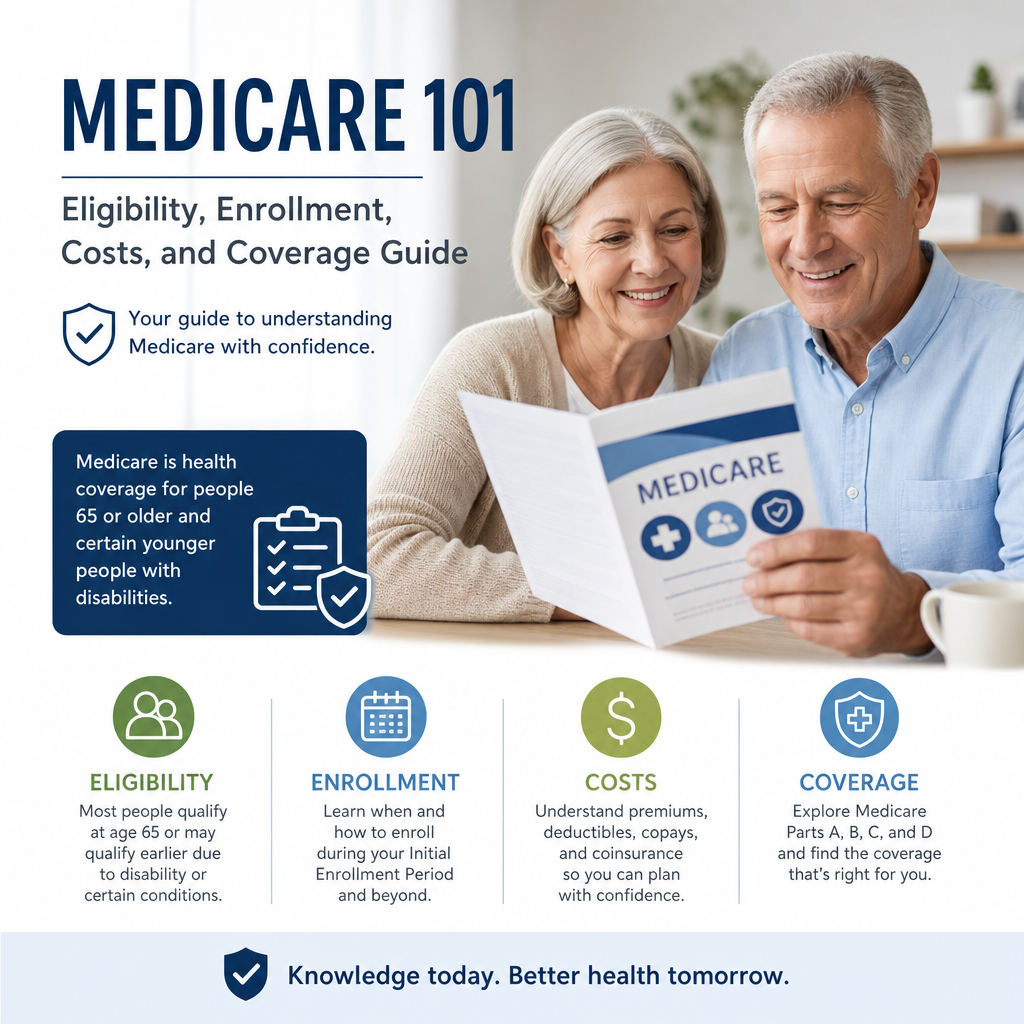
Medicare 101: Eligibility, Enrollment, Costs, and Coverage Guide
Medicare eligibility is the first step to understanding when and how you can get coverage, whether you’re approaching 65 or qualifying through disability. This guide also breaks down enrollment, costs, and the different Medicare parts so you can make confident decisions without the confusion.
By: Emilly on July 23, 2026
Última atualização em: agosto 3, 2026
Medicare can feel complicated the first time you explore it, especially if you’re comparing plans, trying to understand deadlines, or figuring out what you’ll actually pay. This Medicare 101 guide breaks down the essentials in plain English: who qualifies, when and how to enroll, what Medicare costs, and what coverage each part provides. Whether you’re approaching age 65, helping a parent review options, or planning ahead, understanding the basics can save you time, money, and unnecessary stress.
What Is Medicare?
Medicare is the federal health insurance program for people who qualify based on age, disability, or certain medical conditions. Most people first become eligible at age 65, but younger individuals may qualify in specific circumstances.
Medicare is not the same as Medicaid, which is a separate program based on income and resources. It also differs from employer insurance, though some people use Medicare alongside coverage from a job or retiree plan.
At a high level, Medicare is divided into parts:
Part A: Hospital insurance
Part B: Medical insurance
Part C: Medicare Advantage, an alternative way to receive Medicare benefits through private insurers
Part D: Prescription drug coverage
You can use Original Medicare, which includes Part A and Part B, or choose a Medicare Advantage plan instead.
Medicare Eligibility: Who Can Enroll?
Understanding Medicare eligibility is the first step. Most people qualify in one of the following ways.
Age-Based Eligibility
You’re generally eligible for Medicare when you turn 65 if:
You are a U.S. citizen, or
You have been a lawful permanent resident for at least five continuous years
Many people qualify for premium-free Part A if they or a spouse paid Medicare taxes for at least 10 years.
Disability-Based Eligibility
Some people qualify for Medicare before age 65 if they’ve received Social Security Disability Insurance (SSDI) for 24 months. In many cases, Medicare starts automatically after that waiting period.
Specific Medical Conditions
You may also qualify earlier if you have:
End-Stage Renal Disease (ESRD)
Amyotrophic lateral sclerosis (ALS)
These cases have special enrollment rules, so it’s important to confirm timing directly with Social Security or Medicare.
Automatic Enrollment vs. Manual Enrollment
If you already receive Social Security or Railroad Retirement Board benefits before turning 65, you may be enrolled automatically in Part A and Part B. If not, you usually need to sign up yourself.
Medicare Enrollment: When and How to Sign Up
Enrollment timing matters. Missing a deadline can lead to late penalties or coverage gaps, so it helps to know the key periods.
Initial Enrollment Period
Your Initial Enrollment Period is a seven-month window that includes:
The 3 months before your 65th birthday month
Your birthday month
The 3 months after your birthday month
This is often the best time to enroll because it gives you the most flexibility and helps avoid delays.
Special Enrollment Period
If you’re still working and have health coverage through an employer or union, you may be able to delay Part B without penalty. When that coverage ends, you may qualify for a Special Enrollment Period.
This is common for people who:
Continue working past 65
Are covered by a spouse’s employer plan
Lose group health coverage
In many cases, you’ll have an eight-month window to sign up for Part B after employer coverage ends or employment stops, whichever happens first.
General Enrollment Period
If you miss your initial opportunity and don’t qualify for a special period, you can enroll during the General Enrollment Period, which runs from January 1 to March 31 each year.
Coverage usually starts later, and you may face penalties if you delayed enrollment without having creditable coverage.
Open Enrollment for Medicare Advantage and Part D
Each year, Medicare beneficiaries can review and change coverage during the Annual Open Enrollment Period, which runs from October 15 to December 7.
During this time, you can:
Switch from Original Medicare to a Medicare Advantage plan
Switch from Medicare Advantage back to Original Medicare
Change Medicare Advantage plans
Join, switch, or drop a Part D prescription drug plan
This is a good time to compare premiums, drug formularies, provider networks, and out-of-pocket costs.
Medicare Costs: What You May Pay
The cost of Medicare depends on your work history, income, plan choices, and how often you use care. Medicare is not free, and total costs can include premiums, deductibles, copays, and coinsurance.
Part A Costs
Many people pay no monthly premium for Part A if they qualify through work history.
You may still have:
A deductible for each benefit period
Copays or coinsurance for long hospital stays, skilled nursing care, or hospice services
If you do not qualify for premium-free Part A, you may have to pay a monthly premium.
Part B Costs
Part B usually has a monthly premium, plus:
An annual deductible
Typically 20% coinsurance for most covered outpatient services after the deductible is met
Part B covers many doctor and outpatient services, so even people with good health may want to budget for it.
Part C Costs
Medicare Advantage costs vary by plan. You still must pay your Part B premium, and some plans add their own monthly premium.
Other possible costs include:
Deductibles
Copays for doctor visits and prescriptions
Coinsurance
Costs for out-of-network care, depending on the plan type
Because plans differ so much, it’s important to compare more than just the monthly premium.
Part D Costs
Part D plans help cover prescription drugs. Your costs may include:
A monthly premium
An annual deductible, depending on the plan
Copays or coinsurance for medications
Higher costs if you use drugs not listed on the plan’s formulary
Drug coverage can change from year to year, so it’s smart to review your medications during open enrollment.
Income-Related Adjustments
Some people with higher incomes pay more for Part B and Part D. These added amounts are called income-related monthly adjustment amounts, or IRMAA. Medicare uses tax information from a previous year to determine whether this applies.
Extra Help and Savings Programs
If you have limited income or resources, you may qualify for assistance that lowers costs. Programs may help with:
Part D premiums
Deductibles
Copays
Medicare Savings Programs
These programs can make a major difference if you’re managing a fixed income.
Medicare Coverage: What Each Part Includes
A big part of Medicare 101 is understanding what is and isn’t covered. The program covers many important services, but not everything.
Part A Coverage
Part A helps cover inpatient care such as:
Hospital stays
Skilled nursing facility care under certain conditions
Hospice care
Limited home health services
Some inpatient mental health care
Part B Coverage
Part B covers medically necessary outpatient and preventive services, including:
Doctor visits
Preventive screenings and vaccines
Lab tests
Outpatient surgery
Durable medical equipment
Ambulance services
Mental health services
Part C Coverage
Medicare Advantage plans must cover everything Original Medicare covers, except hospice care, which remains covered by Original Medicare. Many plans also add benefits such as:
Dental care
Vision care
Hearing services
Gym or wellness programs
Transportation benefits
These extra benefits can be appealing, but the details vary widely. Always check network rules and cost-sharing before enrolling.
Part D Coverage
Part D helps pay for prescription medications. Every plan has a formulary, which is the list of covered drugs. Plans often group medications into tiers that affect how much you pay.
When comparing Part D plans, check:
Whether your prescriptions are covered
Which pharmacy networks are included
Whether prior authorization is required
Whether mail-order options are available
What Medicare Does Not Cover
Original Medicare generally does not cover:
Most routine dental care
Eye exams for glasses
Hearing aids
Long-term custodial care
Most cosmetic procedures
Care outside the United States in most situations
That’s why some people add supplemental coverage or choose Medicare Advantage plans with extra benefits.
Original Medicare vs. Medicare Advantage
One of the most important decisions in Medicare 101 is whether to stay with Original Medicare or enroll in Medicare Advantage.
Original Medicare
Original Medicare includes Part A and Part B. You can see any doctor or hospital in the U.S. that accepts Medicare.
Pros:
Broad provider choice
No network restrictions in most cases
Easy to pair with a standalone Part D plan
Cons:
No built-in drug coverage
No annual out-of-pocket cap for Part A and B services
May need supplemental coverage, such as Medigap, for cost protection
Medicare Advantage
Medicare Advantage plans are offered by private insurance companies approved by Medicare. They bundle Part A and Part B, and often include Part D.
Pros:
May include extra benefits
Often has an annual out-of-pocket maximum
Can simplify coverage by combining benefits in one plan
Cons:
Usually uses provider networks
Plan rules can be stricter
Drug coverage and extra benefits vary
Out-of-network care may cost more or not be covered
Choosing the Right Path
There isn’t one best option for everyone. Consider:
Your doctors and whether they accept the plan
Your prescription drugs
How often you travel
Your budget for premiums and out-of-pocket costs
Whether you want predictable network-based coverage or broader access
Medigap: Supplemental Coverage for Original Medicare
If you choose Original Medicare, you may want to look at Medigap, also called Medicare Supplement Insurance. These private policies help pay some of the costs that Original Medicare doesn’t cover, such as:
Copayments
Coinsurance
Deductibles
Medigap plans do not work with Medicare Advantage. You can usually have either Original Medicare with Medigap or a Medicare Advantage plan, not both.
Medigap can be useful for people who want more predictable medical bills and broad provider access.
Common Medicare Enrollment Mistakes to Avoid
It’s easy to make avoidable errors when you’re new to Medicare. Here are some of the most common ones:
Missing your enrollment window
Delays can lead to penalties and coverage gaps.
Ignoring employer coverage rules
If you have creditable coverage through work, your enrollment timing may differ.
Choosing a plan based only on premium
Low premiums can come with higher copays or a narrower network.
Not checking prescription coverage
A plan may look affordable until you discover your medications are not covered well.
Assuming all doctors accept the same plan
Provider networks and participation rules can vary.
Practical Steps to Get Started
If you’re approaching Medicare eligibility, here’s a simple action plan:
Mark your enrollment dates
Identify your Initial Enrollment Period or Special Enrollment Period.
List your doctors and prescriptions
Compare plans based on real healthcare use.
Estimate total costs
Include premiums, deductibles, copays, and coinsurance.
Decide between Original Medicare and Medicare Advantage
Think about flexibility, networks, and extra benefits.
Check whether you need Part D or Medigap
These add-ons can be important depending on your needs.
Review plans every year
Coverage and drug formularies can change.
Frequently Asked Questions
1. When should I enroll in Medicare?
Most people should enroll during their Initial Enrollment Period, which starts three months before they turn 65 and ends three months after their birthday month. If you have employer coverage, you may qualify for a Special Enrollment Period later. The right timing depends on your job status, current insurance, and eligibility rules.
2. Do I have to take Medicare at age 65?
Not always. If you have qualifying employer health coverage, you may be able to delay Part B without a penalty. However, the rules are different depending on the size of the employer and whether the plan is creditable. It’s important to confirm this before delaying enrollment.
3. What is the difference between Original Medicare and Medicare Advantage?
Original Medicare is the federal program made up of Part A and Part B. You can see any provider that accepts Medicare, and you can add a standalone Part D plan and Medigap if needed. Medicare Advantage is offered by private insurers and usually combines medical and drug coverage, often with network rules and extra benefits.
4. Does Medicare cover prescriptions?
Yes, but usually not through Original Medicare alone. Most people get prescription coverage through a Part D plan or a Medicare Advantage plan that includes drug coverage. Coverage depends on the plan’s formulary, pharmacy network, and cost-sharing rules.
5. Can Medicare help if I have a low income?
Yes. Depending on your situation, you may qualify for savings programs that help pay Medicare premiums and other costs. You may also be eligible for Extra Help with prescription drug expenses. These programs can significantly reduce your out-of-pocket spending.
Medicare is a foundational part of health coverage for millions of Americans, but it works best when you understand the basics before you enroll. Knowing the difference between eligibility, enrollment periods, costs, and coverage can help you avoid penalties, compare plans more confidently, and choose the option that fits your health needs and budget.
The biggest takeaway from this Medicare 101 guide is simple: don’t focus only on the monthly premium. Look at your doctors, prescriptions, expected services, network rules, and total out-of-pocket costs. If you’re approaching age 65 or helping a loved one prepare, start reviewing your options early so you have time to make a thoughtful decision.
Medicare choices can affect both your healthcare access and your finances for years to come. A little preparation now can lead to better coverage and fewer surprises later.
Emily A, holds a Master's degree in Public Administration (MPA) and has over 7 years of experience researching federal and state assistance programs. She writes educational content focused on government benefits, public policy, and community resources, using information from official agencies to help readers understand available programs and eligibility requirements.