2026 Federal Income Tax Brackets and Rates Explained
Planning ahead is easier when you understand the 2026 federal income tax brackets and rates. This guide breaks down how the progressive tax system works so you can estimate what you may owe and make smarter withholding decisions.
By: Mary on July 23, 2026
Última atualização em: agosto 3, 2026
Understanding the 2026 federal income tax brackets and rates is one of the smartest ways to plan ahead for the tax year. Whether you’re a salaried employee, self-employed, retired, or managing a household budget, knowing how tax brackets work can help you estimate what you may owe, make better withholding decisions, and avoid unpleasant surprises at filing time.
The good news is that federal income taxes in the United States use a progressive system. That means not all of your income is taxed at one rate. Instead, different portions of your income are taxed at different rates. Once you understand that basic idea, the 2026 federal income tax brackets and rates become much easier to follow.
What Federal Income Tax Brackets Actually Mean
A tax bracket is a range of income that is taxed at a specific rate. The federal tax system does not tax all of your income at the rate of your highest bracket. It only taxes the portion of income that falls within each bracket.
For example, if part of your income falls into a 12% bracket and the next portion falls into a 22% bracket, only the income in the second range is taxed at 22%. This is a common point of confusion, but it’s essential for understanding how your final tax bill is calculated.
Progressive taxation in plain English
Here’s the simplest way to think about it:
Your first dollars of taxable income are taxed at the lowest applicable rate.
As income rises, only the additional income above each threshold gets taxed at the next rate.
Your effective tax rate is usually lower than your highest marginal rate.
That’s why two people with similar incomes can have different tax bills depending on deductions, credits, filing status, and other factors.
2026 Federal Income Tax Brackets and Rates Overview
The 2026 federal income tax brackets and rates are expected to follow the familiar bracket structure used in recent years unless Congress changes the tax code. Tax brackets are adjusted periodically for inflation, which means the income thresholds can shift from one year to the next.
While the exact 2026 thresholds may not be finalized until the IRS releases official guidance, taxpayers can still prepare by understanding how the bracket system works and watching for updates from the IRS.
Standard federal income tax rates
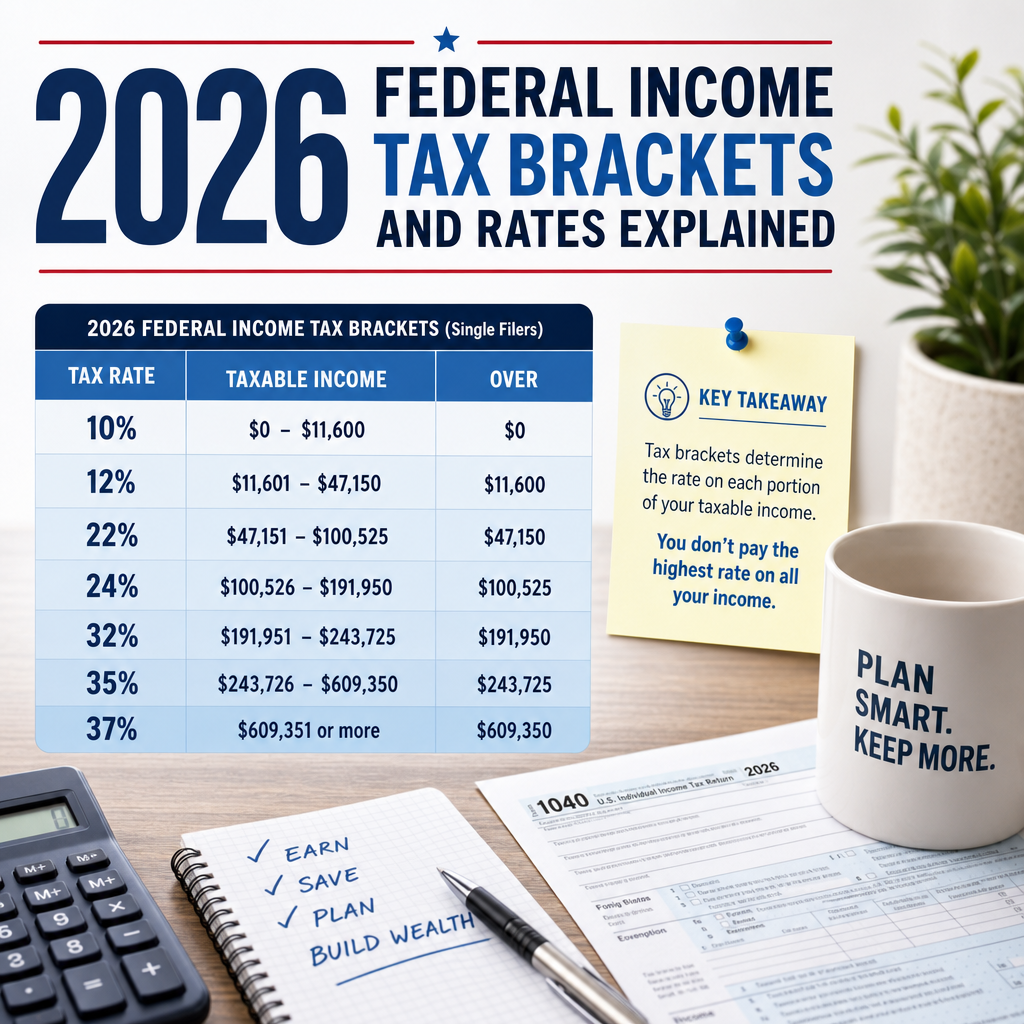
For many recent tax years, the federal income tax structure has included these rates:
10%
12%
22%
24%
32%
35%
37%
These rates are applied progressively across taxable income, not on gross income. Your taxable income is what remains after deductions, such as the standard deduction or itemized deductions, are subtracted from your adjusted gross income.
How Filing Status Affects Your Brackets
Your filing status plays a major role in determining which bracket thresholds apply to you. The IRS uses different bracket ranges for different groups of taxpayers.
Main filing statuses
The bracket tables typically vary for:
Single
Married filing jointly
Married filing separately
Head of household
Each filing status has its own income thresholds, and those differences can significantly affect your tax liability.
Why filing status matters
For example, a married couple filing jointly often has wider bracket ranges than a single filer. That means the couple may pay lower taxes on the same amount of taxable income compared with a single taxpayer. Head of household filers also receive more favorable thresholds than single filers in many cases.
If you expect a change in filing status for 2026, such as marriage, divorce, or qualifying for head of household, it’s worth reviewing how that could affect your tax bracket placement.
Tax Brackets vs. Tax Rates: The Difference That Matters
Many taxpayers use the words “tax bracket” and “tax rate” as if they mean the same thing, but they don’t.
Tax bracket
Your tax bracket is the range your income falls into.
Tax rate
Your tax rate is the percentage applied to the income in that bracket.
Marginal tax rate
This is the rate applied to your last dollar of taxable income. If you move into the 22% bracket, for example, only the income inside that bracket is taxed at 22%.
Effective tax rate
This is your total tax divided by your total taxable income. It gives you a better sense of your actual tax burden than your top bracket alone.
Understanding the difference between these terms helps you make better financial decisions, especially when planning bonuses, retirement contributions, capital gains, or freelance income.
How Deductions Can Lower Your Taxable Income
One of the most practical ways to reduce your tax liability is to lower your taxable income through deductions.
Standard deduction
Most taxpayers claim the standard deduction, which reduces the amount of income subject to tax. The amount changes over time and depends on filing status.
Itemized deductions
Some taxpayers itemize instead of taking the standard deduction. Common itemized deductions include:
Mortgage interest
State and local taxes, within applicable limits
Charitable contributions
Certain medical expenses, if they exceed a threshold
Above-the-line deductions
These deductions can lower adjusted gross income before you even reach taxable income. Examples may include:
Traditional IRA contributions, if eligible
Health savings account contributions
Student loan interest, if eligible
Self-employed retirement contributions
Lower taxable income can move part of your income into a lower bracket or reduce the amount taxed at higher rates.
Practical Example of How Brackets Work
Let’s say a single filer has $70,000 in taxable income in 2026, and the applicable brackets are similar to recent years.
That income would not be taxed all at one rate. Instead, it would be split across the brackets:
The first portion is taxed at 10%
The next portion is taxed at 12%
Any remaining portion is taxed at 22%, depending on where the income lands
This is why a higher tax bracket does not mean every dollar of income is taxed at that higher rate.
Why this matters for planning
If you receive a year-end bonus, sell investments, or take on extra freelance work, you may push some income into a higher bracket. That doesn’t mean the entire amount is taxed more heavily, but it can still increase your total tax bill.
Special Considerations for 2026
Tax planning is never just about brackets. Several other moving pieces affect what you owe.
Inflation adjustments
The IRS often adjusts bracket thresholds, deductions, and some credits for inflation. This can help prevent “bracket creep,” where your income rises with inflation but your tax burden increases even if your real purchasing power does not.
Tax credits
Credits reduce tax directly, which makes them more valuable than deductions in many cases. Depending on your situation, you may qualify for credits such as:
Child Tax Credit
Earned Income Tax Credit
Education credits
Retirement savings credit
Self-employment income
If you freelance, run a business, or work as an independent contractor, you may owe both income tax and self-employment tax. That means bracket planning alone is not enough—you also need to account for estimated tax payments and business deductions.
Capital gains and dividends
Investment income can be taxed differently from wages. Long-term capital gains and qualified dividends often follow their own tax rules, so they may not be taxed at ordinary income tax rates. That distinction matters when you’re trying to estimate your 2026 tax picture.
Smart Ways to Prepare for 2026
Even before official thresholds are published, you can take practical steps to get ready for the 2026 federal income tax brackets and rates.
1. Estimate your taxable income
Start with your expected gross income and subtract likely deductions. This gives you a better picture of where you might land in the bracket structure.
2. Review withholding
If you’re an employee, review your paycheck withholding using Form W-4. Underwithholding can lead to a balance due, while overwithholding means giving the IRS an interest-free loan.
3. Make retirement contributions
Pre-tax contributions to accounts like a traditional 401(k) or traditional IRA may lower taxable income, depending on eligibility and plan rules.
4. Time income and deductions strategically
Some taxpayers can control when income is received or when deductible expenses are paid. For example:
Deferring a bonus into the next tax year
Accelerating deductible expenses into the current year
Harvesting investment losses, if appropriate
5. Watch for life changes
Marriage, divorce, having a child, buying a home, or changing jobs can all change your tax situation.
Common Mistakes to Avoid
It’s easy to misunderstand tax brackets, especially when planning on your own. Here are a few common mistakes.
Mistake 1: Thinking your whole income is taxed at one rate
This is the biggest misconception. Only the income within each bracket is taxed at that bracket’s rate.
Mistake 2: Ignoring deductions
Failing to account for the standard deduction or other deductions can make your tax estimate inaccurate.
Mistake 3: Forgetting filing status
Your filing status can change your bracket thresholds significantly.
Mistake 4: Overlooking credits
A deduction lowers taxable income, but a credit lowers your actual tax bill. Don’t miss credits you may qualify for.
Mistake 5: Waiting until April to plan
Good tax planning happens throughout the year, not just at filing time.
When to Check the IRS for Official 2026 Updates
Because tax brackets can be adjusted annually, the best source for final 2026 numbers is the IRS. Once the agency releases the official inflation-adjusted brackets and related figures, use those numbers for filing and planning.
For the most accurate information, always compare any tax estimates with:
IRS tax tables and bracket announcements
IRS withholding guidance
Official forms and instructions for the 2026 tax year
This is especially important if you have income from multiple sources or you’re near the edge of a bracket threshold.
Frequently Asked Questions
1. What are federal income tax brackets?
Federal income tax brackets are income ranges taxed at specific rates. The U.S. uses a progressive tax system, so only the income within each range is taxed at that bracket’s rate.
2. Do higher tax brackets mean all of my income is taxed more?
No. Only the portion of taxable income that falls into a higher bracket is taxed at that higher rate. Your lower-income portions remain taxed at lower rates.
3. Why do tax bracket thresholds change every year?
The IRS often adjusts tax brackets for inflation. This helps account for rising prices and can prevent taxpayers from being pushed into higher brackets just because of inflation-driven income growth.
4. How do I know which filing status applies to me?
Your filing status depends on your personal situation on the last day of the tax year. Common statuses include single, married filing jointly, married filing separately, and head of household. IRS rules determine which one you qualify for.
5. What’s the best way to estimate my 2026 tax bill?
Start with expected income, subtract deductions, then apply the appropriate tax brackets. If you also have credits, investment income, or self-employment income, factor those in as well. Using IRS guidance or a qualified tax professional can improve accuracy.
Congress.gov for federal tax law and legislative updates
Conclusion
The 2026 federal income tax brackets and rates are an important part of smart tax planning, but they’re only one piece of the bigger picture. To understand what you may owe, you also need to consider your filing status, deductions, credits, and the type of income you earn. Once you see how the progressive tax system works, brackets become much less intimidating and much more useful.
The key takeaway is simple: being in a higher bracket does not mean all of your income gets taxed at that rate. Only the portion that falls within that bracket is taxed there. That distinction can help you estimate your taxes more accurately, make better withholding decisions, and look for legitimate ways to reduce taxable income.
As the 2026 tax year approaches, keep an eye on official IRS updates and review your financial situation early. A little preparation now can save time, reduce stress, and help you make more informed choices all year long.
Mary S, CFP®, is a Certified Financial Planner with over 12 years of experience in personal finance, retirement planning, and wealth management. She writes educational content that helps readers understand financial concepts and make informed decisions based on reliable information.