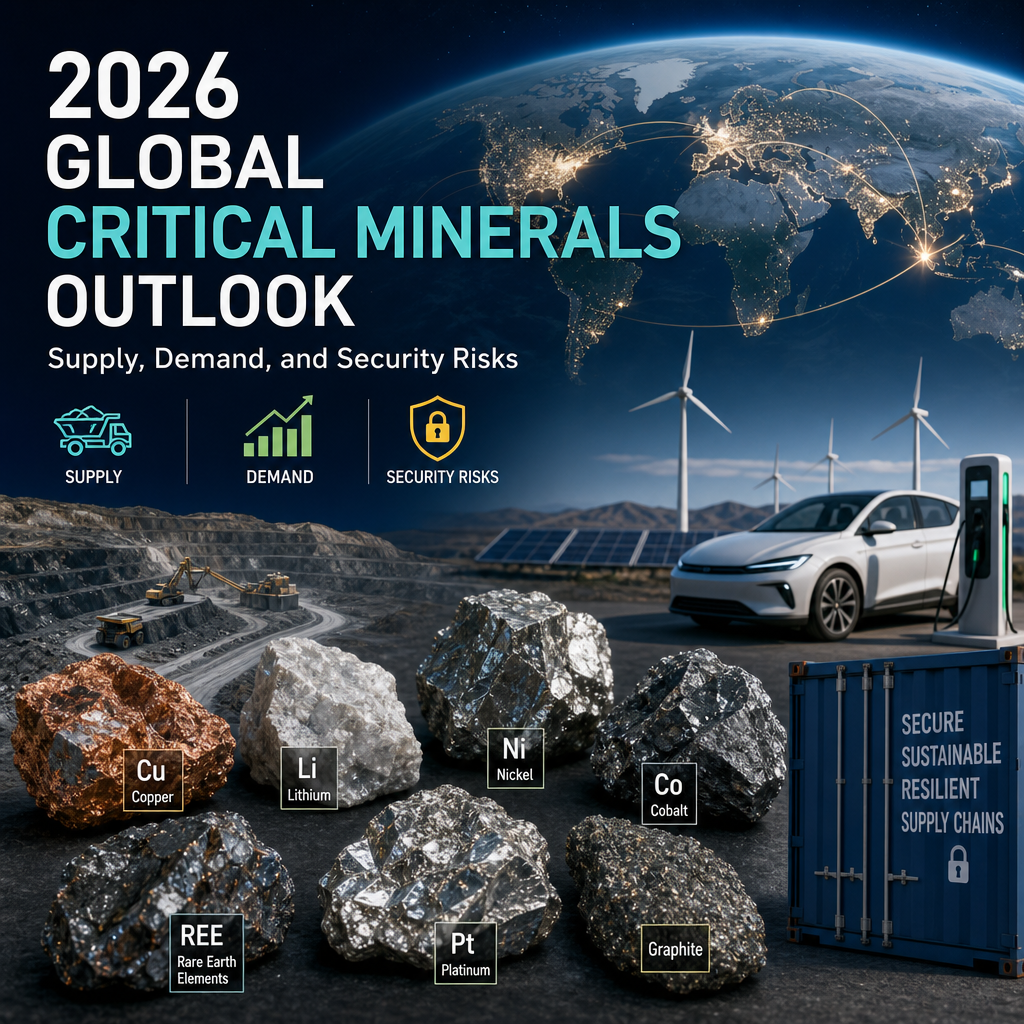
2026 Global Critical Minerals Outlook: Supply, Demand, and Security Risks
The global critical minerals outlook for 2026 points to rising demand, tighter supply chains, and growing security risks as countries compete for lithium, nickel, copper, rare earths, and other essential materials. Understanding where bottlenecks and geopolitical pressures are building will be key to protecting industries, lowering costs, and strengthening resilience.
By: Peter B on July 24, 2026
Última atualização em: agosto 3, 2026
The 2026 global critical minerals outlook is shaping up to be one of the most important strategic conversations in energy, manufacturing, and national security. Critical minerals such as lithium, nickel, cobalt, graphite, copper, rare earth elements, and manganese sit at the center of electric vehicles, grid storage, semiconductors, defense systems, and clean energy infrastructure. As demand rises, so do questions about supply concentration, processing bottlenecks, trade restrictions, and geopolitical risk.
In 2026, the challenge is no longer simply finding more minerals. It is about securing reliable supply chains, diversifying sourcing, expanding processing capacity, and building resilience against disruptions. Governments and companies that understand these trends will be better positioned to manage cost pressure, avoid shortages, and reduce strategic vulnerability.
What Defines the 2026 Global Critical Minerals Outlook?
The 2026 global critical minerals outlook reflects a market where demand growth remains strong, but supply is constrained by long development timelines, permitting delays, financing hurdles, and concentrated processing capacity. Many of the minerals the world now depends on are not scarce in the earth’s crust. The real issue is access, refining, transport, and political control.
The Key Forces Shaping the Market
Several trends are influencing the outlook:
Rapid electrification
Electric vehicles, battery storage, and power grids continue to increase demand for battery metals and copper.
Industrial policy and subsidies
Countries are promoting domestic mining, refining, and manufacturing to reduce dependence on imports.
Geopolitical competition
Export controls, resource nationalism, and trade restrictions are reshaping supply chains.
Sustainability pressure
Buyers want lower-carbon, more traceable mineral sourcing.
Financing and project risk
New mines and refineries often face long lead times and cost overruns.
The result is a market that is strategically important but structurally tight.
Demand Trends: Where Critical Minerals Are Needed Most
Demand is not rising evenly across every mineral. Some materials are seeing especially strong growth because of their role in batteries, electrical systems, and defense technologies.
Battery Materials Remain Central
The biggest demand driver remains the energy transition. Lithium-ion batteries still dominate electric vehicles and stationary storage, which keeps pressure on:
Lithium
Nickel
Cobalt
Graphite
Manganese
Battery chemistry is also evolving. Some manufacturers are reducing cobalt content, while others are shifting toward lithium iron phosphate batteries that use less nickel and cobalt. Even so, total demand for battery minerals continues to increase as the number of electric vehicles and storage systems grows.
Copper Stays in High Demand
Copper is often called the backbone of electrification. It is used in:
Power grids
EV motors and wiring
Charging infrastructure
Renewable energy systems
Data centers
Industrial equipment
Because copper is needed across so many sectors, supply constraints can affect the broader economy. The 2026 global critical minerals outlook suggests copper will remain one of the most strategically important metals, even though it is not always discussed with the same intensity as battery minerals.
Rare Earths and Defense Applications
Rare earth elements are essential for high-performance magnets used in:
Wind turbines
EV motors
Precision-guided systems
Aerospace components
Robotics and advanced electronics
Although total volumes are relatively small compared with bulk metals, supply concentration makes rare earths highly sensitive to geopolitical shifts.
Supply Side Challenges: Why Production Is Hard to Scale
Adding new mineral supply is rarely quick. Mines, refineries, and chemical processing plants take years to permit, finance, build, and commission. That lag creates persistent tension between rising demand and slow supply growth.
Mining Is Only Part of the Problem
A common misconception is that mining alone solves supply risk. In reality, the chain includes:
Exploration and resource definition
Permitting and community approvals
Mine construction
Concentrate production
Refining and processing
Manufacturing into end-use components
Many countries can mine ore, but far fewer can refine it at scale. That means the most vulnerable chokepoints often sit downstream, not underground.
Processing Capacity Is Highly Concentrated
For several critical minerals, refining and separation capacity is dominated by a small number of countries and companies. This concentration creates several risks:
Export restrictions can disrupt global buyers
Political tensions can delay shipments
Industrial accidents or power shortages can create bottlenecks
Environmental rules can slow or halt expansion
In the 2026 global critical minerals outlook, processing capacity is often more important than raw mineral reserves. A country may have access to ore, but without refining infrastructure, it remains dependent on foreign processors.
Permitting and ESG Expectations Slow Projects
Mining projects now face more scrutiny from investors, regulators, and local communities. That is not inherently negative; responsible development matters. But it does mean projects must address water use, land rights, labor conditions, and environmental impact more carefully than in the past.
As a result, companies that ignore social license to operate often encounter delays that weaken supply growth.
Security Risks in the Critical Minerals Supply Chain
Supply chain security has become a core policy concern. Critical minerals are no longer just a commodity issue. They are a national security issue, a manufacturing issue, and an energy resilience issue.
Geopolitical Concentration Creates Leverage
A limited number of countries dominate the supply, refining, or export of many critical minerals. That concentration gives those countries leverage during trade disputes or diplomatic tensions. It also increases the risk of sudden policy changes that ripple through global markets.
Security risks include:
Export bans or quotas
Import tariffs or sanctions
Shipping disruptions
State intervention in mining assets
Political instability in producing regions
Dependency on Single Points of Failure
Many supply chains depend on one mine, one refinery, or one transport corridor. This creates a single point of failure. If that point is disrupted, the effect can spread quickly across industries.
Examples of vulnerable areas include:
Rare earth separation
Battery-grade chemical refining
Graphite anode processing
Smelting and alloy production
Maritime transport routes
Cyber and Infrastructure Risks Are Growing
Critical minerals are increasingly linked to digital infrastructure. Logistics networks, refining plants, and trading systems all depend on secure software and communications. Cyberattacks or infrastructure outages can interrupt delivery even when the mineral itself is available.
How Governments Are Responding
The 2026 global critical minerals outlook is also a story of policy response. Governments recognize that market forces alone may not build resilient supply chains quickly enough.
Strategic Stockpiling
Some countries are building or expanding strategic reserves of minerals considered essential for defense or industrial continuity. Stockpiles can reduce short-term vulnerability, though they do not solve structural supply shortages.
Domestic Mining and Refining Incentives
Policy tools include:
Tax credits
Loan guarantees
Fast-track permitting
Public-private partnerships
Grants for processing facilities
The goal is to bring more of the supply chain onshore or at least closer to allied partners.
Trade Alliances and Friend-Shoring
Many governments are pursuing “friend-shoring,” meaning they source materials from politically aligned countries. This can reduce exposure to geopolitical shocks, but it also requires investment in new logistics, standards, and infrastructure.
Recycling and Circular Economy Strategies
Recycling is becoming a more serious part of the supply picture. While it cannot replace primary mining in the near term, it can help recover valuable materials from batteries, electronics, and industrial waste.
Benefits of recycling include:
Lower reliance on virgin ore
Reduced waste
Potentially smaller environmental footprint
Greater supply diversity over time
What Businesses Should Watch in 2026
Companies that rely on critical minerals need more than headline awareness. They need practical supply chain management.
Focus on Exposure Mapping
Business leaders should know exactly where their materials come from. That means identifying:
Country of origin
Refining location
Transport route
Supplier concentration
Substitute material options
Without this visibility, firms may not realize how vulnerable they are until a disruption occurs.
Build Supplier Diversity
Overdependence on one supplier or one region is risky. Businesses should diversify where possible, even if it requires more effort or a higher short-term cost.
Review Inventory Strategy
Just-in-time inventory can be efficient, but it offers little resilience. Some companies are adopting more flexible buffer stock strategies for especially sensitive materials.
Invest in Material Substitution
Research and product design can reduce dependence on the most constrained minerals. For example:
Lower-cobalt battery chemistries
Better magnet designs using less rare earth material
More efficient copper use in electrical systems
Alternative materials in industrial applications
Plan for Compliance and Traceability
Customers, regulators, and investors increasingly want proof of responsible sourcing. Traceability systems can help companies demonstrate where minerals come from and how they were processed.
The Role of Recycling, Substitution, and Technology
Long-term resilience will depend on more than new mines. Innovation can ease pressure on the supply chain.
Recycling Will Expand, But Gradually
Battery recycling, electronics recovery, and industrial scrap processing are improving. However, the supply of recyclable material still depends on products reaching end-of-life. That means recycling will grow over time, but it will not fully solve near-term supply gaps in 2026.
Substitution Can Reduce Risk
When a mineral becomes too concentrated or expensive, industries look for alternatives. Substitution works best when engineers can redesign products without sacrificing performance. In some cases, that is easy. In others, such as high-performance magnets or battery chemistries, it is more difficult.
Digital Tools Improve Decision-Making
Technology is helping firms track supply chain risk more effectively. Tools such as:
AI-based demand forecasting
Traceability platforms
Mine-to-market monitoring
Logistics visibility systems
can improve planning and reduce surprises.
Regional Outlook: Where the Pressure Points Are
The 2026 global critical minerals outlook varies by region, but some themes are consistent.
North America
North America is focused on reducing import dependence, expanding domestic processing, and building partnerships with allies. The challenge is matching policy goals with actual project delivery.
Europe
Europe is balancing decarbonization goals with supply security. It faces strong demand for battery metals and industrial materials, but much of the processing still happens elsewhere.
Asia-Pacific
Asia remains central to the global mineral and processing system. It is both a manufacturing powerhouse and a major source of supply concentration, particularly in refining.
Emerging Producers
Countries in Africa, Latin America, and parts of Central Asia hold major reserves and production potential. Their role is growing, but stable investment conditions, infrastructure, and local value creation will determine how much that potential translates into supply.
Practical Takeaways for Investors and Decision-Makers
If you are evaluating the 2026 global critical minerals outlook, a few priorities stand out.
For Investors
Look beyond ore reserves to processing capability
Evaluate permitting timelines and political stability
Consider exposure to export controls and trade policy
Assess long-term demand fundamentals, not just short-term price moves
For Policymakers
Support diversified supply chains
Invest in permitting reform without weakening standards
Encourage recycling and recycling infrastructure
Coordinate with allies on strategic sourcing
For Businesses
Map mineral exposure across the full supply chain
Build backup sourcing and inventory strategies
Use traceability systems
Design products for flexibility and substitution
Frequently Asked Questions
What are critical minerals?
Critical minerals are raw materials that are essential to modern industry, energy systems, and national security, but may face supply risk due to geopolitical concentration, limited processing capacity, or long development timelines. Examples include lithium, nickel, cobalt, graphite, rare earths, copper, and manganese.
Why is the 2026 global critical minerals outlook so important?
It matters because demand is rising from electrification, defense, and digital infrastructure while supply remains constrained. The result is a strategic market where shortages, trade restrictions, or processing bottlenecks can affect prices, manufacturing, and energy security.
Which critical minerals face the biggest supply risks in 2026?
Supply risk is especially notable for minerals tied to batteries and advanced manufacturing, including lithium, nickel, cobalt, graphite, and rare earth elements. Copper is also a major concern because demand is broad and essential across many sectors.
How do geopolitical risks affect critical minerals?
Geopolitical risks can disrupt exports, limit access to refining capacity, or create sudden price swings. Countries that control key parts of the supply chain can use that leverage during trade disputes or diplomatic tensions, which increases uncertainty for global buyers.
Can recycling solve critical mineral shortages?
Recycling can help reduce pressure on primary supply, but it cannot fully replace mining in the near term. It works best as part of a broader strategy that includes new mines, processing plants, substitution, and better supply chain planning.
The 2026 global critical minerals outlook highlights a world that depends more than ever on a stable, secure, and diversified mineral supply chain. Demand continues to rise across batteries, electric vehicles, grid infrastructure, defense technologies, and advanced manufacturing. Yet the systems that produce, refine, and move these materials remain concentrated, slow to expand, and exposed to political and operational shocks.
The biggest lesson is that resource availability alone is not enough. Security now depends on processing capacity, trade resilience, traceability, recycling, and strategic coordination among allies and industry leaders. Countries and companies that act early can reduce exposure, improve resilience, and position themselves for long-term competitiveness. Those that delay may face higher costs, tighter supplies, and more disruption as global competition intensifies.
For policymakers, investors, and business leaders, the path forward is clear: map risk, diversify supply, invest in processing, and support innovation that reduces dependency on the most constrained materials. The critical minerals challenge is complex, but it is manageable with foresight, planning, and disciplined execution.
Peter B holds a degree in Journalism and has 5 years
of experience covering U.S. economic policy, labor markets, and
financial news. He writes data-driven news content on topics
like inflation, interest rates, and employment trends.