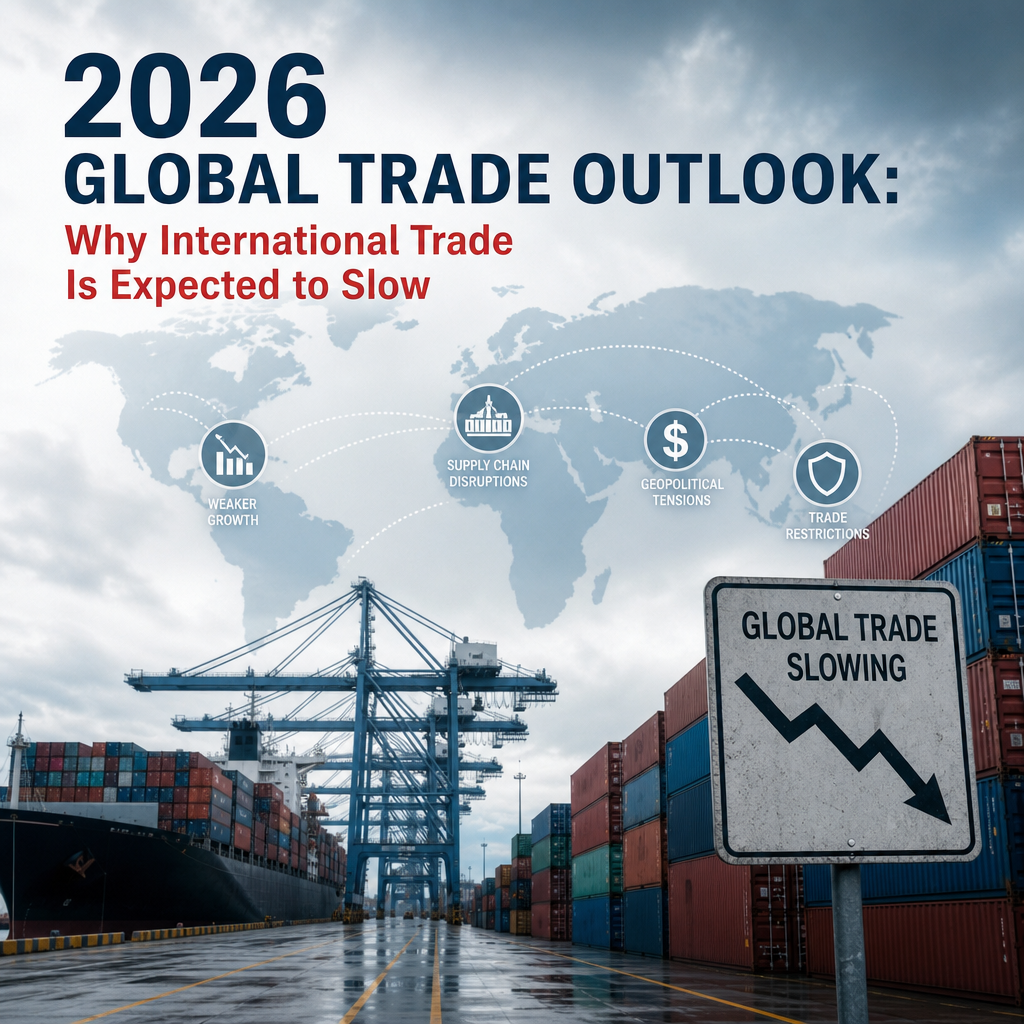
2026 Global Trade Outlook: Why International Trade Is Expected to Slow
The 2026 global trade outlook points to a slower pace for international commerce as weaker demand, higher borrowing costs, and geopolitical tensions reshape cross-border business. While trade is far from collapsing, companies should expect a more cautious environment and plan accordingly.
By: Peter B on July 23, 2026
Última atualização em: agosto 3, 2026
International trade has long been a powerful engine of growth, linking producers, consumers, and supply chains across continents. But the 2026 global trade outlook suggests a more cautious picture. After years of disruption, rebound, and adjustment, international commerce is expected to slow as businesses, governments, and consumers navigate a more fragmented world economy.
That slowdown does not mean trade is collapsing. It means the pace of growth is likely to cool as higher financing costs, geopolitical tensions, shifting industrial policy, and weaker demand reshape how goods and services move across borders. For companies that rely on imports, exports, and cross-border logistics, understanding the forces behind the 2026 global trade outlook is essential for planning ahead.
What Is Driving the 2026 Global Trade Outlook?
The expected slowdown in global trade is not caused by a single event. Instead, several overlapping pressures are changing the environment for international commerce. Some are cyclical, while others are structural and may influence trade for years.
Slower economic growth in major markets
Trade tends to rise when consumers spend more and factories produce more. In 2026, economic growth is expected to remain uneven across the world, with some major economies expanding slowly and others facing ongoing uncertainty.
When household demand softens, companies order fewer imported goods. When business investment weakens, cross-border shipments of machinery, components, and industrial inputs also decline. Even modest slowdowns in large economies can have a broad effect on global trade volumes.
Higher borrowing costs and tighter financial conditions
Interest rates and credit conditions matter more than many businesses realize. When borrowing is expensive, firms often delay expansion, reduce inventory purchases, and scale back capital-intensive projects. That directly affects trade flows.
This is especially important for:
Manufacturers that depend on imported raw materials
Logistics providers financing fleet upgrades or warehouse expansion
Exporters that need trade finance to support overseas sales
Small and mid-sized businesses that rely on credit to bridge payment cycles
Tighter financial conditions can reduce risk-taking and make cross-border trade less dynamic.
Geopolitical uncertainty and fragmented trade policy
The modern trading system faces pressure from sanctions, export controls, tariffs, and industrial policy shifts. Governments are increasingly prioritizing resilience, national security, and strategic independence over pure efficiency.
This trend has several consequences:
Companies diversify suppliers instead of relying on one country
Some trade routes become more expensive or less predictable
Cross-border investment decisions take longer
Firms face more compliance and documentation requirements
As a result, the 2026 global trade outlook points toward more cautious and selective trading relationships rather than a broad expansion of open global commerce.
Why Trade Is Slowing Even as Demand Remains
A slowdown in trade does not always mean demand has vanished. In many sectors, demand still exists, but the way that demand is fulfilled is changing.
Supply chains are being shortened or diversified
During the past decade, many companies discovered that long, lean supply chains can be vulnerable to disruption. In response, businesses are reshaping their networks to include more regional suppliers, backup vendors, and nearshoring strategies.
That shift can reduce the total volume of long-distance trade even if production stays strong. For example, a U.S. company that once sourced all parts from Asia may now split orders between Mexico, the United States, and Southeast Asia. The company still buys globally, but the trade pattern becomes more regional and less concentrated.
Inventory strategies are becoming more conservative
After periods of disruption, many firms moved away from just-in-time inventory models. Some are now holding more stock as a buffer against shipping delays, conflict, or port congestion. Others are cutting inventories to preserve cash in a slower economy.
Either strategy can dampen trade growth:
Higher inventory levels can temporarily boost imports, but not necessarily sustainably
Lower inventory restocking can reduce shipping volumes
More cautious procurement can delay orders across multiple sectors
Services trade is growing, but not enough to offset goods weakness
Trade is not only about containers and cargo ships. Services such as software, finance, education, consulting, and digital delivery continue to expand internationally. However, services growth may not fully compensate for slower movement in physical goods.
Because goods trade still represents a large share of global commerce, weakness in manufacturing and merchandise trade can weigh heavily on the overall picture.
The Role of Technology and Automation
Technology is changing trade, but not always in the same direction that older globalization models assumed.
Digital tools improve efficiency but reduce friction-based demand
Automation, digital documentation, customs software, and AI-based logistics planning can make trade faster and cheaper. That is a benefit for businesses. But efficiency gains can also reduce some of the excess shipping, warehousing, and buffer stock that once inflated trade volumes.
In practical terms:
Better forecasting means fewer urgent shipments
Smarter route planning reduces waste
Digital platforms can help firms source locally or regionally with less effort
Automation in manufacturing can reduce reliance on large cross-border labor networks
So while technology supports trade, it also helps companies do more with less movement across borders.
E-commerce continues to reshape cross-border commerce
Online selling has made international trade more accessible for small businesses and niche brands. Yet it also intensifies competition and creates new pressure on pricing, fulfillment, and customs compliance.
For smaller sellers, the barrier is no longer just finding customers overseas. It is managing:
Duties and taxes
Returns and reverse logistics
Product labeling rules
Cross-border payment risk
These challenges can slow expansion, especially for businesses with limited margins.
Regional Trade Patterns Are Changing
A major theme in the 2026 global trade outlook is not simply “less trade,” but “different trade.”
Nearshoring and friendshoring are reshaping flows
Companies are increasingly sourcing from countries that are geographically closer or politically aligned. This reduces exposure to long shipping routes and regulatory risk, but it can also reallocate trade rather than expand it.
For example:
North American supply chains may deepen between the U.S., Mexico, and Canada
European firms may seek more regional suppliers
Asian manufacturing networks may become more diversified across Southeast Asia
These changes can support resilience, but they may not produce the same growth in total trade volumes that a fully globalized system once did.
Emerging markets face mixed prospects
Some emerging economies may benefit from supply chain diversification, especially those able to offer manufacturing capacity, skilled labor, and stable policy environments. Others may struggle if global demand softens or if they remain heavily dependent on a few export categories.
Countries tied to commodities, electronics assembly, or low-cost manufacturing could see uneven outcomes depending on pricing, demand, and policy shifts.
What This Means for Businesses
A slower trade environment does not remove opportunity. It changes where the risks and rewards are likely to appear.
Businesses should prepare for more variability
Volatility is becoming the norm. Companies should expect changes in:
Freight rates
Delivery times
Customs requirements
Currency values
Trade compliance obligations
In this setting, flexibility becomes a competitive advantage.
Practical steps companies can take now
To adapt to the 2026 global trade outlook, businesses can focus on the following:
Diversify suppliers
Reduce dependence on a single country, region, or vendor.
Build backup sourcing options for critical inputs.
Review trade finance needs
Make sure cash flow and payment terms can support slower order cycles.
Work with lenders or insurers on letters of credit and export credit tools if needed.
Improve compliance readiness
Stay current on tariffs, sanctions, product standards, and customs rules.
Audit product classifications and origin documentation.
Strengthen demand forecasting
Use data to avoid overordering or underordering.
Align procurement with realistic sales projections.
Consider regional market strategies
Shorten lead times by serving nearby customers from local or regional hubs.
Evaluate whether nearshoring can improve reliability.
A simple example
Imagine a furniture importer that sources wood components from one overseas supplier and finished items from another. If shipping costs rise and delivery times become less reliable, the company may decide to:
Split orders across two suppliers
Keep more inventory in a domestic warehouse
Source some products from a nearby country
Use trade data to forecast seasonal demand more accurately
This kind of adjustment may not eliminate trade, but it can make the business more resilient in a slower global environment.
Policy Will Matter More Than Ever
Governments will play a central role in shaping the trade environment in 2026. Trade policy is no longer just about tariffs. It now includes industrial strategy, technology controls, energy security, and supply chain resilience.
Key policy areas to watch
Tariffs and retaliatory measures
Export controls on strategic goods and technologies
Subsidies for domestic manufacturing
Customs modernization and border efficiency
Sustainability rules and carbon-related reporting
These policies can either support smoother commerce or add friction. Businesses that track policy developments closely will be better positioned to adjust their sourcing and pricing strategies.
Trade agreements still matter
Even in a fragmented environment, trade agreements can provide stability, reduce uncertainty, and open market access. Companies operating internationally should pay attention to regional trade blocs and bilateral agreements that may offer tariff advantages or simplified procedures.
The Big Picture for 2026
The 2026 global trade outlook reflects a world that is less synchronized than in previous decades. Instead of one dominant wave of globalization, trade is becoming more regional, more strategic, and more selective.
That shift is being driven by:
Slower economic growth
Higher financing costs
Geopolitical risk
Supply chain reconfiguration
Policy intervention
Technology-driven efficiency gains
International trade is still essential. It remains a source of growth, innovation, and access to goods and services that many economies cannot produce efficiently on their own. But the pattern of trade is changing, and the pace is expected to slow.
Frequently Asked Questions
1. Why is international trade expected to slow in 2026?
International trade is expected to slow because of weaker economic growth, tighter financial conditions, geopolitical uncertainty, and ongoing supply chain restructuring. These factors reduce demand for cross-border goods and make companies more cautious about global expansion.
2. Does a slower trade outlook mean global trade will decline?
Not necessarily. A slower outlook usually means trade growth is expected to cool, not disappear. Trade may still grow in some sectors or regions, but at a more modest pace than in stronger economic periods.
3. Which industries are most affected by a slowdown in trade?
Manufacturing, logistics, shipping, retail, and commodities are often among the most affected. These sectors rely heavily on imports, exports, and international supply networks. Technology and services may be less exposed, though they are not immune.
4. How can businesses prepare for a slower global trade environment?
Businesses can prepare by diversifying suppliers, reviewing trade finance, improving compliance, forecasting demand more accurately, and exploring regional sourcing or nearshoring. Building flexibility into operations is often the best defense against uncertainty.
5. What is the difference between slower trade growth and deglobalization?
Slower trade growth means international commerce is still happening, but at a reduced pace. Deglobalization suggests a broader retreat from cross-border integration. In reality, the world is seeing a mix of both: trade continues, but it is becoming more regional, strategic, and selective.
The 2026 global trade outlook points to a slower, more complex era for international commerce. Trade is unlikely to vanish, but the days of easy, broad-based expansion appear to be behind us for now. Slower demand, higher financing costs, policy fragmentation, and changing supply chain strategies are all pushing businesses and governments to rethink how they buy, sell, and move goods across borders.
For companies, the key takeaway is not to retreat from trade, but to adapt to it. That means diversifying suppliers, strengthening compliance, improving forecasting, and paying close attention to regional opportunities. It also means understanding that resilience may matter more than pure efficiency in the years ahead.
In a world where trade is expected to move more slowly, the most prepared businesses will not necessarily be the biggest. They will be the ones that stay flexible, informed, and ready to respond as conditions shift. If your organization depends on global commerce, now is the time to review your strategy and build a more durable foundation for 2026 and beyond.
Peter B holds a degree in Journalism and has 5 years
of experience covering U.S. economic policy, labor markets, and
financial news. He writes data-driven news content on topics
like inflation, interest rates, and employment trends.