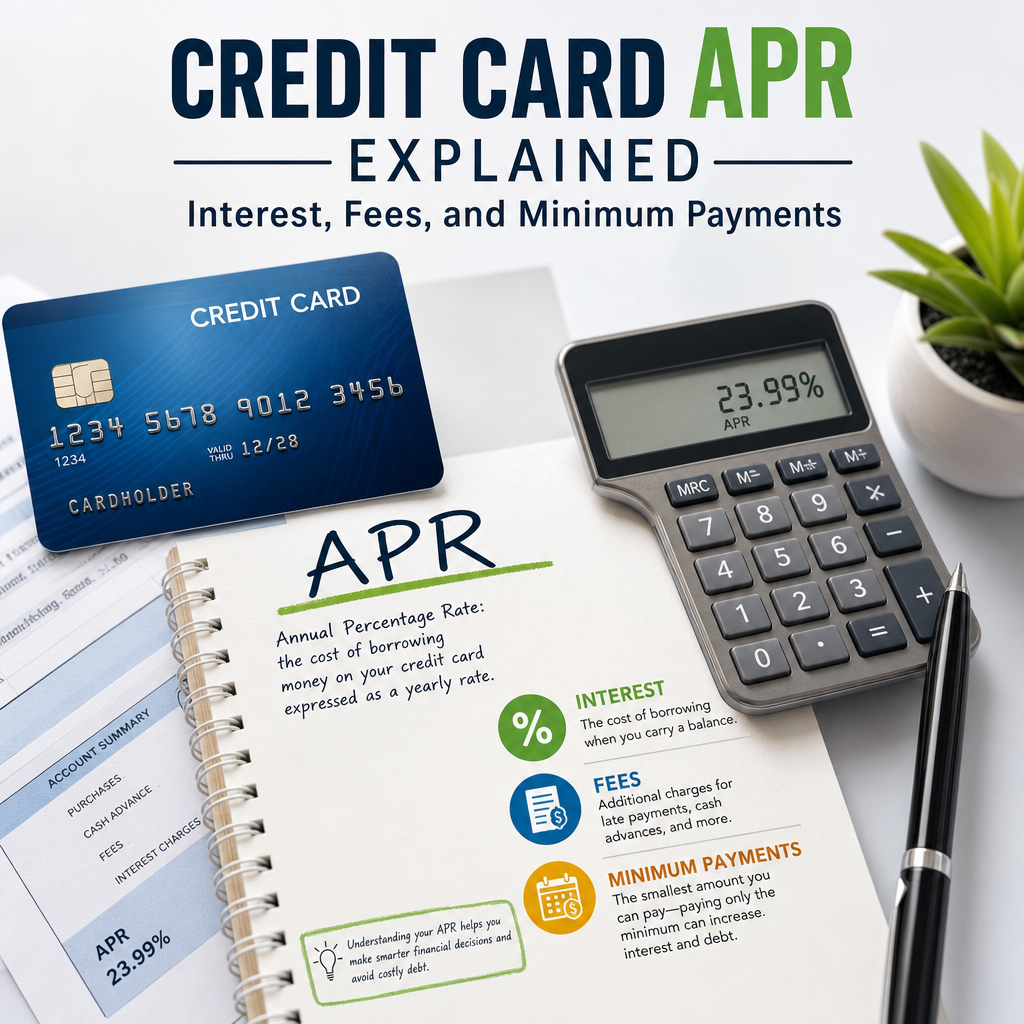
Credit Card APR Explained: Interest, Fees, and Minimum Payments
If you’ve ever wondered why your balance seems to shrink so slowly, credit card APR may be the reason. Learn how interest, fees, and minimum payments work together so you can better manage debt and avoid costly surprises.
By: Mary on July 23, 2026
Última atualização em: agosto 3, 2026
If you’ve ever looked at a credit card statement and wondered why your balance barely moved after making a payment, the answer often comes down to credit card APR explained in plain English. APR affects how much interest you owe, how your minimum payment is calculated, and how quickly debt can grow if you carry a balance.
Understanding APR is one of the most useful things you can do for your finances. It helps you compare cards, avoid costly surprises, and make smarter decisions about payments and spending. In this guide, we’ll break down how APR works, how fees fit into the picture, and why minimum payments can be more expensive than they look.
What Does APR Mean on a Credit Card?
APR stands for annual percentage rate. On a credit card, it is the yearly cost of borrowing money, expressed as a percentage.
Unlike a one-time fee, APR is tied to the amount you carry from month to month. If you pay your balance in full every billing cycle, you usually avoid interest charges on purchases. But if you carry a balance, the card issuer applies interest based on your APR.
APR vs. Interest Rate
Many people use these terms interchangeably, but there is a small distinction:
Interest rate is the base cost of borrowing.
APR often includes the interest rate plus certain fees or borrowing costs, depending on the product.
For credit cards, APR is the number most issuers use to describe the cost of carrying a balance. It may apply differently to purchases, cash advances, and balance transfers.
How Credit Card APR Works
Credit card APR is usually listed as an annual rate, but it is charged over time. Most issuers divide the APR into a daily periodic rate, then apply it to your average daily balance.
A Simple Example
Suppose your card has a 24% APR.
Daily periodic rate = 24% ÷ 365
That rate is applied to your balance each day
Interest builds if you do not pay the full statement balance by the due date
So even though APR is annual, the interest can accumulate daily, which is why balances can grow quickly when payments are small.
Common Types of Credit Card APR
Most cards may have more than one APR:
Purchase APR
The rate applied to everyday card purchases.
Balance transfer APR
The rate for balances moved from another card. Some cards offer a promotional 0% rate for a limited time.
Cash advance APR
Often higher than the purchase APR and usually starts accruing interest immediately.
Penalty APR
A higher rate that may apply after serious late payments or other account issues.
Knowing which APR applies to which transaction helps you avoid expensive surprises.
Credit Card APR Explained Alongside Fees
APR is only part of the story. Credit cards can also come with fees, and these can increase the true cost of using credit.
Common Credit Card Fees
Here are some fees to watch for:
Annual fee: A yearly charge for having the card
Late payment fee: Charged when you miss the due date
Cash advance fee: Often a percentage of the amount withdrawn
Balance transfer fee: Usually a percentage of the transferred amount
Foreign transaction fee: Charged when you make purchases in another currency
Returned payment fee: Charged when a payment is not processed successfully
Why Fees Matter
A card with a low APR can still be expensive if it has high fees. For example:
A card with a 0% intro APR might charge a 3% balance transfer fee
A rewards card may have an annual fee that only makes sense if you use the benefits regularly
A cash advance can cost more because of both the fee and the higher APR
When comparing credit cards, look at the full cost, not just the APR.
How Minimum Payments Affect Your Debt
Minimum payments are the smallest amount you can pay each month to keep your account in good standing. They may feel manageable, but they often work against you if you carry a balance.
Why Minimum Payments Are So Low
Credit card issuers design minimum payments to cover:
A small portion of your principal balance
Interest charges
Sometimes fees or a fixed dollar amount
This means only a small part of your payment may reduce what you actually owe.
The Hidden Problem
If you pay only the minimum:
More of your balance stays on the card
Interest continues to accrue on the remaining amount
It takes much longer to pay off the debt
You may pay far more over time
For people with high balances, minimum payments can create the feeling of progress without much real reduction in debt.
Credit Card APR Explained Through Real-Life Situations
Let’s look at a few practical examples to see how APR, interest, fees, and minimum payments work together.
Example 1: Carrying a Balance
Imagine you charged $1,000 on a credit card with a 22% APR and only make the minimum payment.
What happens:
Interest is charged on the unpaid balance
Your payment mostly goes toward interest at first
The principal shrinks slowly
It may take many months or years to pay off the card
Even a modest balance can become harder to eliminate if you only make minimum payments.
Example 2: Using a Balance Transfer Offer
You move $3,000 from a high-interest card to a new card with 0% intro APR for 12 months and a 3% balance transfer fee.
What to consider:
You may save money on interest during the promo period
You will pay the transfer fee upfront
If you don’t pay off the balance before the promo ends, the regular APR may apply
This can be a smart strategy if you have a plan to pay down the debt quickly.
Example 3: Cash Advances
You withdraw cash from your credit card at an ATM.
Possible costs:
Cash advance fee
Higher APR than purchases
Interest may begin immediately, with no grace period
Cash advances are usually one of the most expensive ways to borrow money.
How to Read Your Credit Card Terms
Your card’s cardholder agreement or pricing disclosures tells you the exact APRs, fees, and rules that apply. It can feel dense, but it is worth reviewing.
What to Look For
Pay close attention to:
Purchase APR
Balance transfer APR
Cash advance APR
Penalty APR
Grace period rules
Fee schedule
How interest is calculated
Questions to Ask Yourself
Before using the card heavily, consider:
Will I carry a balance?
Do I need a promotional APR?
Is there an annual fee?
Are there balance transfer or cash advance fees?
Can I pay more than the minimum each month?
These questions can help you choose a card that fits your habits instead of working against them.
How to Lower the Cost of Credit Card APR
You may not be able to change your APR immediately, but you can reduce how much it costs you.
Practical Ways to Save Money
Pay the full statement balance
This is the simplest way to avoid interest on purchases.
Pay more than the minimum
Even a small extra payment can reduce interest over time.
Use balance transfers carefully
A promotional rate can help if you have a repayment plan.
Avoid cash advances
They often come with high fees and immediate interest.
Ask for a lower APR
If you have a strong payment history, your issuer may be willing to review your account.
Set up autopay for at least the minimum
This helps you avoid late fees and protects your payment history.
Track due dates and statement cycles
Timing payments well can reduce interest and help preserve your grace period.
A Smart Repayment Strategy
If you’re paying off multiple cards, focus on one of these methods:
Avalanche method: Pay extra on the card with the highest APR first
Snowball method: Pay extra on the smallest balance first for quick wins
Both can work. The best choice depends on whether you want to save the most money or build momentum.
When APR Matters Most
APR becomes especially important in certain situations.
You Carry a Balance
If you rarely pay your card in full, APR affects your monthly cost and long-term debt.
You Use Intro Offers
A 0% APR promotion can be helpful, but only if you understand when the promotional period ends and what the standard APR will be afterward.
You Have Multiple Cards
Different APRs on different cards can make debt management more complicated. A small balance on a high-APR card can cost more than a larger balance on a low-APR card.
You’re Comparing Credit Card Offers
A rewards card with a higher APR may be worth it if you pay in full every month. But if you carry a balance, a lower APR card could save you far more than rewards earn you back.
Common Mistakes to Avoid
A few simple mistakes can make credit card costs much worse.
1. Ignoring the APR After the Intro Period
Many people focus on the promotional offer and forget the regular rate. Mark the expiration date on your calendar.
2. Thinking Minimum Payments Are Enough
Minimum payments keep the account current, but they are not a good long-term strategy for eliminating debt.
3. Using Cash Advances for Convenience
The convenience is expensive. Consider other options before using a card for cash.
4. Missing a Due Date
Late payments can trigger fees, hurt your credit, and possibly lead to a penalty APR.
5. Overlooking Fees
An annual fee or balance transfer fee can erase much of the value of a low APR offer if you do not use the card strategically.
Credit Card APR Explained in One Simple Rule
If you want the shortest possible takeaway, here it is:
Pay in full when you can
Pay more than the minimum when you can’t
Read the fees before you apply
Know which APR applies to each transaction
That one habit can save you a surprising amount of money over time.
Frequently Asked Questions
What is a good credit card APR?
A “good” credit card APR depends on your credit profile and the type of card. In general, lower is better if you expect to carry a balance. Rewards cards often have higher APRs than basic low-interest cards, so compare the APR against the card’s benefits and fees.
Does APR apply if I pay my bill in full every month?
Usually, no interest is charged on purchases if you pay the full statement balance by the due date and your card offers a grace period. However, cash advances and some other transactions may begin accruing interest immediately.
What’s the difference between APR and APY?
APR is the annual cost of borrowing money. APY, or annual percentage yield, is typically used for savings accounts and reflects the effect of compounding interest earned. Credit cards usually use APR, not APY.
Why did my APR increase?
Your APR can go up for several reasons, including promotional rates ending, missed payments, or a change in the issuer’s terms. If you see an unexpected increase, check your statement and cardholder agreement to understand why.
Can I negotiate my credit card APR?
Sometimes, yes. If you have a history of on-time payments and a good credit standing, you can call your issuer and ask for a lower APR. Approval is not guaranteed, but it may be worth trying, especially if you have competing offers from other cards.
Credit card APR plays a major role in how much your borrowing really costs. It affects interest charges, influences the impact of minimum payments, and shapes whether a balance transfer or promotional offer truly saves you money. Once you understand how APR, fees, and payment timing work together, you can make better decisions about which cards to use, how much to pay, and when to avoid debt altogether.
The biggest lesson is simple: the lower your balance and the faster your payments, the less APR hurts you. That means paying in full whenever possible, avoiding costly cash advances, and reading the fine print before you apply for a new card. If you already carry credit card debt, a clear payoff plan can help you take control and reduce interest over time.
The more you understand about credit card APR explained in practical terms, the easier it becomes to use credit as a tool instead of a trap. Start by reviewing your current cards, checking their APRs and fees, and choosing one small change you can make this month to lower your cost.
Mary S, CFP®, is a Certified Financial Planner with over 12 years of experience in personal finance, retirement planning, and wealth management. She writes educational content that helps readers understand financial concepts and make informed decisions based on reliable information.