Why the Strait of Hormuz Is Critical to Global Oil Supplies
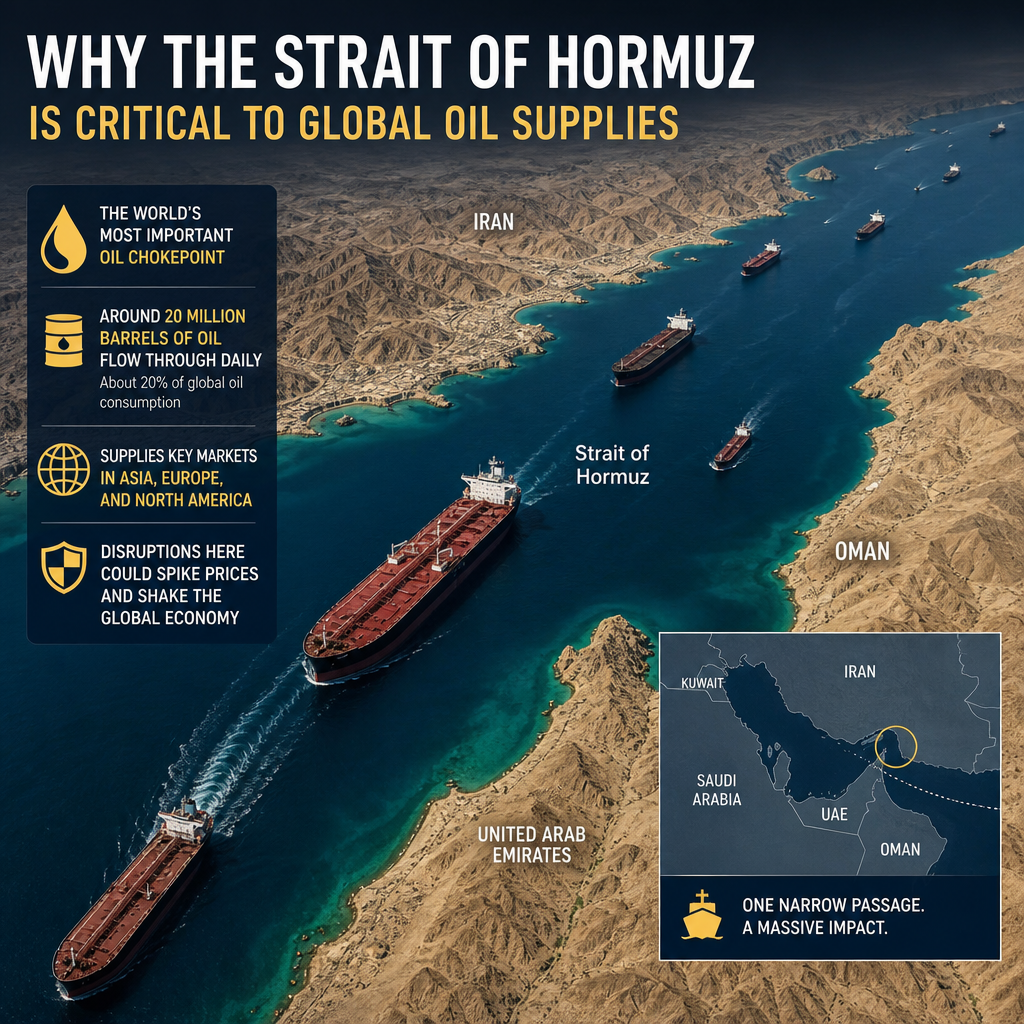
The Strait of Hormuz is a tiny stretch of water with an outsized impact, carrying a major share of the world’s oil and gas through a single critical passage. That makes it one of the most closely watched chokepoints in global energy markets, where even small disruptions can ripple worldwide.
By: Peter B on July 24, 2026
Última atualização em: agosto 3, 2026
The Strait of Hormuz is one of the most important waterways in the world, and its role in the global energy system is hard to overstate. This narrow channel between the Persian Gulf and the Gulf of Oman handles a huge share of the oil and liquefied natural gas that moves by sea each day. Because so much energy flows through such a tight passage, even the possibility of disruption can influence prices, shipping routes, and national security planning around the world.
Understanding why the Strait of Hormuz matters helps explain not just oil market volatility, but also why governments, shipping companies, and energy producers pay such close attention to events in the region. From geography to geopolitics, the strait sits at the center of some of the most important energy questions facing the global economy.
What Makes the Strait of Hormuz So Important?
The Strait of Hormuz connects the oil-rich Persian Gulf to the Arabian Sea and beyond. Countries such as Saudi Arabia, Iraq, Kuwait, the United Arab Emirates, and Qatar rely on this waterway to ship oil and gas to global markets. Because there are limited alternative export routes for many producers, the strait remains a key chokepoint in international trade.
This matters for a simple reason: when a large share of global supply passes through one narrow corridor, any disruption can affect availability and pricing far beyond the region itself.
A chokepoint with global consequences
The Strait of Hormuz is often called an energy chokepoint because:
It is narrow relative to the volume of traffic it carries.
It serves multiple major oil and gas exporters.
It links directly to global shipping lanes.
It is vulnerable to political tensions, military incidents, and sabotage.
Even when traffic continues uninterrupted, the risk of disruption can be enough to move markets. Traders, refiners, and governments all watch the strait closely because uncertainty in this region can ripple through the entire energy supply chain.
Why the Strait of Hormuz Is Critical to Global Oil Supplies
The Strait of Hormuz is critical to global oil supplies because it serves as a primary route for crude oil and refined petroleum products leaving the Middle East. The region remains one of the largest sources of exported oil, so any constraint on movement through the strait can tighten supply quickly.
For many countries, the importance of the Strait of Hormuz comes down to this:
Oil produced in the Persian Gulf is in high global demand.
Many producers depend on sea transport to reach customers.
The strait is a direct, efficient route to international markets.
There are few practical alternatives for matching the same scale of exports.
Major producers depend on the route
Several major exporters use the Strait of Hormuz to send oil to Asia, Europe, and other regions. These shipments support refineries, transport systems, manufacturing, and electricity generation in importing countries.
Some producers have built pipelines or other export infrastructure to reduce risk, but those alternatives rarely replace the full capacity of seaborne exports. As a result, the strait remains a central part of the world’s oil logistics network.
It affects more than crude oil
Although oil is the headline issue, the Strait of Hormuz is also important for liquefied natural gas, especially from Qatar, one of the world’s largest LNG exporters. That means disruption could affect not only gasoline and diesel markets, but also power generation and heating in countries that rely on imported gas.
The Geography of a Global Energy Chokepoint
The Strait of Hormuz is narrow enough to create a natural bottleneck. Ships must move through a confined route, which leaves little room for error and makes traffic especially sensitive to congestion or conflict.
Why narrow waters create risk
A narrow maritime passage increases risk in several ways:
Ships have limited maneuvering room.
Naval vessels and commercial tankers operate in close proximity.
Mines, drones, missiles, or sabotage can pose outsized threats.
A single incident can delay many vessels behind it.
In a wider body of water, shipping lanes can be adjusted more easily. In the Strait of Hormuz, the physical layout itself makes resilience more complicated.
Built-in vulnerability
The geography of the strait means that energy security planning must account for more than market conditions. Weather, accidents, maritime law enforcement, and military activity can all become part of the risk calculation. This is why insurers, freight operators, and energy companies often monitor the region continuously.
How Disruption in the Strait of Hormuz Affects Oil Markets
When the Strait of Hormuz is threatened, oil markets often react quickly. Prices can rise as buyers and sellers anticipate possible supply shortages or delivery delays. Even rumors of tension may be enough to create volatility.
Market reactions happen fast
Oil markets are sensitive to uncertainty because supply chains are interconnected. If tankers cannot move reliably through the strait, refiners may worry about feedstock shortages. Traders may bid up prices in advance. Shipping companies may increase insurance costs or reroute vessels if possible.
Typical market effects can include:
Higher crude oil prices
Increased shipping insurance premiums
Greater volatility in fuel markets
Delays in refinery planning and cargo delivery
More focus on strategic petroleum reserves
These changes do not require a full shutdown to matter. Even partial interruptions, harassment of vessels, or elevated military tension can influence prices and logistics.
Why timing matters
Oil does not move through the system instantly. A disruption today may affect refiners, wholesalers, and consumers later. That lag makes early warning and contingency planning especially important. Governments and companies often act quickly because the longer uncertainty lasts, the greater the economic impact.
Geopolitics and Security in the Strait of Hormuz
The Strait of Hormuz sits in a region shaped by long-standing geopolitical tensions. Regional rivalries, military posture, sanctions, and maritime disputes all contribute to the strategic importance of the waterway.
Security concerns go beyond oil
While the strait is often discussed in terms of energy, it is also a major security flashpoint. Naval patrols, maritime surveillance, and international cooperation all play a role in keeping the route open. At the same time, the presence of military forces can add complexity, especially during periods of political strain.
Security concerns in the region may involve:
Attacks on commercial vessels
Seizures or inspections of tankers
Missile or drone threats
Mine warfare
Escalation between regional powers
These risks make the strait one of the most watched shipping lanes on earth.
Diplomatic signaling
Sometimes the biggest impact of tension in the Strait of Hormuz is not physical disruption but signaling. A warning, exercise, or incident can send a message to markets and governments. Because the stakes are high, even limited events can have outsized consequences.
Alternative Routes and Why They Are Limited
Countries have tried to reduce their dependence on the Strait of Hormuz, but alternatives are still constrained by capacity, cost, and geography. Pipelines, overland routes, and different export terminals can help, yet they do not fully replace the strait’s role.
Pipelines can help, but not solve the problem
Some Gulf producers have built pipelines to ports outside the strait or to the Red Sea. These projects can provide partial relief during emergencies, but they usually cannot absorb all the oil that normally moves through Hormuz.
Reasons alternatives remain limited:
They often have lower capacity than sea transport.
They require major investment and political coordination.
They may cross challenging terrain or unstable regions.
They can still be vulnerable to attack or disruption.
Shipping remains the most practical option
For many exporters, moving oil by tanker remains the most efficient and scalable choice. That is why the Strait of Hormuz continues to matter even as energy producers seek more resilience in their export systems.
What This Means for Consumers and Businesses
The Strait of Hormuz may seem far away from everyday life, but disruptions there can affect fuel costs, transportation expenses, and broader inflation pressures. Businesses that depend on energy, freight, or petrochemical inputs can feel the effects quickly.
Potential real-world impacts
A disruption in the strait can influence:
Gasoline and diesel prices
Airline fuel costs
Freight and shipping rates
Manufacturing expenses
Utility and heating costs in gas-dependent regions
For consumers, this may show up as higher prices at the pump or more expensive goods. For businesses, it can mean tighter margins, planning uncertainty, and a need for stronger supply chain risk management.
Why resilience matters
Companies with energy exposure often prepare by:
Monitoring geopolitical developments
Diversifying suppliers where possible
Using hedging strategies
Building inventory buffers
Reviewing logistics contingency plans
These measures do not remove the risk, but they can reduce the damage from short-term shocks.
Lessons from the Strait of Hormuz for Global Energy Security
The importance of the Strait of Hormuz shows a broader lesson: modern energy systems depend on secure infrastructure, stable trade routes, and careful geopolitical management. A single narrow passage can influence markets on every continent.
Key takeaways for policymakers
Governments looking at energy security often focus on:
Diversifying import sources
Expanding strategic reserves
Supporting international maritime security
Encouraging flexible logistics networks
Investing in alternative energy systems over time
These steps cannot eliminate vulnerability entirely, but they can reduce dependence on a single route.
Key takeaways for businesses
For companies, the Strait of Hormuz is a reminder that supply chain risk is not just about suppliers and prices. It is also about geography, maritime access, and geopolitical stability. Good planning requires understanding how those factors interact.
Frequently Asked Questions
1. Why is the Strait of Hormuz so important to oil trade?
The Strait of Hormuz is important because it connects the Persian Gulf to global shipping lanes and carries a large share of the oil and gas exported from the Middle East. Many major producers rely on it as their main route to international markets.
2. What countries depend most on the Strait of Hormuz?
Countries around the Persian Gulf, including Saudi Arabia, Iraq, Kuwait, the UAE, and Qatar, depend heavily on the strait to move oil and LNG. Importing countries in Asia and Europe also rely on those shipments.
3. What happens if the Strait of Hormuz is blocked?
If the strait were blocked or seriously disrupted, global oil and gas supply could tighten quickly. That could raise energy prices, increase shipping costs, and create volatility in fuel and financial markets.
4. Are there alternatives to the Strait of Hormuz?
There are some alternatives, such as pipelines and other export routes, but they do not fully replace the scale and efficiency of the strait. Most producers still rely on it for a large portion of their exports.
5. Does the Strait of Hormuz only matter for oil?
No. It also matters for liquefied natural gas, especially shipments from Qatar. In addition, the strait affects shipping, insurance, regional security, and global market confidence.
The Strait of Hormuz remains one of the most critical points on the global energy map because it sits at the intersection of geography, trade, and geopolitics. A huge volume of oil and natural gas moves through this narrow passage, making it a vital link between producers in the Middle East and consumers around the world. That concentration creates efficiency, but it also creates risk.
When the strait is stable, energy markets tend to operate more smoothly. When tension rises, the effects can spread quickly through shipping, pricing, insurance, and supply planning. That is why governments, energy companies, and investors monitor the region so closely. The lesson is clear: global oil supplies depend not only on production levels, but also on the security of the routes that carry energy to market.
For anyone interested in energy policy, economics, or international security, the Strait of Hormuz is a topic worth following closely. It offers a powerful example of how one small geographic corridor can influence the daily lives of people far beyond the region itself.
Peter B holds a degree in Journalism and has 5 years
of experience covering U.S. economic policy, labor markets, and
financial news. He writes data-driven news content on topics
like inflation, interest rates, and employment trends.