How Artificial Intelligence Is Changing Jobs Around the World
AI jobs transformation is reshaping work in every corner of the world, from automating routine tasks to creating new opportunities and redefining old roles. As companies and workers adapt, understanding these changes is key to staying ahead in a fast-moving job market.
By: Peter B on July 24, 2026
Última atualização em: agosto 3, 2026
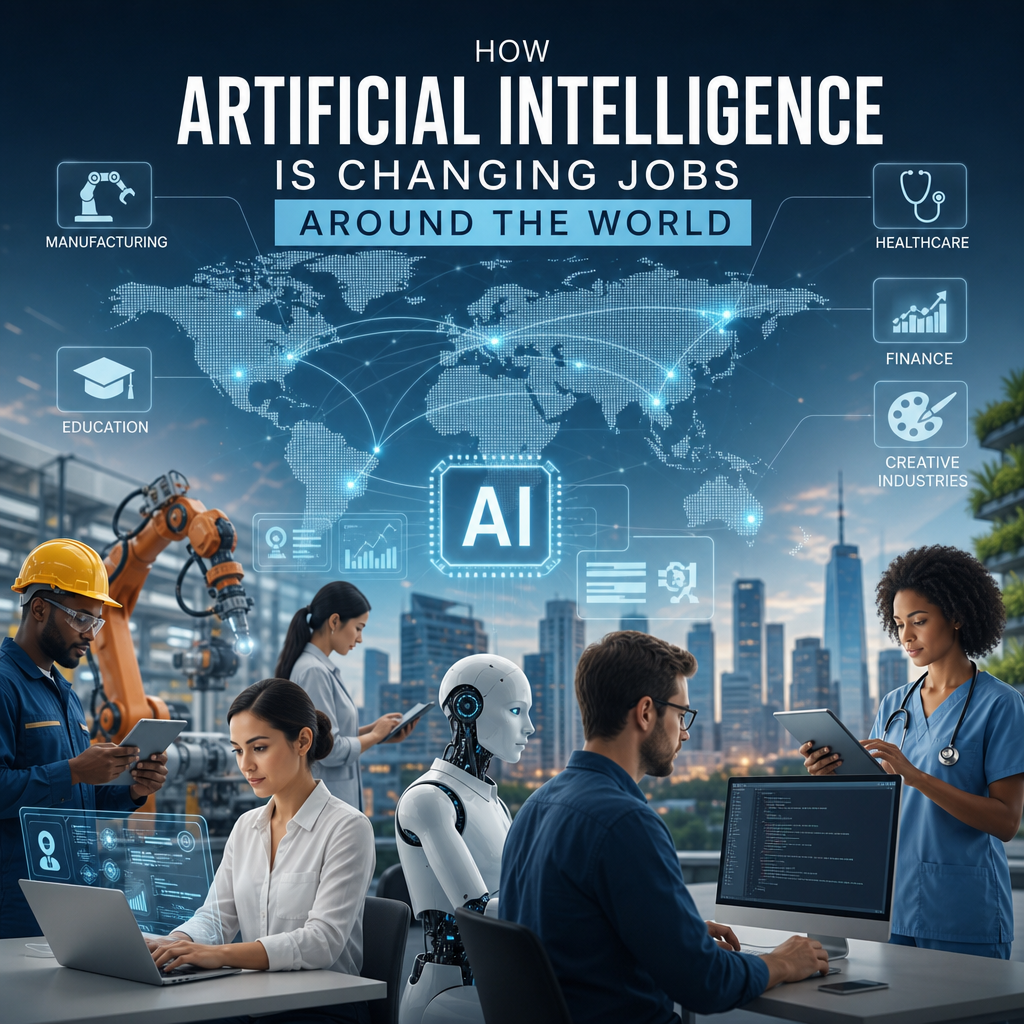
Artificial intelligence is no longer a distant idea reserved for science fiction or research labs. It is already reshaping workplaces, altering career paths, and changing how people complete everyday tasks. From customer support and healthcare to manufacturing, finance, and education, AI is changing jobs around the world in practical and sometimes unexpected ways.
For workers, this shift can feel exciting, confusing, or even intimidating. Some tasks are being automated. New roles are emerging. Many existing jobs are being redesigned rather than replaced. Understanding how artificial intelligence is changing jobs around the world is essential for employees, employers, students, and policy makers who want to stay prepared.
Why AI Is Transforming the Global Job Market
AI systems can process large amounts of data, identify patterns, generate content, and support decision-making faster than most humans can. That makes them especially useful for repetitive, data-heavy, or rules-based work.
But AI is not only replacing tasks. In many cases, it is enhancing human work.
AI changes tasks, not just jobs
A job usually includes many separate tasks. AI may automate one part of a role while leaving the rest to people. For example:
A marketing professional may use AI to draft ad copy, then refine it with human judgment.
A nurse may use AI-assisted software to organize patient information, while still relying on clinical expertise and empathy.
A logistics manager may use AI to optimize routes, but still make final decisions when conditions change.
This is why the conversation should focus on task transformation, not just job loss.
Different countries feel the impact differently
The effect of AI on employment varies by region. Countries with high levels of digital infrastructure often adopt AI faster. In other places, limited access to technology, education, or investment can slow adoption.
Industries also differ in how exposed they are. Office-based, information-heavy work is often more exposed to AI tools than jobs that require physical presence, manual skill, or complex human interaction.
How Artificial Intelligence Is Changing Jobs Around the World in Major Industries
AI is affecting nearly every sector, but the changes look different depending on the type of work.
Office and administrative work
Administrative roles often involve scheduling, document handling, data entry, and reporting. These are exactly the kinds of tasks AI can streamline.
Examples include:
Automated email sorting
Meeting transcription and summaries
Calendar scheduling
Document classification
Form processing
That does not mean administrative jobs disappear overnight. Instead, workers may spend less time on routine tasks and more time on coordination, communication, and problem-solving.
Customer service and support
AI-powered chatbots and virtual assistants are becoming common in customer support. They can answer simple questions, resolve basic issues, and guide customers to the right resources.
This creates two major changes:
Simple inquiries are increasingly handled by AI.
Human support agents focus more on complex, emotional, or high-value issues.
For example, a telecom company may use AI to reset passwords or check order status. Human agents then handle billing disputes, service exceptions, or frustrated customers who need real empathy.
Healthcare
In healthcare, AI can help with administrative efficiency, medical imaging support, risk prediction, and patient triage. It can reduce paperwork and help clinicians spot trends faster.
However, healthcare remains deeply human. Doctors, nurses, and caregivers still need judgment, ethical reasoning, and compassion. AI works best as a support tool, not a replacement for licensed professionals.
Manufacturing and logistics
AI-powered robots, predictive maintenance tools, and smart supply chain systems are changing how factories and warehouses operate. These tools can improve speed, accuracy, and safety.
Common applications include:
Quality inspection
Inventory forecasting
Equipment monitoring
Route planning
Warehouse picking assistance
In these fields, some manual tasks are reduced, while technical roles, equipment oversight, and process management become more important.
Finance and accounting
Banks, insurers, and accounting firms use AI for fraud detection, document review, customer onboarding, and basic analysis. This can save time and reduce human error.
At the same time, finance professionals who understand both data and business strategy may become more valuable. AI can surface patterns, but people still interpret risk, advise clients, and make final decisions.
Media, marketing, and creative work
AI tools can generate outlines, image drafts, headlines, and content suggestions. That has sparked concern in creative industries, but the bigger story is more nuanced.
Many writers, designers, and marketers are using AI to:
Brainstorm ideas
Draft first versions
Speed up editing
Analyze audience behavior
Personalize content
The most successful professionals are often those who combine creativity with AI literacy. Human taste, storytelling, and brand strategy still matter enormously.
The Biggest Ways AI Is Changing Jobs Around the World
The effects of AI on work can be grouped into several major shifts.
1. Automation of routine tasks
The most obvious change is automation. Repetitive tasks that follow clear rules are easiest for AI to handle.
This can increase productivity, but it also means workers may need to adapt to new responsibilities.
2. Creation of new jobs
AI is not only eliminating tasks; it is also creating roles that did not exist before or were once niche.
Examples include:
AI product managers
Machine learning engineers
Prompt engineers
AI governance specialists
Data labeling and model training roles
AI auditors and compliance professionals
Some of these jobs require advanced technical skills. Others require project management, ethics, legal knowledge, or communication.
3. Redesign of existing roles
Most workers will not move into entirely new professions. Instead, many jobs will be reshaped.
A teacher may use AI to create lesson materials more quickly. A recruiter may use AI to screen resumes faster. A sales representative may use AI to identify likely leads. In each case, the job changes, but it does not vanish.
4. Greater demand for human skills
As AI handles more routine work, human strengths become even more important. These include:
Critical thinking
Emotional intelligence
Communication
Leadership
Adaptability
Creativity
Ethical judgment
In many professions, the ability to work alongside AI may become a core skill.
Which Workers Are Most Affected?
Not everyone faces the same level of disruption. AI tends to affect workers based on the tasks they do, the tools they use, and how easily those tasks can be automated.
Roles with higher exposure
Jobs that involve structured information, repetitive processes, or digital content are often more exposed. Examples may include:
Data entry clerks
Basic customer support agents
Routine bookkeeping roles
Some translation and transcription tasks
Entry-level content production tasks
Roles with lower exposure
Jobs that require physical dexterity, face-to-face interaction, or complex real-world judgment are usually less exposed. These may include:
Skilled trades
Childcare and eldercare
Emergency response
Many field-based maintenance jobs
Leadership roles requiring nuanced decisions
Still, almost no job is entirely untouched. AI tools are spreading across industries, so even lower-exposure jobs may change in specific tasks.
What This Means for Workers
AI can feel like a threat if it is introduced without training or communication. But for workers, the real challenge is often not AI itself. It is the speed of change.
Skills that matter more now
To stay competitive, workers can focus on skills that complement AI rather than compete with it.
Useful skills include:
Digital literacy
Data interpretation
Tool evaluation
Problem-solving
Collaboration
Writing and communication
Ethical decision-making
Learn to use AI as a tool
Workers who understand AI tools often become more efficient and more valuable. This does not require becoming an engineer. It may simply mean knowing how to:
Write effective prompts
Review AI-generated work critically
Spot errors or bias
Use AI to speed up research
Automate low-value tasks
Keep learning throughout your career
Lifelong learning is becoming part of normal work life. Short online courses, workshops, professional certifications, and internal training can help workers adapt as new tools emerge.
What Employers Need to Consider
Organizations that adopt AI successfully usually treat it as a workforce strategy, not just a software purchase.
Communicate clearly
Employees are more likely to trust AI adoption when leaders explain:
Why the tool is being introduced
Which tasks it will support
How human roles will change
What training will be provided
Invest in training
A company that introduces AI without training may create confusion or resistance. Training should cover both technical use and practical decision-making.
Create guardrails
AI can make mistakes, reflect bias, or produce unreliable outputs. Employers should define when human review is required, how data is protected, and what standards apply to AI-assisted work.
Redesign workflows thoughtfully
The best results often come when businesses redesign work around AI rather than simply layering it on top of old processes.
The Global Divide: Opportunity and Inequality
One of the most important issues in how artificial intelligence is changing jobs around the world is inequality. AI can improve productivity, but it can also widen gaps if access is uneven.
Countries with stronger advantages may move faster
Nations with strong digital infrastructure, research capacity, and education systems are better positioned to adopt AI and create high-value jobs.
Workers without access may fall behind
People who lack internet access, training, or upskilling opportunities may struggle to compete in a labor market where AI familiarity matters more.
Policy can make a difference
Governments, schools, and employers can reduce inequality by supporting:
Digital education
Workforce retraining
Broadband access
Apprenticeships
Career transition programs
Responsible AI governance
Practical Examples of AI and Job Change
Here are a few realistic examples of how AI changes work without completely removing the human role.
Example 1: A paralegal office
AI can review contracts, organize files, and flag common clauses. The paralegal then focuses on case preparation, attorney support, and exception handling.
Example 2: A hospital scheduling department
AI can predict appointment no-shows and help manage scheduling. Staff members then spend more time helping patients with special needs or complex insurance situations.
Example 3: A small business marketing team
AI can generate content ideas, analyze campaign performance, and suggest subject lines. The team then uses human creativity to shape the brand voice and review final output.
How to Prepare for the Future of Work
Preparing for an AI-driven economy does not mean predicting every change. It means building flexibility.
For workers
Learn the AI tools used in your field
Strengthen human-centered skills
Watch how your job is changing task by task
Ask for training early
Build a portfolio of adaptable abilities
For students
Focus on both technical and communication skills
Learn how to evaluate information critically
Explore fields that blend human and digital expertise
Stay curious about new tools and workplace trends
For employers
Introduce AI with clear goals
Protect workers from unnecessary disruption
Offer retraining and career pathways
Measure success by quality, not only speed
Keep human oversight in place where needed
Frequently Asked Questions
1. Is AI going to replace most jobs?
AI is more likely to change jobs than replace most of them entirely. In many cases, it automates specific tasks while leaving human work in place. Jobs that require judgment, empathy, physical skill, or complex communication are less likely to be fully automated.
2. Which jobs are most at risk from AI?
Jobs with repetitive, predictable, or data-heavy tasks are generally more exposed. This includes some administrative, customer support, and content production roles. However, even these jobs often evolve rather than disappear completely.
3. How can workers stay competitive in an AI-driven job market?
Workers can strengthen digital literacy, learn the AI tools used in their industry, and improve human-centered skills such as communication, problem-solving, and adaptability. Ongoing learning is one of the best defenses against disruption.
4. Will AI create new careers?
Yes. AI is creating roles in areas such as machine learning, data governance, AI product management, compliance, and human-in-the-loop oversight. It is also increasing demand for professionals who can combine domain expertise with AI fluency.
5. How should companies introduce AI responsibly?
Companies should explain why they are using AI, train workers properly, keep humans involved in important decisions, and put clear rules in place for data protection, quality control, and accountability. Responsible rollout matters as much as the technology itself.
Artificial intelligence is changing jobs around the world in profound but uneven ways. It is automating routine work, supporting human decision-making, and creating new opportunities in industries that are still learning how to adapt. For many workers, the biggest shift is not the disappearance of jobs, but the redesign of tasks and the growing importance of skills that AI cannot easily replace.
The future of work will likely belong to people and organizations that learn how to use AI responsibly. Workers who build digital confidence, stay flexible, and strengthen their human strengths will be better prepared for change. Employers that invest in training, transparency, and thoughtful implementation will be better positioned to benefit from AI without losing trust.
The key takeaway is simple: AI is not just a technology story. It is a workforce story, an education story, and a global development story. The more we understand its impact now, the better we can shape a future of work that is productive, fair, and human-centered.
Peter B holds a degree in Journalism and has 5 years
of experience covering U.S. economic policy, labor markets, and
financial news. He writes data-driven news content on topics
like inflation, interest rates, and employment trends.