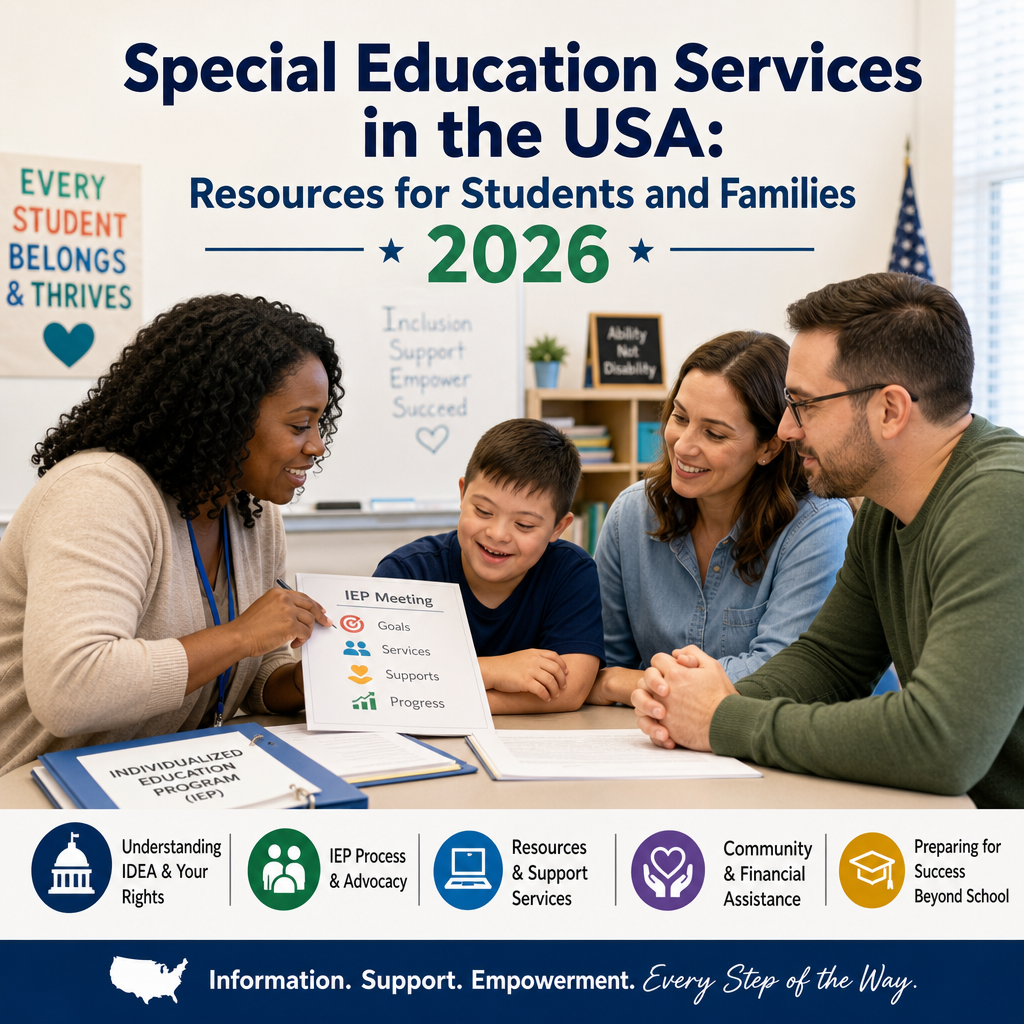
Special Education Services in the USA: Resources for Students and Families in 2026
Special education services in the USA are evolving in 2026, giving families more ways to find the right support, from evaluations and IEPs to accessible classroom tools and expert guidance. This guide breaks down what parents and students need to know to navigate the process with confidence.
By: Jennifer on July 22, 2026
Última atualização em: agosto 3, 2026
Special education in the United States continues to evolve, with new tools, legal guidance, and support networks helping students with disabilities access a more inclusive education. For families navigating school meetings, evaluations, and individualized planning, the process can feel overwhelming at first. But in 2026, there are more resources than ever to help students receive the support they need and deserve.
Whether a child needs help with reading, speech, behavior, mobility, attention, or emotional regulation, special education services are designed to create meaningful access to learning. This guide breaks down what families should know about special education in 2026, how services work, and where to find support along the way.
What Special Education Means in 2026
Special education is not a separate system meant to isolate students. Instead, it is a set of services, accommodations, and instructional strategies designed to help students with disabilities learn alongside their peers as much as possible.
Under federal law, students with disabilities may qualify for support through programs such as:
IDEA (Individuals with Disabilities Education Act)
Section 504 of the Rehabilitation Act
The Americans with Disabilities Act (ADA)
These laws protect students in public schools and guide how services are delivered. In 2026, schools are using more digital tools and hybrid service models, but the core goal remains the same: provide a free appropriate public education in the least restrictive environment.
Common Disabilities Served
Special education services may support students with:
Autism spectrum disorder
Specific learning disabilities
Speech or language impairments
ADHD
Intellectual disabilities
Emotional disturbance
Hearing or vision impairments
Orthopedic or physical disabilities
Traumatic brain injuries
Health-related conditions
Developmental delays
Not every student with a disability needs special education, but many benefit from accommodations, therapies, or specialized instruction.
How a Student Qualifies for Services
The process usually begins when a parent, teacher, or school staff member notices that a child is struggling more than expected. This may lead to a formal evaluation.
Step 1: Request an Evaluation
Families can request an evaluation in writing. Schools may also initiate the process if they suspect a disability may be affecting learning.
An evaluation may include:
Academic testing
Speech and language assessments
Observations in class
Psychological testing
Occupational or physical therapy screening
Social-emotional assessments
Step 2: Eligibility Decision
After testing, the school team reviews the results to decide whether the student qualifies under IDEA or Section 504. The team considers whether the disability affects educational performance and whether specialized support is needed.
Step 3: Create a Plan
If eligible, the student may receive:
An IEP (Individualized Education Program)
A 504 Plan
Related services such as speech therapy or counseling
Classroom accommodations
Assistive technology
An IEP is generally used when a student needs special education instruction. A 504 Plan is used when the student needs accommodations but not specialized instruction.
What an IEP Includes
An IEP is a written plan tailored to the student’s unique needs. It is reviewed at least once a year and updated as needed.
Key Parts of an IEP
An IEP may include:
Current performance levels
Annual goals
Special education services
Related services
Accommodations and modifications
Transportation support
Behavior intervention plans
Progress monitoring details
For example, a student with dyslexia may receive structured literacy instruction, extra time on tests, and access to audiobooks. A student with autism may receive speech therapy, visual schedules, and social skills support.
Why the IEP Matters
The IEP is more than paperwork. It is the roadmap for a student’s education. A strong IEP can make daily learning less frustrating and more successful. Families should keep copies of the plan and review it carefully before each meeting.
Section 504 Plans and When They Help
Section 504 plans are often used for students who can participate in general education with accommodations. These plans can be valuable for students with ADHD, anxiety, chronic illness, or temporary medical needs.
Examples of 504 Accommodations
Common accommodations include:
Extended time on assignments and tests
Preferential seating
Breaks during class
Large-print materials
Permission to use a planner or reminder system
Modified homework load
Access to medication or health services
Flexible attendance for medical needs
A 504 plan does not usually include specialized instruction, but it can still make a major difference in a student’s daily experience.
Important Resources for Families in 2026
Families in 2026 have access to more support than ever, from federal organizations to local advocacy centers. Knowing where to start can save time and reduce stress.
1. Your Child’s School District
The first and most direct resource is the school itself. Families can contact:
The classroom teacher
The special education case manager
The school psychologist
The counselor
The principal
The district’s special education director
School staff can explain evaluation timelines, services, parent rights, and available interventions.
2. Parent Training and Information Centers
Every state has Parent Training and Information Centers, often called PTIs. These federally funded organizations help families understand special education law, prepare for meetings, and resolve concerns.
They can help with:
Writing letters to request evaluations
Reviewing IEPs and 504 plans
Understanding parent rights
Finding local advocacy services
Preparing for disputes or mediation
For many families, a PTI is one of the most useful free resources available.
3. State Department of Education
State education agencies publish special education rules, complaint procedures, and resources for parents. They often provide:
Eligibility guidelines
Sample forms
Parent handbooks
Procedural safeguards
Contact information for dispute resolution offices
These websites can be helpful when families need clarity on state-specific timelines or requirements.
4. Disability Rights Organizations
National and state disability rights groups can provide legal guidance, advocacy, and information. These organizations may assist with school discrimination concerns, access issues, or civil rights protections.
Examples include:
Disability Rights Education and Defense Fund (DREDF)
National Disability Rights Network (NDRN)
Local legal aid organizations
Protection and Advocacy agencies in each state
These groups are especially useful when a family is facing repeated service delays or access barriers.
5. Related Service Providers
Students may receive school-based services from professionals such as:
Speech-language pathologists
Occupational therapists
Physical therapists
School psychologists
Behavior specialists
Social workers
Orientation and mobility specialists
Families should ask these providers how services are being measured and what progress should look like over time.
6. Assistive Technology Support
In 2026, assistive technology is playing a bigger role in special education. Tools may include:
Text-to-speech software
Speech-to-text apps
Communication devices
Screen readers
Digital organizers
Adaptive keyboards and mice
Accessible tablets and learning platforms
Schools are expected to consider whether a student needs assistive technology as part of the evaluation and planning process.
New and Growing Trends in 2026
The special education landscape is changing as technology, remote services, and accessibility standards improve.
Digital Accessibility Is More Important Than Ever
Many schools now use online assignments, digital textbooks, and classroom platforms. That means accessibility must be built into everything from homework portals to school announcements.
Students may need:
Captioned videos
Readable PDFs
Keyboard navigation
Compatible learning software
Accessible school websites
Families should speak up if digital materials are not usable for their child.
Teletherapy and Hybrid Services
Some related services are now offered through teletherapy, especially in rural or underserved areas. For some students, virtual speech therapy or counseling can be effective and convenient. For others, in-person support remains necessary.
A strong plan should be based on the student’s needs, not just what is easiest for the school to deliver.
More Focus on Emotional and Behavioral Support
Schools are paying more attention to mental health and behavior in the classroom. Students with anxiety, trauma histories, or emotional regulation challenges may receive behavior intervention plans, counseling, or positive supports.
This shift is important because behavior is often a sign that a child is struggling, not simply “misbehaving.”
Greater Family Advocacy Through Online Communities
Families are also using online parent groups, webinars, and state advocacy forums to learn from one another. While these communities can be helpful, families should verify legal or educational advice with professionals or official sources.
How Families Can Advocate Effectively
Advocacy does not have to mean conflict. Often, the strongest results come from being organized, consistent, and informed.
Keep Records
Save:
Evaluation reports
IEPs and 504 plans
Progress reports
Emails
Meeting notes
Samples of schoolwork
Medical documentation
Records help families track patterns and support requests with evidence.
Put Requests in Writing
Email is often the clearest way to make a request. Written communication creates a record and helps avoid misunderstandings.
For example, a parent might write:
I am requesting a full psychoeducational evaluation to better understand my child’s reading difficulties and support needs.
Prepare for Meetings
Before attending an IEP or 504 meeting:
Review the current plan
Make a list of concerns
Bring examples of school struggles
Ask for data and progress updates
Take notes during the meeting
Families can also bring an advocate, friend, or support person if allowed by the school district.
Ask Clear Questions
Helpful questions include:
What goals are being measured?
How often will services be delivered?
How will progress be reported?
What happens if my child is not making progress?
What accommodations are used in each class?
How will staff communicate with our family?
Clear questions lead to clearer answers.
What to Do If Services Are Not Working
Sometimes students do not make enough progress even when services are in place. In that case, families should ask for a review.
Possible next steps include:
Requesting a meeting to revise the IEP or 504 plan
Asking for additional testing
Seeking an independent educational evaluation
Requesting a behavior assessment
Reviewing whether accommodations are actually being used
Filing a complaint or asking for mediation if necessary
Parents should not assume that a poor outcome means the child cannot succeed. It may simply mean the plan needs adjustment.
Support Beyond School
Special education is important, but families often need support outside the classroom too. Community resources can strengthen the child’s success.
Community-Based Resources May Include
Early intervention programs
After-school tutoring
Disability sports and recreation
Children’s mental health services
Medicaid or insurance-covered therapy
Support groups for parents
Local libraries with accessible materials
Nonprofit organizations serving specific disabilities
These supports can reduce stress and help children build confidence.
Transition Planning for Older Students
For students approaching adulthood, transition planning is a critical part of special education. In 2026, many schools are placing greater emphasis on preparing students for life after high school.
Transition services may focus on:
College readiness
Job training
Independent living skills
Self-advocacy
Transportation
Community involvement
Families should begin asking about transition goals early, not just during the final years of high school.
Practical Example: A Family Navigating Support
Consider a middle school student named Maya who struggles with reading, writing, and attention. Her parents notice she dreads homework and avoids reading aloud in class. They request an evaluation, and the school finds she has a specific learning disability and ADHD.
Her IEP includes:
Structured literacy instruction
Extended time on tests
Preferential seating
Check-ins for assignment planning
Access to audiobooks
Progress reports every grading period
Maya also receives support from the school counselor and uses a digital planner on her tablet. With these services in place, she becomes more confident and begins turning in work more consistently.
This example shows how the right supports can change a student’s school experience.
Frequently Asked Questions (FAQ)
1. What are special education services in the USA?
Special education services are individualized educational supports designed for students with disabilities who qualify under the Individuals with Disabilities Education Act (IDEA). These services may include specialized instruction, speech therapy, occupational therapy, counseling, assistive technology, and classroom accommodations to help students succeed academically and socially.
2. Who is eligible for special education services?
Eligibility is determined through a comprehensive evaluation conducted by the student’s school district. Students must have a qualifying disability recognized under IDEA and demonstrate that they require specialized instruction to benefit from their education. Eligibility requirements may vary depending on individual circumstances.
3. What is an Individualized Education Program (IEP)?
An Individualized Education Program (IEP) is a legally binding document that outlines a student’s educational goals, specialized services, accommodations, and progress monitoring. The IEP is created collaboratively by parents, teachers, school professionals, and, when appropriate, the student.
4. How can parents request a special education evaluation?
Parents can submit a written request to their child’s school or school district asking for a special education evaluation. Once the request is received, the school will explain the evaluation process, obtain parental consent if required, and assess whether the student qualifies for services under federal and state guidelines.
5. Are special education services free in public schools?
Yes. Eligible students attending public schools generally receive special education services at no cost to their families under IDEA. These services are funded through federal, state, and local education resources, although the types of services available may differ by school district.
6. What rights do parents have during the special education process?
Parents have important legal rights, including participating in IEP meetings, reviewing educational records, requesting independent evaluations under certain circumstances, receiving prior written notice of significant decisions, and using dispute resolution procedures if disagreements arise.
7. Can students receive accommodations without having an IEP?
Yes. Some students who do not qualify for an IEP may be eligible for accommodations through a Section 504 Plan under the Rehabilitation Act of 1973. A 504 Plan provides accommodations that help students access educational opportunities but does not typically include specialized instruction.
8. Where can families find reliable information about special education services?
Families can learn more by visiting official resources such as the U.S. Department of Education, their state department of education, and their local school district. These organizations provide up-to-date information on eligibility, parental rights, available services, and educational support programs.
Conclusion
Special education services in the USA are designed to help students with disabilities learn, grow, and participate more fully in school. In 2026, families have more information and more resources than ever, from school-based supports and federal protections to parent centers, advocacy groups, and assistive technology.
The process can feel complicated, but no family has to navigate it alone. By understanding evaluation rights, asking questions, keeping records, and using available resources, parents and students can work toward a plan that truly meets the child’s needs.
Jennifer, M.Ed., holds a degree in Higher Education Administration, with
a focus on U.S. college financial aid, admissions policy, and student
support systems. She researches and writes about scholarships, federal
aid programs, and the college planning process to help students and
families make informed, well-supported decisions.