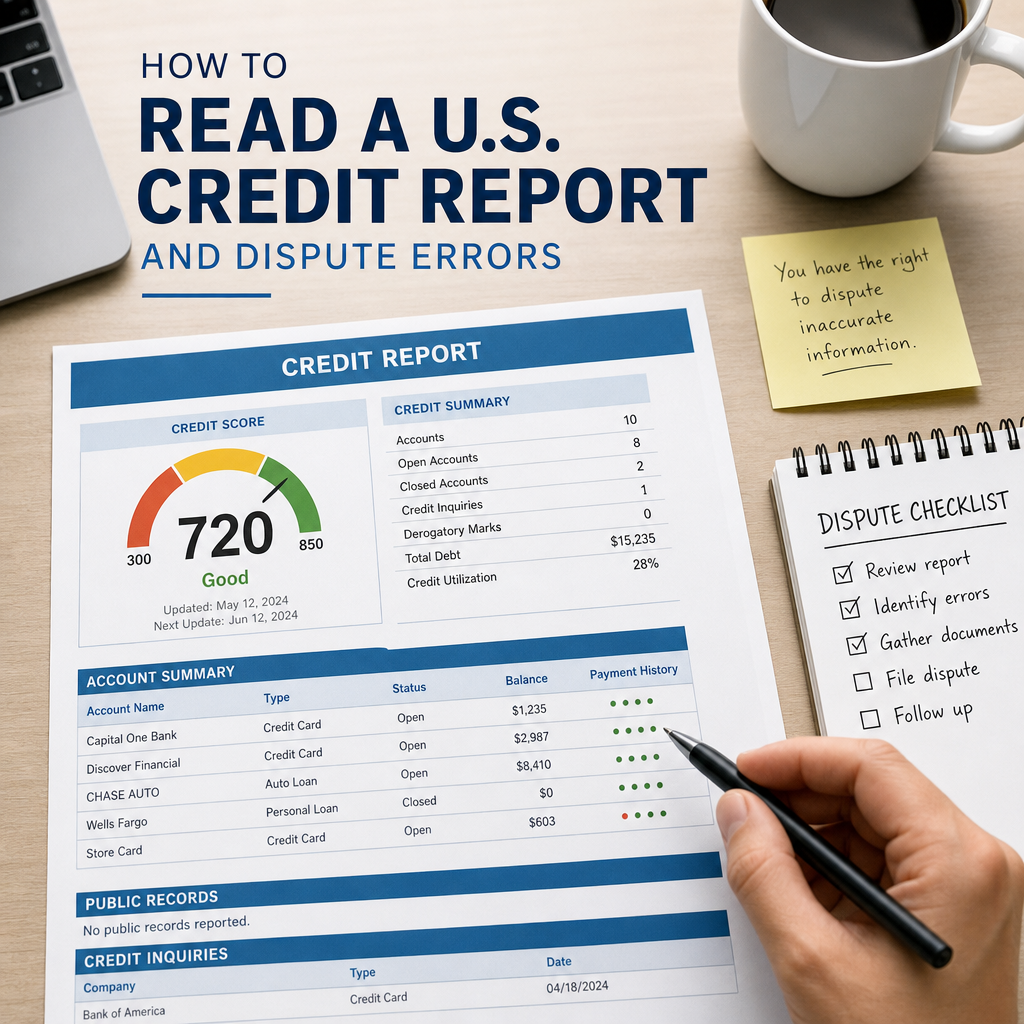
How to Read a U.S. Credit Report and Dispute Errors
Learn how to read a U.S. credit report so you can catch credit report errors before they cost you money. This guide shows you what to check, how to spot mistakes, and the right way to dispute them.
By: Mary on July 23, 2026
Última atualização em: agosto 3, 2026
Understanding how to read a U.S. credit report is one of the most practical financial skills you can develop. Your credit report affects whether you qualify for a mortgage, car loan, apartment, or even certain jobs. It also shapes the interest rates and terms lenders may offer you. If your report contains errors, those mistakes can cost you real money.
The good news is that credit reports are manageable once you know what to look for. In this guide, you’ll learn how to read a U.S. credit report, spot common problems, and dispute errors the right way. You’ll also get practical tips for protecting your credit over time.
What a Credit Report Is and Why It Matters
A credit report is a detailed record of your borrowing history. It is compiled by credit bureaus based on information from lenders, creditors, public records, and collection agencies.
In the U.S., the three major consumer credit bureaus are:
Equifax
Experian
TransUnion
Each bureau may have slightly different information, which is why it’s important to review all three reports.
Your credit report typically includes:
Personal identification information
Credit accounts and payment history
Credit inquiries
Public records, such as bankruptcies
Collections accounts
Employment information in some cases
Lenders use this information to assess risk. Even one inaccurate late payment or account balance can affect your credit score and borrowing options.
How to Read a U.S. Credit Report
A credit report can feel overwhelming at first, but it becomes easier when you break it into sections. The layout may differ depending on the bureau, but the core information is similar.
1. Review Your Personal Information
Start with your name, current and past addresses, Social Security number, date of birth, and employment history.
Look for:
Misspelled names
Old or unfamiliar addresses
Incorrect Social Security number digits
Employers you never worked for
Minor errors in this section may not directly affect your score, but they can signal a mixed file, which happens when someone else’s information gets attached to your report. That can create serious problems later.
2. Check the Account Summary
This section gives you a quick snapshot of your credit profile. It may show:
Number of open accounts
Number of closed accounts
Total balances
Revolving credit limits
Payment status
Negative accounts
Use this summary as a roadmap before digging into the details.
3. Examine Each Credit Account
This is usually the most important part of the report. You’ll see accounts such as credit cards, auto loans, student loans, mortgages, and retail accounts.
For each account, verify:
The creditor’s name
Account number
Account status
Date opened
Credit limit or original loan amount
Current balance
Payment history
Payment status, such as current, late, charged off, or closed
A few things deserve special attention:
Payment History
Late payments can stay on your credit report for up to seven years, so accuracy matters. Confirm that any missed payment actually happened and that the date is correct.
Account Status
An account should not be listed as closed if it is still open, or open if it has been paid off and closed. Incorrect status information can distort how lenders view your credit.
Balance and Credit Limit
If a card shows the wrong balance or limit, your credit utilization may appear higher than it really is. That can hurt your credit score.
4. Look at the Inquiries Section
This section lists businesses that accessed your credit report. There are two types of inquiries:
Hard inquiries: These usually happen when you apply for credit and may affect your score temporarily.
Soft inquiries: These happen when you check your own credit or when a company reviews your report for non-lending purposes. Soft inquiries do not affect your score.
Check that every hard inquiry is legitimate. If you don’t recognize one, it could indicate identity theft or an application error.
5. Review Public Records and Collections
Public records may include bankruptcies, judgments, or tax liens, depending on what the bureau reports and what is legally permitted. Collections accounts come from unpaid debts that were sent to a collection agency.
Verify:
The original creditor
The amount owed
The date of delinquency
Whether the account was already paid or settled
Whether the debt is actually yours
Collection information is especially worth reviewing carefully, because old or duplicate accounts sometimes appear by mistake.
Common Credit Report Errors to Watch For
Credit report mistakes are more common than many people realize. Here are some of the issues that appear most often.
Incorrect Personal Information
This may include:
Wrong name or initials
Incorrect address history
Mistyped Social Security number
Someone else’s employment data
These errors can point to identity mix-ups.
Accounts That Aren’t Yours
An account may belong to another person with a similar name, or it may be the result of identity theft.
Duplicate Accounts
A single debt may appear more than once, especially if it was transferred to collections or sold to another company.
Incorrect Late Payments
A lender may report a late payment in error, or the payment may have been applied after the cutoff date.
Closed Accounts Reported as Open
This can make it appear that you still owe money or have more active debt than you actually do.
Wrong Balances or Credit Limits
These errors can hurt your utilization ratio and make your credit look riskier than it is.
Outdated Negative Information
Most negative information has time limits. If an item should no longer be reported, it may need to be removed.
How to Dispute Errors on a Credit Report
If you find an error, you have the right to dispute it. The Fair Credit Reporting Act gives consumers the ability to challenge inaccurate information with the credit bureaus and, in some cases, the furnisher of the information, such as the lender.
Step 1: Gather Evidence
Before you file a dispute, collect any documents that support your claim. Examples include:
Bank statements
Account statements
Payment confirmations
Letters from lenders
Identity theft reports
Cancellation notices
Court documents
Copies of your credit reports showing the error
The more organized your records are, the stronger your dispute will be.
Step 2: Identify Exactly What Is Wrong
Be specific. Don’t simply say, “My credit report is wrong.”
Instead, state something like:
“Account number ending in 1234 is not mine.”
“Payment reported as 30 days late in March 2024 was paid on time.”
“Balance on my auto loan should be $4,200, not $7,200.”
Precision helps the bureau investigate efficiently.
Step 3: File Your Dispute With the Credit Bureau
You can dispute inaccuracies online, by mail, or by phone with each credit bureau. Written disputes are often the best choice because they create a paper trail.
Your dispute letter should include:
Your full name and address
Date of birth
Social Security number or a partial number if you prefer
A clear description of each error
Copies of supporting documents
A request that the bureau investigate and correct the information
Keep the original documents and send copies only.
Step 4: Consider Disputing With the Furnisher Too
If the error came from a lender or collection agency, you can also contact that company directly. In many cases, the furnisher must investigate if you dispute the information and provide evidence that it may be inaccurate.
Step 5: Track the Investigation
Credit bureaus generally have a set time frame to investigate disputes. They may contact the furnisher, review the evidence, and respond with the results.
When the investigation is complete, the bureau should tell you:
Whether the information was changed, deleted, or verified
Whether an updated credit report will be sent
The outcome of the dispute
If the bureau corrects the error, check all three credit reports to make sure the same mistake is not still showing elsewhere.
Step 6: Add a Consumer Statement if Needed
If the dispute is unresolved and you still believe the information is wrong, you may be able to add a short statement to your report explaining your side. This will not remove the account, but it can give lenders more context.
How to Write a Strong Credit Dispute Letter
A clear dispute letter improves your chances of a smooth review. Keep it professional and factual.
Here’s a simple structure:
Introduce yourself
Include your full name, address, and identifying information.
List each disputed item
Provide the account name, account number, and the exact problem.
Explain why it is incorrect
Be brief but specific.
Request correction or deletion
State that you want the bureau to investigate and remove inaccurate information.
Attach evidence
Include copies, not originals.
Example Language
I am writing to dispute inaccurate information on my credit report. The account listed as XYZ Bank, account ending in 7890, is incorrectly reported as 30 days late in May 2024. I made the payment on time, as shown in the attached bank statement. Please investigate and correct this item.
Tips for Protecting Your Credit While the Dispute Is Pending
A dispute does not automatically freeze your credit activity. While the investigation is underway, continue to monitor your reports and protect your accounts.
Do This:
Keep making on-time payments
Watch for new suspicious activity
Save all dispute-related paperwork
Monitor all three credit reports
Consider placing a fraud alert if you suspect identity theft
Avoid This:
Closing old accounts without a reason
Ignoring collection notices
Disputing accurate information just because it hurts your score
Applying for unnecessary new credit while your report is under review
When to Escalate the Problem
Sometimes a dispute does not lead to the result you expected. If that happens, you still have options.
You may want to escalate if:
The bureau fails to correct an obvious error
A lender continues reporting inaccurate information after being notified
You believe identity theft is involved
Multiple bureaus show inconsistent results
The same error reappears after being removed
In more serious cases, you can submit complaints to the Consumer Financial Protection Bureau and, if necessary, seek help from a consumer law attorney or nonprofit credit counselor.
How Often Should You Check Your Credit Report?
A smart habit is to review your credit reports at least once a year, and more often if you are actively applying for credit or recovering from identity theft.
You can get free weekly online access to your credit reports through AnnualCreditReport.com, the official source authorized by federal law. Reviewing your reports regularly helps you catch errors early, before they affect a loan application or interest rate.
Frequently Asked Questions
1. What is the best way to read a U.S. credit report?
Start with your personal information, then review each account, payment history, balances, inquiries, collections, and public records. Compare all three reports because each bureau may show slightly different data. Focus on anything that looks unfamiliar, outdated, duplicated, or inaccurate.
2. How long do credit report errors take to fix?
The investigation period can vary, but credit bureaus generally must investigate disputes within a set time frame under federal law. Simple errors may be corrected fairly quickly, while more complex issues can take longer if the furnisher needs additional review. Keep copies of all correspondence and follow up if needed.
3. Can I dispute a credit report error online?
Yes. All three major credit bureaus offer online dispute options. However, written disputes by mail can be helpful if you want a documented paper trail or need to include detailed explanations and attachments. Choose the method that best fits the issue and the amount of evidence you have.
4. What if the same error appears on all three credit reports?
You may need to dispute the item with each bureau separately, since each one maintains its own file. It can also help to contact the creditor or collection agency that reported the information. If the error involves identity theft or mixed files, consider placing a fraud alert and gathering additional documentation.
5. Will disputing an error hurt my credit score?
No, filing a legitimate dispute does not hurt your credit score. In fact, correcting inaccurate information can improve your report over time. The only thing that may change temporarily is the way your report looks while the investigation is pending.
Learning how to read a U.S. credit report gives you more control over your financial life. Once you understand the major sections—personal information, accounts, inquiries, collections, and public records—you can spot problems before they cause lasting damage. Just as important, you know how to dispute errors with confidence and provide the documentation that supports your case.
The key is to be careful, specific, and persistent. Don’t assume that a mistake will fix itself, and don’t ignore accounts you don’t recognize. Review your credit reports regularly, keep your records organized, and act quickly when something looks wrong. A clean and accurate credit report can improve your chances of getting approved for loans, help you qualify for better terms, and reduce stress when it matters most. If you haven’t checked your reports recently, now is a smart time to start.
Mary S, CFP®, is a Certified Financial Planner with over 12 years of experience in personal finance, retirement planning, and wealth management. She writes educational content that helps readers understand financial concepts and make informed decisions based on reliable information.