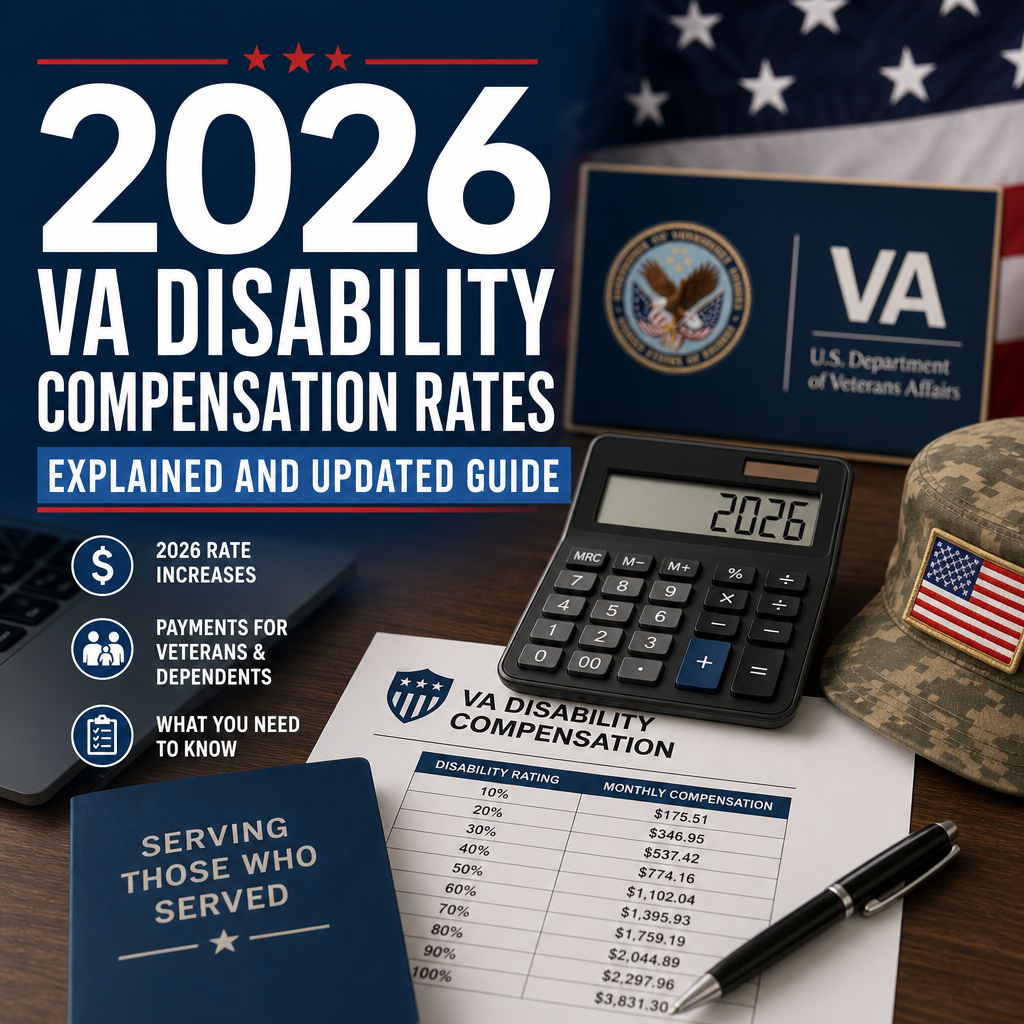
2026 VA Disability Compensation Rates Explained and Updated Guide
Learn how 2026 VA disability compensation rates are determined, who qualifies, and what factors can increase your monthly benefit. This guide breaks down the basics so you can better estimate your payment and plan ahead with confidence.
By: Emilly on July 23, 2026
Última atualização em: agosto 3, 2026
If you receive VA disability benefits—or expect to file a claim soon—understanding 2026 VA disability compensation rates is essential. These monthly payments help veterans with service-connected disabilities manage the financial impact of injuries, illnesses, or conditions tied to military service. While the exact 2026 figures depend on the official annual adjustment, the way those rates are calculated, who qualifies, and how dependent status affects payment all follow a clear system.
In this guide, we’ll explain how 2026 VA disability compensation rates work, what factors influence your monthly payment, and how to estimate what you may receive. You’ll also learn how dependents, special circumstances, and future cost-of-living adjustments can change your benefit amount.
What Are VA Disability Compensation Rates?
VA disability compensation is a monthly tax-free payment to veterans with disabilities that the Department of Veterans Affairs connects to military service. The payment amount depends primarily on your disability rating, which ranges from 10% to 100% in 10-point increments.
The 2026 VA disability compensation rates are the updated monthly amounts the VA uses for that year’s benefit payments. These rates are typically adjusted to reflect changes in the cost of living, so most veterans see a yearly increase, though the exact amount varies.
Why the rate matters
Your rating determines more than just the size of your check. It can also affect:
Eligibility for additional benefits
Compensation for dependents
Access to other VA programs
Combined ratings if you have multiple service-connected conditions
For many veterans, knowing the current and upcoming rates makes it easier to budget and plan for medical or household expenses.
How 2026 VA Disability Compensation Rates Are Determined
The VA does not set disability compensation in a vacuum. Rates are adjusted based on federal law and a cost-of-living mechanism tied to inflation trends. This annual update is designed to preserve purchasing power over time.
Key factors behind the payment amount
Several elements influence the amount you receive:
Your disability rating
Higher ratings generally mean higher monthly compensation.
Dependent status
Veterans with a spouse, children, or dependent parents may receive additional money.
Marital and family situation
Payments vary depending on whether a spouse needs aid and attendance, whether you have school-age children, or whether a dependent is disabled.
Special monthly compensation (SMC)
Some severe disabilities qualify for extra compensation beyond the standard rating schedule.
Combined ratings
If you have more than one service-connected condition, the VA uses a combined ratings formula rather than simple addition.
Understanding the VA Disability Rating System
To make sense of 2026 VA disability compensation rates, it helps to understand how the rating system works.
What a disability rating means
A VA disability rating reflects the severity of a service-connected condition. The rating is expressed as a percentage:
10%
20%
30%
40%
50%
60%
70%
80%
90%
100%
A higher percentage usually means your condition has a greater impact on your ability to work or function day to day.
How multiple disabilities are combined
If you have more than one service-connected condition, the VA doesn’t simply add the percentages together. Instead, it uses a combined ratings table to calculate your overall disability rating.
For example:
A 50% condition and a 30% condition do not equal 80%
The combined result is lower because the VA accounts for remaining “whole person” efficiency
This is one reason two veterans with similar medical issues can receive different monthly compensation.
2026 VA Disability Compensation Rates and Dependents
Dependents can significantly affect your monthly payment. The VA recognizes that veterans with families often face greater financial responsibilities.
Who counts as a dependent?
The VA may count the following as dependents:
A spouse
Children under 18
Children between 18 and 23 who are in school
Children who became permanently unable to support themselves before age 18
Dependent parents in some cases
How dependents change your compensation
Veterans with higher disability ratings are often eligible for additional compensation for dependents. For example, a veteran rated at 30% or higher may qualify for extra pay if they have a spouse or children.
The exact increase depends on:
Disability percentage
Number of dependents
Whether the spouse also needs aid and attendance
Whether the veteran has children in school or children with disabilities
Because dependent-related compensation can become complex, it’s important to keep the VA updated if your family situation changes.
Special Monthly Compensation and Other Add-Ons
Not every benefit fits neatly into the standard rating table. Some veterans qualify for special monthly compensation or other additional payments.
What is special monthly compensation?
Special monthly compensation is extra tax-free compensation for veterans with severe disabilities or specific circumstances, such as:
Loss of use of a hand or foot
Blindness in one or both eyes
Need for regular aid and attendance
Being housebound
Certain combinations of serious disabilities
SMC is separate from your standard disability rating. In some cases, it can raise your total monthly benefit well above the regular schedule.
Other situations that may increase payment
You may also receive additional compensation if:
Your spouse is also a disabled veteran
You are caring for a child with disabilities
You qualify for aid and attendance assistance
You have a dependent parent with limited income
These benefits are not automatic. You generally need to provide documentation and notify the VA of the change in circumstances.
How to Estimate Your 2026 VA Disability Compensation Rates
Even before the VA publishes the final yearly schedule, you can estimate your likely payment by looking at your rating and dependent status.
Step-by-step way to estimate your monthly rate
Find your current disability rating
Check your VA award letter or online account.
Identify your dependent category
Determine whether you have a spouse, children, or dependent parents.
Look for special monthly compensation
Review whether any additional benefits apply to your situation.
Use the updated rate chart
Compare your rating and family status to the official VA compensation table for the year.
Check for pending changes
A marriage, divorce, child turning 18, or new school enrollment can change your payment.
Example
Suppose a veteran has:
A 70% disability rating
A spouse
One child
That veteran will receive a different monthly amount than a single veteran with a 70% rating, because the VA adds dependent compensation to the base rate.
The same principle applies at every rating level.
Common Mistakes Veterans Make With Compensation Rates
Knowing the rate table is important, but many veterans lose out because they miss an update or misunderstand how the VA pays benefits.
Mistakes to avoid
Not reporting a marriage or divorce
Failing to add a newborn or adopted child
Not submitting school enrollment for a child over 18
Assuming multiple ratings are added together directly
Ignoring eligibility for special monthly compensation
Waiting too long to appeal an inaccurate rating
Small administrative errors can lead to underpayment or delayed benefits.
How to Check Your VA Disability Payment
The VA offers several ways to review your benefit information.
If your payment seems off, compare it to your rating and dependent status. A change in family situation, a new decision on your claim, or a correction to your record could explain the difference.
Why 2026 VA Disability Compensation Rates Matter for Claim Planning
Whether you’re filing an initial claim, requesting an increase, or appealing a decision, understanding compensation rates helps you make smarter choices.
Practical reasons to stay informed
Budgeting: You can plan monthly expenses more accurately.
Claim strategy: A higher rating may qualify you for additional dependent pay or SMC.
Life changes: Marriage, childbirth, or a child entering college can affect compensation.
Appeals: If your rating is incorrect, your payment may be too low.
Staying up to date also helps you avoid missing deadlines or failing to submit supporting documents.
Tips for Maximizing Your VA Compensation Properly
You should never chase benefits you don’t qualify for, but you should make sure you receive every dollar you’ve earned.
Helpful steps
Keep all medical records organized
Submit evidence that clearly connects the condition to service
Update dependent information promptly
Review your award letter carefully
File for an increase if your condition worsens
Ask about secondary service-connected conditions if one disability leads to another
Veterans often receive a higher combined rating when they document how conditions overlap or worsen over time.
Frequently Asked Questions
1. What are 2026 VA disability compensation rates?
The 2026 VA disability compensation rates are the monthly tax-free payment amounts veterans receive for service-connected disabilities during the 2026 benefit year. The amount depends on the veteran’s disability rating, dependent status, and any additional compensation such as special monthly compensation.
2. Do VA disability rates increase every year?
Usually, yes. VA disability compensation is typically adjusted annually to reflect cost-of-living changes. The exact increase depends on federal adjustment rules and the official schedule published for the year.
3. Does my spouse or children increase my VA disability payment?
In many cases, yes. Veterans with a disability rating of 30% or higher may receive additional compensation for a spouse, children, or dependent parents. The amount depends on the rating and the number and type of dependents.
4. How does the VA combine multiple disability ratings?
The VA uses a combined ratings formula rather than simply adding percentages together. This method accounts for how each condition affects your overall functioning and usually results in a combined rating lower than the simple total of individual percentages.
5. What should I do if my VA payment seems wrong?
First, review your disability rating, dependent status, and award letter. Then check whether you recently had a family or medical change that should be reported. If the issue remains unresolved, contact the VA or work with an accredited representative to correct the record.
Understanding 2026 VA disability compensation rates can help you take control of your benefits and plan more confidently for the year ahead. Your monthly payment is shaped by more than just your disability percentage. Dependents, combined ratings, and special monthly compensation can all affect the final amount. That means the most accurate way to estimate your benefit is to review your current rating, confirm your dependent information, and compare it with the official VA schedule when it is available.
If you’re already receiving compensation, make it a habit to check your award letter and update the VA whenever your family or medical situation changes. If you’re preparing a new claim or seeking an increase, understanding how the rate structure works can help you avoid common mistakes and make better decisions about your next steps. The more informed you are, the better positioned you’ll be to receive the compensation you’ve earned through service.
Emily A, holds a Master's degree in Public Administration (MPA) and has over 7 years of experience researching federal and state assistance programs. She writes educational content focused on government benefits, public policy, and community resources, using information from official agencies to help readers understand available programs and eligibility requirements.