VA Disability Service Connection: Eligibility and Evidence Explained
Understanding VA disability service connection is one of the most important steps for veterans seeking disability benefits. In simple terms, service connection is the link between a current disability and an event, injury, disease, or exposure during military service. Without that connection, the VA generally cannot grant disability compensation.
For many veterans, the challenge is not just proving they have a medical condition. It’s showing that the condition is related to service in a way the VA recognizes. That’s where solid evidence, clear medical records, and a well-supported claim can make a real difference.
This guide explains how VA disability service connection works, who may qualify, what evidence matters most, and how to strengthen a claim with practical, reliable documentation.
What VA Disability Service Connection Means
The VA uses the term service connection to determine whether a veteran’s disability can be linked to active military service. If the connection is established, the veteran may receive monthly compensation, access to additional benefits, and in some cases, eligibility for related programs.
A disability may be service-connected in several ways:
- It began during active duty
- It was caused by military service
- It was aggravated by service
- It developed after service but is linked to an in-service event, illness, or exposure
- It is secondary to another service-connected condition
The key question is always the same: Did military service cause or worsen the condition?
Why Service Connection Matters
Service connection is more than a technical requirement. It is the foundation of a VA disability claim. Even if a veteran has a serious diagnosis, the VA will still need evidence that ties the condition to service.
That connection can affect:
- Monthly disability compensation
- Access to healthcare and follow-up treatment
- Eligibility for additional VA benefits
- Future claims for related conditions
Basic Eligibility for VA Disability Service Connection
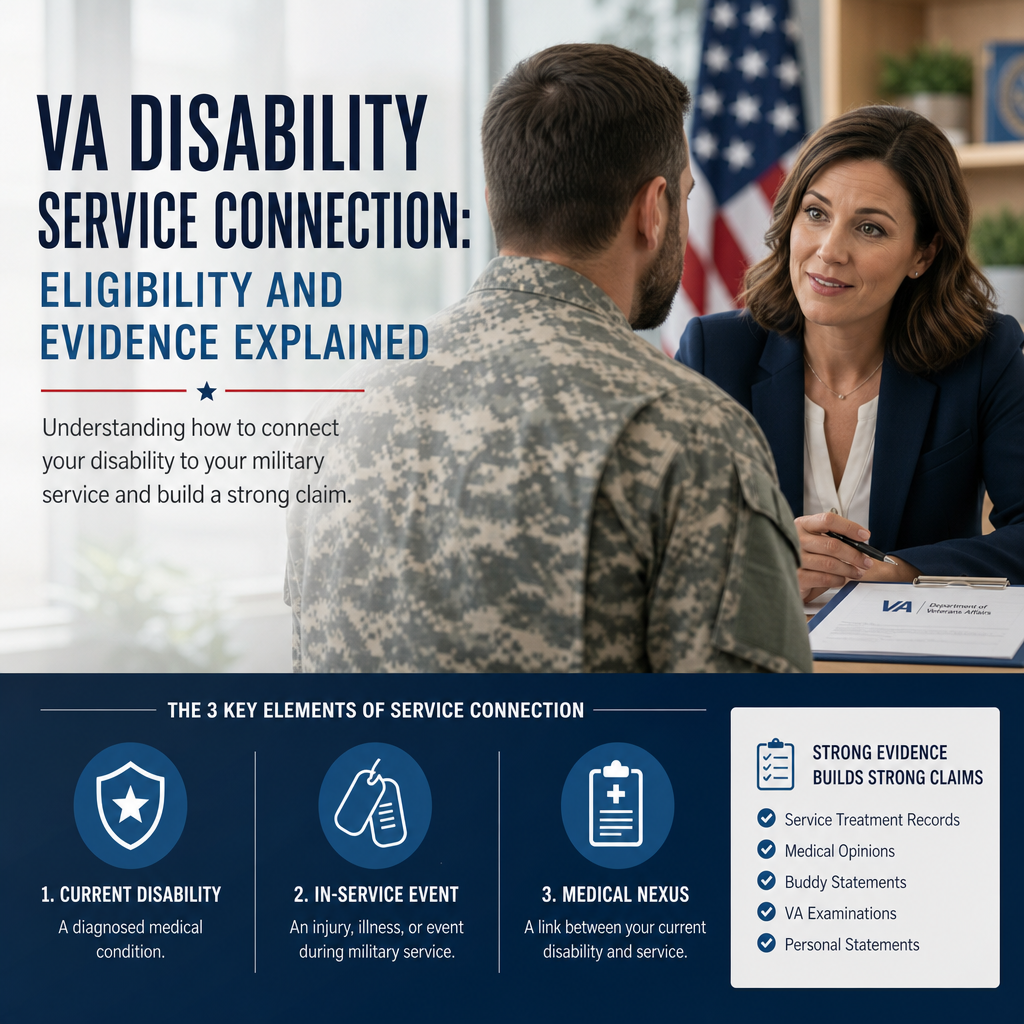
To qualify for VA disability service connection, a veteran generally needs three things:
- A current diagnosed disability or chronic condition
- An in-service event, injury, illness, or exposure
- A medical nexus, or link, between the current disability and service
These three elements are often called the “service connection triangle.” If one piece is missing, the claim may be denied.
1. A Current Disability
The VA typically requires a present diagnosis or symptoms that cause functional impairment. This can include physical and mental health conditions such as:
- Back injuries
- Hearing loss
- PTSD
- Sleep apnea
- Migraines
- Arthritis
- Tinnitus
- Depression or anxiety
A past injury alone is usually not enough. The condition must still exist, or its effects must still be present.
2. An In-Service Event, Injury, or Disease
The second element is something that happened during military service. This may include:
- A training injury
- Combat trauma
- Exposure to hazardous materials
- Repeated strain from duties
- An illness diagnosed while on active duty
- A documented accident or incident
Sometimes the event is clearly documented in service treatment records. Other times, it may be supported by personnel records, unit records, or lay statements from the veteran and others who witnessed the event.
3. A Medical Nexus
A nexus is the medical or factual link between the current disability and the in-service event. This is often the most contested part of a claim.
A medical nexus can come from:
- A VA compensation and pension exam
- A private doctor’s opinion
- A specialist’s report
- Treatment records showing continuity of symptoms
- Medical literature connecting the condition to service-related exposures or injuries
The stronger and more specific the nexus, the better the claim is likely to hold up.
Common Types of VA Disability Service Connection
Not every claim is decided the same way. The VA recognizes several paths to service connection, and understanding them can help veterans identify the strongest basis for their claim.
Direct Service Connection
Direct service connection applies when the condition started in service or was caused by something that happened in service.
Examples include:
- A knee injury from a documented parachute landing
- Hearing loss from repeated weapons fire
- A back condition after a service-related accident
This is often the most straightforward type of claim, especially when service records clearly document the event.
Secondary Service Connection
A condition may also be service-connected if it developed as a result of another service-connected disability.
Examples include:
- Knee problems caused by an altered gait from a service-connected ankle injury
- Depression resulting from chronic pain caused by a service-connected condition
- Migraines worsened by a service-connected traumatic brain injury
Secondary service connection can be especially important for veterans whose health problems have developed over time.
Aggravation of a Pre-Existing Condition
If a veteran had a medical condition before service, the VA may still grant service connection if military service made it permanently worse.
To succeed with an aggravation claim, the evidence should show:
- The condition existed before service
- Service caused a measurable, lasting worsening
- The worsening was beyond normal progression
This is often a fact-specific issue and may require detailed medical review.
Presumptive Service Connection
Some conditions are presumed to be related to service if certain service requirements are met. In these cases, veterans may not need to prove the medical nexus in the usual way.
Presumptive service connection may apply to:
- Certain chronic conditions
- Some conditions related to toxic exposure
- Illnesses associated with specific service periods or locations
Presumptions change over time, so veterans should always check current VA guidance for the most up-to-date rules.
Evidence That Supports VA Disability Service Connection
Evidence is the backbone of a successful claim. The more complete and consistent the documentation, the easier it is to show the link between service and disability.
Service Treatment Records
Service treatment records are often the first place to look. These records may show:
- Clinic visits during active duty
- Diagnoses made in service
- Reports of pain or injury
- Follow-up treatment
- Temporary duty limitations or profiles
Even if a condition wasn’t fully diagnosed in service, repeated complaints can help establish a pattern.
Personnel Records
Military personnel records can help verify:
- Duty assignments
- Combat service
- Exposure risks
- Training environments
- Awards, performance reports, or specialty roles
These details can support the veteran’s account of how a condition developed.
Post-Service Medical Records
Post-service treatment records are critical, especially when symptoms continued after separation. They can show:
- A formal diagnosis
- Ongoing treatment
- Medication history
- Specialist referrals
- Worsening symptoms over time
A consistent medical history often strengthens the claim significantly.
Lay Statements
Lay evidence is a veteran’s own statement or statements from people who observed the condition. This can include:
- The veteran’s personal statement
- Spouse or family member statements
- Buddy statements from fellow service members
- Statements from coworkers or friends
Lay statements can help explain things that records do not fully capture, such as pain levels, visible symptoms, or changes in behavior.
Nexus Letters
A nexus letter is a medical opinion that explains why the condition is at least as likely as not related to service. A strong nexus letter usually includes:
- Review of relevant records
- Medical reasoning
- Discussion of symptoms and history
- A clear conclusion using VA standards
Not every nexus letter is equally helpful. The best ones are detailed, specific, and consistent with the record.
How the VA Evaluates Service Connection Claims
The VA does not look at evidence in isolation. It weighs the entire record to decide whether service connection is established.
The “At Least as Likely as Not” Standard
For many claims, the VA uses a standard that asks whether the evidence shows the condition is at least as likely as not related to service. In practical terms, this means the evidence for and against service connection is roughly balanced, or the evidence supporting the claim is stronger.
If the evidence tips in the veteran’s favor, the claim may be granted.
Continuity of Symptoms
When a condition was not formally diagnosed in service, continuity of symptoms can still matter. If a veteran can show symptoms began in service and continued afterward, that history may support service connection.
Helpful evidence includes:
- Repeated medical visits
- Personal journals or statements
- Family observations
- Pharmacy records
- Workplace accommodations
Credibility and Consistency
The VA will compare statements against records. Inconsistencies do not automatically defeat a claim, but they can create doubts.
To improve credibility:
- Be honest and specific
- Avoid exaggeration
- Explain gaps in treatment if they exist
- Describe symptoms in concrete terms
- Keep personal statements consistent with medical evidence
Common Reasons Service Connection Claims Are Denied
Many denials happen not because the condition is unimportant, but because the evidence does not fully support the legal standard.
Common reasons include:
- No current diagnosis
- No documented in-service event or injury
- Weak or missing nexus opinion
- Long gaps in treatment
- Conflicting medical evidence
- A condition is considered unrelated to service
- The claim lacks enough detail
A denial is not always the end of the road. Veterans can often supplement the record with better evidence, file a supplemental claim, or appeal.
How to Strengthen a VA Disability Service Connection Claim
A well-prepared claim gives the VA a clearer path to approval. Here are practical ways to improve the evidence.
1. Gather Complete Records Early
Request:
- Service treatment records
- Personnel records
- VA treatment records
- Private medical records
- Pharmacy records
- Prior claim decisions, if any
A full record helps identify missing pieces and possible supporting evidence.
2. Write a Clear Personal Statement
A strong statement should answer:
- What happened in service?
- When did symptoms begin?
- How have symptoms changed over time?
- How do they affect daily life?
Keep it factual and detailed. For example, instead of saying “my back hurts a lot,” describe how pain limits standing, lifting, sleep, or work.
3. Ask for a Medical Opinion When Appropriate
If the relationship to service is not obvious, a medical opinion may help explain the connection. The provider should review your records and address the likely cause of the condition using VA-friendly language.
4. Include Buddy Statements
A fellow service member, spouse, or friend can provide useful observations about:
- The in-service event
- The veteran’s symptoms
- Changes after service
- The effect on daily functioning
These statements can be especially valuable when official records are incomplete.
5. Stay Consistent During Exams
During a VA compensation exam, describe your symptoms honestly and consistently. Be specific about frequency, severity, and functional impact. Avoid minimizing symptoms, but also avoid overstating them.
Examples of VA Disability Service Connection
Here are a few simplified examples to show how claims may work in real life.
Example 1: Direct Service Connection
A veteran injures a shoulder during field training. Service records show the injury, and post-service records show ongoing pain and limited motion. A doctor confirms the current shoulder condition is consistent with the original injury. This may support direct service connection.
Example 2: Secondary Service Connection
A veteran has a service-connected ankle injury that causes an altered gait. Over time, the veteran develops chronic knee pain. A medical opinion links the knee condition to the altered movement caused by the ankle disability. This may support secondary service connection.
Example 3: Aggravation
A veteran entered service with mild asthma. During service, exposure and physical demands worsened the condition significantly, and the symptoms never returned to baseline after separation. If medical evidence shows lasting aggravation, the VA may grant service connection based on aggravation.
Frequently Asked Questions
What is the difference between disability and service connection?
A disability is the medical condition itself. Service connection is the link between that condition and military service. The VA generally needs both a current disability and evidence tying it to service.
Can I get VA disability if my condition showed up after I left the military?
Yes, in some cases. If the condition can be linked to something that happened in service, the VA may still grant service connection. This is common with conditions that develop slowly or become noticeable later.
What if my service records do not show the injury?
Missing records do not automatically defeat a claim. Buddy statements, personal statements, post-service medical records, and a strong medical nexus may still support service connection.
Do I need a doctor’s letter for every claim?
Not always, but a medical nexus letter can be very helpful when the connection is not obvious. Some claims are granted based on VA exams and record evidence alone, especially when service treatment records are clear.
Can a pre-existing condition be service-connected?
Yes, if military service made the condition permanently worse beyond normal progression. This is called aggravation, and it often requires careful medical evidence.
Official Resources
- VA Disability Compensation Overview – U.S. Department of Veterans Affairs
- VA Schedule for Rating Disabilities – eCFR
- VA Evidence Submission and Claims Information
- National Archives: Veterans’ Service Records
- MedlinePlus: Veterans and Military Health
Conclusion
Successfully proving VA disability service connection comes down to one central idea: showing that your current condition is tied to your military service. That may sound simple, but in practice it often requires careful documentation, clear medical evidence, and a coherent story that connects the dots from service to diagnosis.
The strongest claims usually include a current diagnosis, proof of an in-service event or exposure, and a medical nexus that explains how the two are related. Records matter, but so do personal statements, buddy letters, and consistent treatment history. Even when a claim seems difficult, veterans often have more supporting evidence than they realize.
If you are preparing a claim or reviewing a denial, focus on the quality of your evidence and the clarity of your service connection theory. Gather records, document symptoms carefully, and make sure the medical opinion addresses the right question. Taking those steps can make your claim more complete, more credible, and more likely to succeed.