How Global Health Agencies Prepare for Cross-Border Disease Outbreaks
Cross-border disease outbreaks can escalate quickly, so global health agencies focus on early detection, shared information, and coordinated action. By strengthening surveillance, testing, and public health communication, they help countries respond faster and contain threats before they spread further.
By: Peter B on July 24, 2026
Última atualização em: agosto 3, 2026
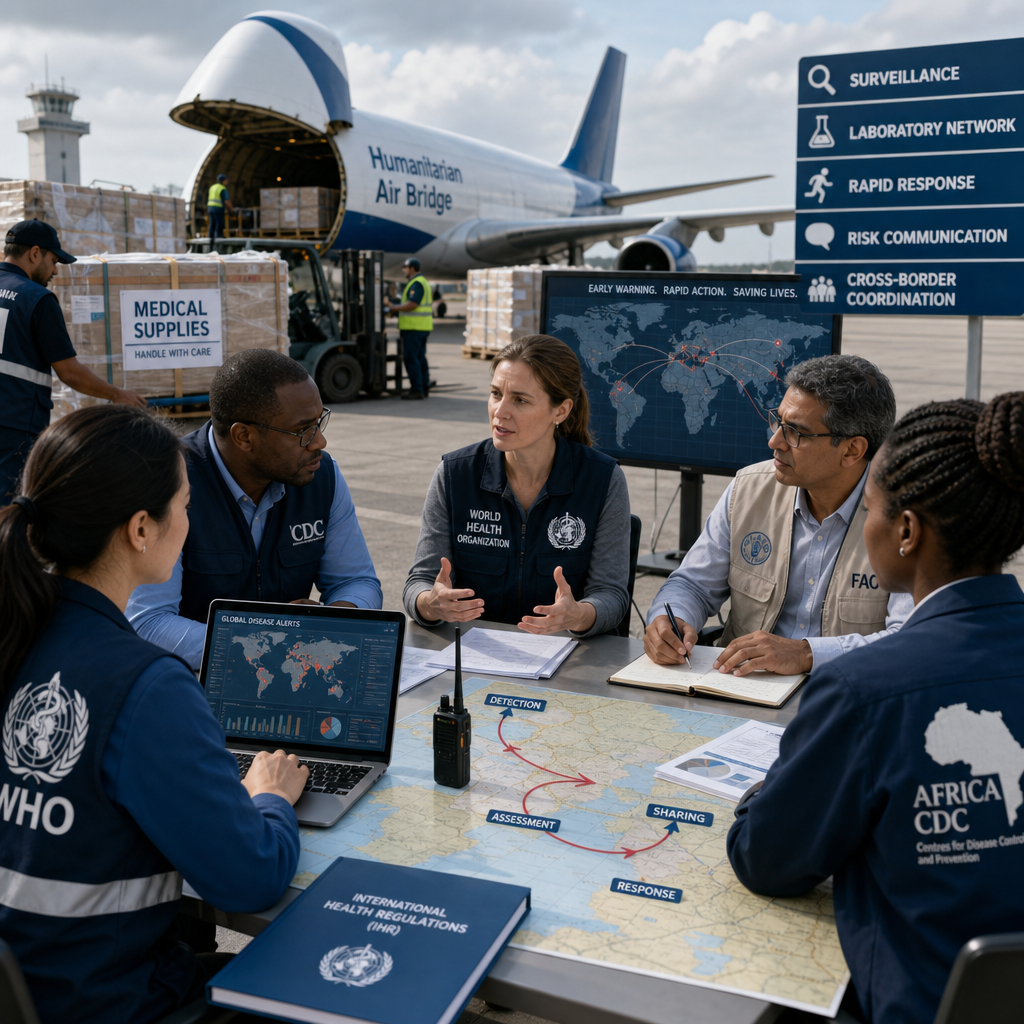
When a contagious disease begins spreading across borders, the response cannot stay local for long. Airlines, migration patterns, trade routes, and dense urban travel networks can turn a regional health event into a global concern in days. That is why how global health agencies prepare for cross-border disease outbreaks matters so much. Their work helps countries detect threats early, share information quickly, and respond in a coordinated way before an outbreak becomes a larger crisis.
These agencies do far more than issue warnings. They support surveillance systems, coordinate laboratory testing, guide public communication, and help countries build stronger health security. In a connected world, preparation is the difference between containment and chaos.
Why Cross-Border Disease Outbreaks Require Global Coordination
Diseases do not respect borders. A traveler may carry an infection before symptoms appear, and a local outbreak can spread through international travel, trade, or displaced populations. Because of that, no country can manage every threat alone.
Global health agencies help countries work together in several important ways:
Sharing real-time outbreak information
Standardizing public health guidance
Supporting laboratory confirmation and genomic analysis
Coordinating logistics for vaccines, tests, and supplies
This coordination is especially important for emerging infectious diseases, when governments may not yet understand how the pathogen spreads, how severe it is, or which interventions work best.
The Core Mission of Global Health Agencies
Organizations such as the World Health Organization (WHO), the Centers for Disease Control and Prevention (CDC), the Africa CDC, UNICEF, and regional health networks focus on reducing risk, improving preparedness, and limiting the international spread of disease. Their work often begins long before an outbreak reaches headlines.
Early Detection and Surveillance
Surveillance is the foundation of outbreak preparedness. Global health agencies monitor disease trends through:
Routine national reporting systems
Hospital and clinic surveillance
Laboratory reporting
Event-based monitoring from news, social media, and community alerts
Cross-border data-sharing platforms
Strong surveillance systems help identify unusual spikes in illness, new symptoms, or clusters of infection that may signal something more serious.
Risk Assessment and Situation Analysis
Once a potential outbreak is detected, agencies assess the risk. They ask questions such as:
How contagious is the disease?
How severe is it?
Which populations are most affected?
Are there international travel links?
Do countries have the capacity to detect and respond?
A careful risk assessment helps decision-makers prioritize resources and decide whether travel advisories, screening, or emergency support are needed.
How Global Health Agencies Prepare Before an Outbreak Starts
Preparation does not begin when an outbreak is already spreading. It starts much earlier through planning, training, and health system strengthening.
Building International Surveillance Networks
One of the most important tools for preventing cross-border spread is a strong surveillance network. Agencies help countries connect local data systems so that unusual events can be spotted quickly and compared across regions.
These networks may include:
Disease reporting platforms
Laboratory referral systems
Border health surveillance
Sentinel sites in hospitals and clinics
Event-based intelligence from trusted partners
By linking these systems, agencies can identify patterns that one country might miss on its own.
Strengthening Laboratory Capacity
Fast, accurate testing is essential during an outbreak. Global health agencies work with national laboratories to improve diagnostic capacity and quality assurance.
This includes helping labs:
Train staff on biosafety and testing protocols
Obtain equipment and reagents
Use validated diagnostic assays
Share samples for confirmation and sequencing
Improve shipping and specimen handling procedures
When a new pathogen emerges, genomic sequencing can also help trace transmission chains and detect mutations that might affect public health measures.
Training Health Workers and Emergency Teams
Preparedness also depends on skilled people. Agencies often conduct simulation exercises, workshops, and field training for:
Epidemiologists
Laboratory technicians
Border health officials
Clinicians
Emergency responders
Risk communication teams
These trainings help teams understand their roles before a crisis begins. In many cases, agencies also support field epidemiology training programs, which build long-term local expertise in outbreak detection and investigation.
Developing Emergency Response Plans
Global health agencies encourage countries to develop outbreak response plans that spell out:
Chain of command
Reporting procedures
Isolation and quarantine protocols
Laboratory workflows
Public communication strategies
Supply chain and logistics plans
A clear plan reduces confusion when a crisis hits. It also helps governments avoid overlapping responsibilities and delayed action.
How Global Health Agencies Respond During a Cross-Border Outbreak
Once an outbreak is underway, global health agencies shift from preparedness to active response. The goal is not only to slow transmission but also to help countries act with the same facts and a shared strategy.
Coordinating International Communication
During a cross-border disease outbreak, delayed or inconsistent messaging can fuel confusion and panic. Agencies work to provide trusted, evidence-based updates to governments, health workers, and the public.
Good communication includes:
Clear explanations of what is known and unknown
Practical advice for prevention and care
Guidance tailored to travelers and border communities
Updates on case counts, affected regions, and transmission risks
This communication must balance urgency with accuracy. Agencies avoid overstatement while still urging caution when needed.
Supporting Contact Tracing and Case Investigation
When an infection is confirmed, public health teams try to identify who may have been exposed. Global health agencies may assist with:
Contact tracing methods
Data management tools
Case definitions
Exposure tracking for travelers
Cross-border follow-up when contacts move between countries
For example, if a traveler is exposed in one country but develops symptoms in another, agencies help local authorities coordinate so that the contact is not lost.
Deploying Emergency Teams and Technical Experts
In many outbreaks, countries request technical support. Global health agencies may send epidemiologists, logisticians, laboratory specialists, infection prevention experts, and risk communicators to assist national teams.
These experts help with tasks such as:
Setting up case investigation systems
Improving triage and isolation procedures
Supporting sample collection and testing
Strengthening hospital infection control
Advising on border screening measures
The goal is to reinforce national capacity, not replace it.
Managing Supplies and Logistics
Outbreaks can quickly create shortages of test kits, protective equipment, medicines, and vaccines. Global health agencies often help coordinate procurement and distribution to ensure that resources go where they are needed most.
This may involve:
Forecasting supply needs
Coordinating shipments across borders
Supporting cold chain management
Prioritizing high-risk areas
Working with partners to avoid duplication
Reliable logistics are often the difference between an effective response and a stalled one.
The Role of International Health Regulations
A major part of global outbreak preparedness is the International Health Regulations (IHR), a legally binding framework that helps countries prevent, detect, and respond to public health risks that may spread internationally.
The IHR encourage countries to:
Build core public health capacities
Report events that could become international threats
Cooperate on surveillance and response
Keep travel and trade measures proportionate to the risk
Global health agencies use the IHR as a foundation for collaboration. They help countries understand their obligations, improve compliance, and strengthen national preparedness in ways that benefit everyone.
Coordinating Border Health Measures Without Disrupting Travel Unnecessarily
Cross-border outbreaks often raise concerns about airports, ports, land crossings, and migration routes. While border measures can be useful, they must be targeted and evidence-based.
When Border Screening Helps
Border screening may be useful when:
The disease has a recognizable symptom pattern
Travelers may arrive from high-risk areas
Health authorities need to provide information or referrals
Entry screening can support case finding in combination with other measures
When Border Screening Has Limits
However, border screening is not a perfect solution. Many infections spread before symptoms appear, and screening can miss asymptomatic cases. That is why agencies emphasize layered strategies rather than relying on a single intervention.
Those strategies may include:
Pre-travel and post-arrival guidance
Health declaration forms
Referral systems for symptomatic travelers
Testing and follow-up when appropriate
Coordination with airlines, ports, and transport operators
A smart border strategy protects public health without creating unnecessary barriers.
The Importance of Community Trust and Local Partnerships
Even the best technical plan fails without trust. Global health agencies know that communities play a central role in outbreak response, especially in border regions where people may cross daily for work, family, or commerce.
Working With Local Leaders
Agencies often partner with:
Community health workers
Religious leaders
Local government officials
Indigenous and migrant community representatives
Cross-border trade associations
These partners help explain public health guidance in ways that people understand and trust.
Addressing Misinformation
Outbreaks often generate rumors, fear, and misinformation. Global health agencies support communication strategies that correct false claims without dismissing public concerns. They may use radio, social media, local languages, and community forums to share practical, culturally relevant information.
How Technology Improves Cross-Border Outbreak Preparedness
Modern outbreak response increasingly depends on digital tools. Technology helps agencies detect threats faster and coordinate across distances.
Useful Digital Tools Include
Electronic disease reporting systems
Mobile contact tracing applications
Genomic sequencing databases
Dashboard-based situation reports
Secure communication tools for public health teams
These tools can speed up analysis, but they work best when countries also maintain strong human networks and clear procedures. Technology supports public health; it does not replace it.
Real-World Example: Coordinated Response in Practice
Imagine an outbreak of a respiratory illness begins in one country and then appears in a neighboring nation within a week. A traveler may have passed through several transport hubs before symptoms started.
A coordinated global response might look like this:
The first country detects unusual pneumonia cases through hospital surveillance.
The lab confirms the pathogen and shares the result with international partners.
Neighboring countries review travel history and strengthen case finding.
Global health agencies issue updated guidance for clinicians and border health staff.
Public communication teams advise travelers on symptoms and when to seek care.
Technical teams help both countries improve testing, isolation, and contact tracing.
If needed, agencies coordinate supplies, staffing, and risk assessment updates.
This kind of rapid, connected action can limit spread and give countries valuable time to respond.
What Makes a Prepared Health System More Resilient
A well-prepared system does not eliminate outbreaks, but it responds faster and more effectively. Preparedness usually depends on several long-term investments:
Strong primary care and referral systems
Trained public health workforce
Reliable laboratories
Data sharing between sectors
Emergency financing and supply chains
Public trust in health guidance
These investments also strengthen response to other emergencies, from measles resurgences to novel respiratory viruses.
Frequently Asked Questions
1. What do global health agencies do during a cross-border disease outbreak?
They help countries detect cases, share information, coordinate public health guidance, support laboratory testing, and organize emergency response activities. Their role is to strengthen national action and reduce the spread of disease between countries.
2. Why is international cooperation important during an outbreak?
International cooperation makes it easier to track the disease, follow exposed travelers, share scientific data, and deliver supplies where they are needed. Since pathogens can move quickly across borders, countries benefit when they act from the same evidence base.
3. How do agencies decide whether an outbreak is a global threat?
They assess factors such as transmission speed, severity, geographic spread, available treatments or vaccines, and whether the affected countries can control the outbreak. They also review travel patterns and the potential for broader international spread.
4. Are border screenings effective at stopping outbreaks?
Border screenings can help identify some symptomatic travelers and provide public health information, but they are not enough on their own. Many infections spread before symptoms appear, so agencies usually combine screening with testing, surveillance, communication, and case follow-up.
5. What is the International Health Regulations framework?
The International Health Regulations are an international agreement that helps countries build outbreak response capacity and report serious health events that may spread internationally. They provide a structure for cooperation, transparency, and proportional public health measures.
Cross-border disease outbreaks are one of the clearest reminders that public health is a shared responsibility. No single country can monitor every threat, test every sample, or stop every chain of transmission alone. That is why global health agencies play such a critical role: they connect surveillance systems, coordinate laboratory work, support emergency teams, and help governments communicate clearly and act quickly.
The most effective outbreak responses begin long before the first case crosses a border. They depend on strong surveillance, trained health workers, trusted communication, and international cooperation built through frameworks like the International Health Regulations. When agencies and countries work together, they can detect outbreaks earlier, respond more efficiently, and reduce disruption to travel, trade, and daily life.
Understanding how global health agencies prepare for cross-border disease outbreaks gives us a clearer view of modern health security. It also shows why preparedness is not a one-time effort but a continuous investment in systems, people, and partnerships. The more countries strengthen these foundations now, the better equipped the world will be when the next outbreak appears.
Peter B holds a degree in Journalism and has 5 years
of experience covering U.S. economic policy, labor markets, and
financial news. He writes data-driven news content on topics
like inflation, interest rates, and employment trends.