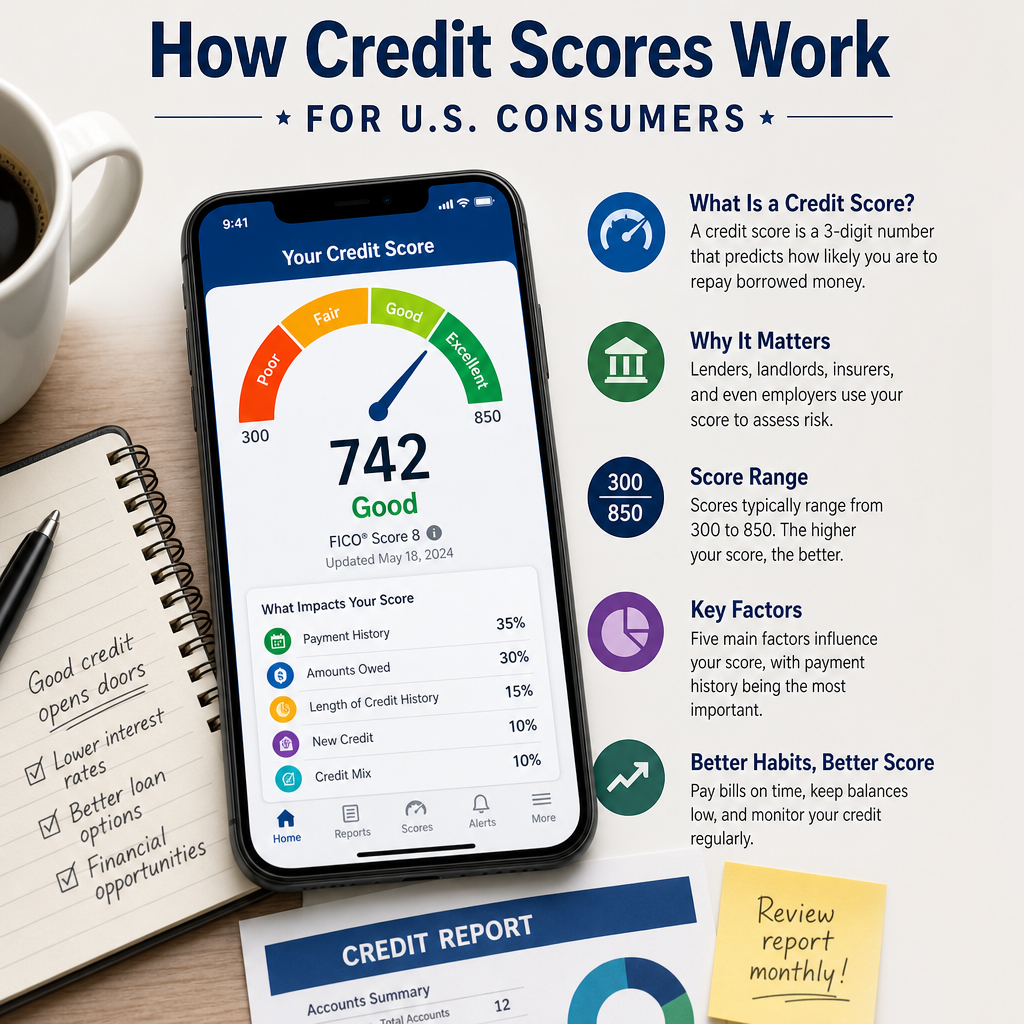
Credit scores can feel mysterious, but they’re really just a snapshot of your borrowing history and how reliably you manage credit over time. Once you understand what goes into them, credit scores become much easier to improve and use to your advantage.
By: Mary on July 23, 2026
Última atualização em: agosto 3, 2026
Understanding how credit scores work for U.S. consumers can make a major difference in everyday financial life. Whether you’re applying for a credit card, renting an apartment, financing a car, or buying a home, your credit score often shapes the options available to you. Yet many people only see the number without knowing what drives it or how to improve it.
The good news is that credit scores are not mysterious once you learn the basics. They are built from information in your credit reports, and lenders use them to estimate how likely you are to repay borrowed money. That means your score is not a judgment of your character or income. It is a snapshot of your credit behavior over time.
In this guide, we’ll break down how credit scores work, what affects them, common myths, and practical steps U.S. consumers can take to build stronger credit.
What Is a Credit Score?
A credit score is a three-digit number that summarizes your credit risk. In the U.S., scores typically range from 300 to 850, though different scoring models may use slightly different ranges.
Lenders use credit scores to answer a simple question: If this person borrows money, how likely are they to pay it back on time?
Credit scores are calculated using data from your credit reports, which are maintained by the major credit bureaus:
Equifax
Experian
TransUnion
These reports include details such as:
Open and closed credit accounts
Payment history
Outstanding balances
Credit limits
Recent credit applications
Public records in some cases
A credit score is essentially a mathematical summary of that information.
How Credit Scores Work for U.S. Consumers
To understand how credit scores work for U.S. consumers, it helps to know that scoring models look at patterns in your credit history. The most commonly used scoring model is the FICO Score, though VantageScore is also widely used.
Both models try to predict risk using similar factors, but they may weigh those factors a little differently. That is why your score can vary from one lender or bureau to another.
The Main Factors That Affect Your Score
While the exact formulas are proprietary, most credit scoring models focus on five major categories.
1. Payment History
This is usually the most important factor. Lenders want to know whether you pay bills on time.
Examples of payment behavior that can hurt your score:
Late credit card payments
Missed loan payments
Accounts sent to collections
Bankruptcy or other serious delinquencies
On-time payments, especially over a long period, help build stronger credit.
2. Credit Utilization
Credit utilization compares your revolving balances to your available credit. In simple terms, it measures how much of your credit limit you’re using.
For example:
Credit card limit: $10,000
Current balance: $2,500
Utilization: 25%
Lower utilization is usually better. Many consumers aim to keep utilization below 30%, and even lower can be favorable.
3. Length of Credit History
A longer credit history gives scoring models more information. This factor may include:
The age of your oldest account
The average age of all accounts
How long specific accounts have been open
That’s why closing an old credit card can sometimes affect your score, especially if it reduces your available credit or shortens your average account age over time.
4. Credit Mix
Having different types of credit can help, especially if you manage them responsibly. Common credit types include:
Credit cards
Auto loans
Student loans
Mortgages
Personal loans
You do not need every type of credit to have a good score. But a healthy mix can show that you can handle different repayment structures.
5. New Credit and Inquiries
When you apply for credit, lenders may check your report with a hard inquiry. Too many hard inquiries in a short period can suggest risk, especially if you are opening several accounts quickly.
Other signs of new credit activity include:
Recently opened accounts
Multiple applications in a short time
Rapid balance increases on new accounts
A few inquiries usually do not cause major damage, but frequent application activity can.
Credit Scores vs. Credit Reports
Many consumers confuse credit scores with credit reports. They are related, but not the same.
Credit Reports
Your credit report is the detailed record of your credit activity. It includes account history, balances, payment status, and other data reported by lenders.
Credit Scores
Your credit score is the number generated from the information in your credit report.
Think of it this way:
Credit report = the full story
Credit score = the summary
If your score drops unexpectedly, the first step is to check your credit reports for errors, late payments, or signs of identity theft.
Why Credit Scores Matter
Credit scores affect more than loan approvals. They can influence the cost and terms of many financial products.
A stronger score may help you:
Qualify for lower interest rates
Get approved for rental housing more easily
Receive better terms on auto loans and mortgages
Secure higher credit limits
Avoid deposits or extra fees in some situations
A lower score may still allow access to credit, but often with less favorable terms. That can increase borrowing costs over time.
Real-Life Example
Imagine two consumers applying for the same auto loan:
Consumer A has a strong credit score and a history of on-time payments.
Consumer B has several late payments and high credit card balances.
The lender may offer Consumer A a lower interest rate and better loan terms. Consumer B may still get approved, but the loan may cost more each month and over the life of the loan.
That difference is one reason credit scores matter so much.
How to Check Your Credit Score and Credit Reports
U.S. consumers should review both their credit scores and credit reports regularly. Checking your own credit does not hurt your score.
Where to Get Your Credit Reports
By federal law, you can request free credit reports from the three major bureaus through AnnualCreditReport.com. During some periods, consumers may also have access to more frequent free reports, but the official source remains the same.
When reviewing reports, look for:
Accounts you recognize
Correct payment histories
Accurate balances and credit limits
Hard inquiries you authorized
Negative items that are outdated or incorrect
Where to Find Your Credit Score
Many banks, credit card issuers, and financial apps provide free credit scores to customers. These scores are useful, but they may use a different model than a lender does.
That means it’s smart to:
Track your score over time
Focus on the trend, not just a single number
Compare the score with the credit report behind it
Common Myths About Credit Scores
There is plenty of bad advice about credit. Here are some of the most common myths.
Myth 1: Checking Your Own Score Hurts It
False. Self-checking is a soft inquiry and does not lower your score.
Myth 2: Carrying a Balance Helps Your Score
False. You do not need to carry a balance to build credit. Paying your statement balance in full each month is often the healthiest approach.
Myth 3: Closing a Credit Card Always Improves Your Score
Usually false. Closing an old card can reduce your available credit and potentially raise utilization. It may also affect your credit history.
Myth 4: You Need to Be Rich to Have Good Credit
False. Credit scores reflect how you use credit, not your income level.
Myth 5: All Credit Scores Are the Same
False. Different scoring models and credit bureaus can produce different results. A lender may see a different score than the one in your banking app.
How to Improve Your Credit Score
Improving a credit score takes time, but the process is straightforward. Focus on habits that show steady, responsible credit use.
1. Pay Every Bill on Time
On-time payment is the foundation of strong credit. Set reminders, automate payments when possible, and pay at least the minimum due before the deadline.
2. Lower Your Credit Card Balances
If your balances are high, work on reducing them. Even modest progress can help lower utilization and improve your score.
Practical ways to do this:
Pay more than the minimum
Target high-interest cards first
Use extra income or tax refunds strategically
Avoid adding new charges while paying down debt
3. Keep Older Accounts Open When Possible
If an old card has no annual fee and you can manage it responsibly, keeping it open may support your credit history and available credit.
4. Limit New Applications
Only apply for new credit when you need it. Too many applications can create unnecessary hard inquiries and signal risk.
5. Dispute Errors on Your Credit Reports
Mistakes happen. If you spot inaccurate information, dispute it with the credit bureau and the company that reported it. Common errors include:
Wrong account status
Accounts that do not belong to you
Incorrect late payment records
Duplicate collections entries
6. Build Credit Gradually
If you have little or no credit history, start small. Options may include:
A secured credit card
A credit-builder loan
Becoming an authorized user on a trusted account
A low-limit starter card used responsibly
How Long Negative Information Stays on Your Credit Report
Negative items do not remain forever. Most late payments, collections, and hard inquiries eventually age off your credit report. More serious items, such as bankruptcy, may stay longer depending on the type.
This matters because time is one of your allies in credit repair. Even if your score is low today, positive payment behavior and reduced debt can steadily improve it.
What U.S. Consumers Should Watch For
Keeping an eye on your credit means more than chasing a higher score. It also helps protect you from fraud and financial mistakes.
Watch for:
New accounts you didn’t open
Unfamiliar inquiries
Sudden score drops
Collection accounts you don’t recognize
Billing activity tied to identity theft
If something looks wrong, act quickly. Contact the lender, dispute the item, and consider placing a fraud alert or credit freeze if needed.
Practical Credit Habits That Work
Here are a few simple habits that can make a real difference:
Set up autopay for at least the minimum payment.
Review your credit card statements every month.
Keep utilization low by paying down balances before the statement closes.
Avoid applying for credit unless you have a clear reason.
Check your credit reports at least once a year.
Keep older accounts active if it makes sense.
Build savings so you can handle emergencies without relying heavily on credit.
These steps may seem small, but over time they can lead to a more stable and resilient credit profile.
Frequently Asked Questions
1. What is a good credit score for U.S. consumers?
A “good” score depends on the lender and scoring model, but generally, higher scores are better. Many lenders consider scores in the good to excellent range more favorable for loans and credit cards. Still, approval also depends on income, debt, and other factors.
2. How often should I check my credit score?
It’s a good idea to check your score regularly, especially if you are planning to apply for a loan or trying to improve your credit. Many people review it monthly through a bank, card issuer, or financial app. Also, review your credit reports at least annually.
3. Will paying off debt immediately raise my score?
It can help, especially if the debt is on credit cards and your utilization drops. The impact is not always instant, because lenders report balances on different schedules. But paying down balances is one of the most effective long-term credit habits.
4. Can I build credit without a credit card?
Yes. You can build credit with installment loans, credit-builder loans, rent reporting services in some cases, and by becoming an authorized user on another person’s account. A credit card is common, but it is not the only path.
5. Why did my credit score drop even though I paid on time?
Several things can cause a score drop, including higher credit card balances, a new hard inquiry, an account closure, or changes in how your lender reports information. Check your credit reports to identify the likely cause before assuming the drop is permanent.
Learning how credit scores work for U.S. consumers gives you more control over your financial future. A credit score is not just a number—it reflects patterns in how you borrow, repay, and manage credit over time. By understanding the main scoring factors, reviewing your credit reports, and building habits like on-time payments and low utilization, you can make steady progress toward stronger credit.
The key is consistency. You do not need perfect credit to start improving, and you do not need complicated strategies to move in the right direction. Small actions—such as paying down balances, avoiding unnecessary applications, and checking for errors—can have a meaningful impact over time.
If you are planning a major financial move, such as buying a home, financing a car, or simply trying to save on interest, now is the time to take your credit seriously. Start by reviewing your reports, understanding what affects your score, and focusing on the habits that build long-term financial confidence.
Mary S, CFP®, is a Certified Financial Planner with over 12 years of experience in personal finance, retirement planning, and wealth management. She writes educational content that helps readers understand financial concepts and make informed decisions based on reliable information.