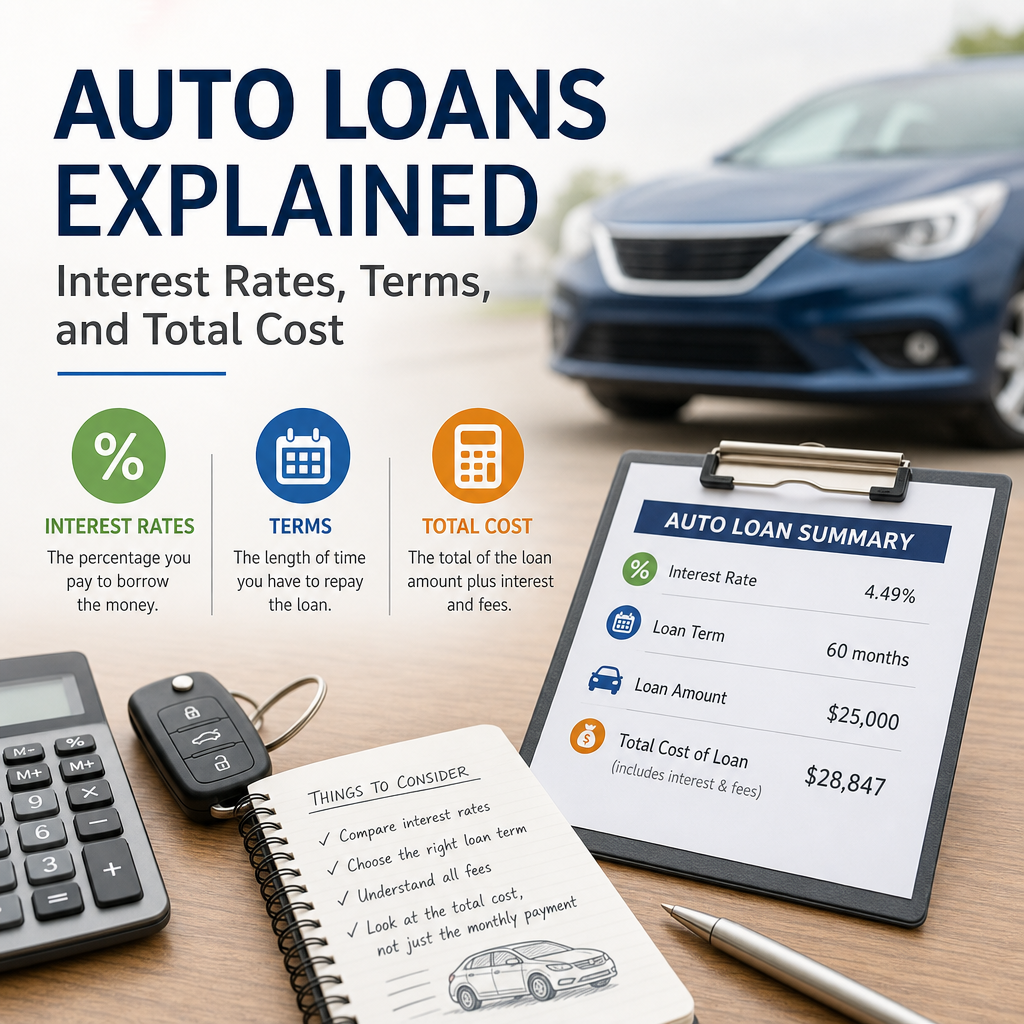
Auto Loans Explained: Interest Rates, Terms, and Total Cost
Auto loans can make buying a car more affordable upfront, but the interest rate and loan term you choose will shape your monthly payment and the total cost over time. Learn how to compare offers so you can borrow confidently and avoid paying more than you need to.
By: Mary on July 23, 2026
Última atualização em: agosto 3, 2026
Buying a car is exciting, but the financing can feel a little less straightforward. If you’re comparing dealerships, banks, and online lenders, understanding auto loans can help you make a smarter decision and avoid paying more than necessary over time. The good news is that once you understand how interest rates, loan terms, and the total cost of borrowing work together, the process becomes much easier to navigate.
This guide breaks down the basics of auto loans, explains what affects your monthly payment, and shows how to think about the full cost of a vehicle—not just the sticker price. Whether you’re shopping for a new car or a reliable used one, these fundamentals can help you borrow with confidence.
What Is an Auto Loan?
An auto loan is money borrowed to buy a vehicle, usually repaid in fixed monthly installments over a set period. The lender provides the funds upfront, and you agree to pay back the principal plus interest.
In most cases, the vehicle itself acts as collateral. That means if you don’t repay the loan, the lender can repossess the car. Because of that built-in security, auto loans often have lower interest rates than unsecured loans such as credit cards or personal loans.
Auto loans are commonly used for:
New cars
Used cars
Certified pre-owned vehicles
Some private-party purchases
In certain cases, refinancing an existing auto loan
How Auto Loan Interest Rates Work
The interest rate is the cost of borrowing money, expressed as a percentage. Even a small difference in rate can have a big impact on the total amount you pay over the life of the loan.
Lenders usually quote either:
APR (Annual Percentage Rate): Includes the interest rate plus certain loan fees
Interest rate only: The base borrowing rate without added costs
When comparing auto loans, APR is often the better number to use because it gives you a more complete picture of the cost.
What Affects Your Rate?
Lenders look at several factors when setting your auto loan rate:
Credit score and credit history
Borrowers with stronger credit typically qualify for lower rates because lenders see them as less risky.
Loan term
Longer terms may come with slightly higher rates, depending on the lender.
Vehicle age
New cars often qualify for better rates than older used vehicles.
Down payment
A larger down payment can lower lender risk and may improve your terms.
Debt-to-income ratio
Lenders want to know how much of your monthly income already goes toward debt.
Loan amount and vehicle value
If you borrow a large amount relative to the car’s value, the lender may view the loan as riskier.
Fixed vs. Variable Rates
Most auto loans have fixed rates, which means your rate and monthly payment stay the same for the full loan term. That predictability makes budgeting easier.
Variable-rate auto loans are less common. With those, the interest rate can change over time based on market conditions. If you’re financing a vehicle, fixed-rate loans are usually the more common and practical choice.
Understanding Auto Loan Terms
The loan term is the length of time you have to repay the loan, usually measured in months. Common terms include:
24 months
36 months
48 months
60 months
72 months
84 months
A longer term lowers your monthly payment, but it usually increases the total interest you pay. A shorter term raises your monthly payment but reduces the overall cost.
Example: How Term Affects Payment
Imagine two borrowers finance the same vehicle:
Loan A: 48-month term
Loan B: 72-month term
Loan B will likely have a lower monthly payment, which can make it seem more affordable. But because the money is borrowed for longer, the borrower usually pays more interest overall.
That tradeoff is one of the most important parts of auto loans to understand. A lower payment does not always mean a better deal.
Finding the Right Balance
When choosing a loan term, think about:
Your monthly budget
How long you plan to keep the car
Whether you want to pay off the loan before the vehicle loses a lot of value
How much total interest you’re willing to pay
A good rule of thumb is to choose the shortest term you can comfortably afford without straining your budget.
The Total Cost of an Auto Loan
The total cost of a car loan is more than the price of the vehicle. It includes the principal, interest, and sometimes fees. If you only focus on the monthly payment, you may miss how expensive the loan really is.
What Makes Up the Total Cost?
Here are the main components:
Vehicle price: The amount you pay for the car
Down payment: Money paid upfront, which reduces the loan amount
Interest charges: The cost of borrowing
Fees: May include origination fees, documentation fees, title fees, and registration costs
Optional add-ons: Extended warranties, gap insurance, and other products may increase the financed amount
Why Monthly Payment Can Be Misleading
A dealership may offer a payment that looks manageable, but that payment could be stretched across a longer term. For example, a lower monthly payment on a 72- or 84-month loan may cost much more over time than a slightly higher payment on a 48- or 60-month loan.
That’s why it helps to ask two questions:
What will my monthly payment be?
What will I pay in total by the end of the loan?
Both numbers matter.
How to Compare Auto Loans
Comparing auto loans goes beyond looking at the interest rate alone. The best loan is the one that fits your budget and costs the least overall.
Compare These Key Details
When reviewing offers, look at:
APR
Loan term
Monthly payment
Total interest paid
Down payment requirements
Fees and closing costs
Prepayment penalties, if any
Ask the Lender These Questions
Before signing, ask:
Is the APR fixed or variable?
Are there any origination or documentation fees?
Is there a penalty for paying off the loan early?
Does the rate depend on enrolling in automatic payments?
Are there discounts for existing customers or members?
Getting answers in writing can help you avoid surprises later.
Factors That Can Lower Your Auto Loan Cost
There are several practical ways to reduce the cost of financing a vehicle.
Improve Your Credit Before Applying
A better credit profile may qualify you for a lower APR. If you have time before buying, you can strengthen your application by:
Paying bills on time
Reducing credit card balances
Correcting errors on your credit report
Avoiding new debt before applying
Make a Larger Down Payment
A bigger down payment can reduce how much you borrow, which lowers both your monthly payment and the interest you pay over time.
Choose a Shorter Term
If your budget allows, a shorter term can save you money. You’ll pay off the car faster and reduce the total interest charged.
Shop Around
Don’t accept the first offer you receive. Compare rates from:
Banks
Credit unions
Online lenders
The dealership’s financing department
Some buyers find better rates through credit unions or preapproval from a bank before heading to the dealership.
Consider a Less Expensive Vehicle
It may sound obvious, but choosing a lower-priced car can have a huge impact on your financing. The less you borrow, the less interest you pay.
Dealership Financing vs. Bank or Credit Union Loans
Many buyers assume dealership financing is automatically the best option, but that’s not always true.
Dealership Financing
Dealerships often work with multiple lenders and can offer convenient one-stop shopping. In some cases, manufacturers also provide promotional rates on new vehicles.
Potential advantages:
Fast and convenient
May offer promotional APRs
Can be easier for buyers with different credit profiles
Potential drawbacks:
The offered rate may not be the lowest available
Loan terms may include added fees or optional products
You may feel pressured to make quick decisions
Bank or Credit Union Financing
Getting preapproved by a bank or credit union can help you know your budget before you shop. Credit unions, in particular, may offer competitive rates to qualified members.
Potential advantages:
Clear terms before you visit the dealership
Often competitive rates
Easier comparison shopping
Potential drawbacks:
May require membership or account setup
Approval may take more time than dealership financing
A smart strategy is to compare both. Preapproval gives you leverage and helps you recognize whether the dealership’s offer is actually competitive.
Common Auto Loan Mistakes to Avoid
Even well-prepared buyers can make financing mistakes. Avoiding these pitfalls can save you money and stress.
Focusing Only on the Monthly Payment
A low payment can hide a long loan term or high interest rate. Always look at the total cost.
Financing Too Much
Rolling taxes, fees, warranties, and add-ons into the loan increases the amount you pay interest on. If possible, keep the loan amount as close to the car’s price as you can.
Ignoring the APR
Two loans with the same monthly payment can cost very different amounts if the APRs are different.
Skipping Preapproval
Preapproval helps you shop with confidence and compare offers more effectively.
Overlooking the Vehicle’s Value
It’s easy to borrow more than the car is worth, especially with long terms and small down payments. That can create problems if you need to sell or trade in the vehicle later.
How to Estimate the Real Cost of an Auto Loan
You don’t need to be a math expert to estimate what a loan will cost. A few simple steps can help.
Step 1: Identify the Loan Amount
Start with the purchase price, then subtract:
Down payment
Trade-in value
Any rebates or incentives
Add in taxes and fees if they’ll be financed.
Step 2: Look at the APR and Term
These two numbers drive the loan’s cost. Higher APRs and longer terms usually mean more interest paid.
Step 3: Use an Auto Loan Calculator
An auto loan calculator can help you estimate:
Monthly payment
Total amount repaid
Total interest paid
Even a basic calculator can show how changing the term or down payment affects the outcome.
Step 4: Compare Scenarios
Try adjusting one variable at a time:
What if you borrow $2,000 less?
What if you choose a 60-month term instead of 72 months?
What if your APR is one percentage point lower?
Small changes can make a meaningful difference.
When Refinancing an Auto Loan Makes Sense
If you already have a car loan, refinancing may help lower your rate or monthly payment. Refinancing means replacing your current loan with a new one, ideally with better terms.
Refinancing may be worth considering if:
Your credit has improved since you bought the car
Interest rates have dropped
Your current monthly payment is too high
You want to change the loan term
However, refinancing is not always the best option. Fees, remaining loan balance, and the car’s age and mileage all matter. Make sure the numbers actually improve your position before moving forward.
Practical Example: Comparing Two Loan Offers
Let’s say you’re financing a $25,000 car.
Offer 1
APR: 5.5%
Term: 60 months
Lower total interest
Higher monthly payment
Offer 2
APR: 6.0%
Term: 72 months
Lower monthly payment
Higher total interest
Offer 2 may feel easier on your monthly budget, but over time it could cost more. If you can afford Offer 1, it may be the better long-term choice.
This is why it’s so important to look at the whole picture when evaluating auto loans.
Frequently Asked Questions
What credit score do I need for an auto loan?
There is no single minimum score for every lender. Some lenders work with borrowers who have lower credit scores, while others prefer stronger credit profiles. In general, better credit can improve your chances of getting a lower interest rate and more favorable terms.
Is a shorter auto loan term always better?
Not always, but it usually reduces the total interest you pay. The tradeoff is a higher monthly payment. A shorter term makes sense if you can afford the payment comfortably and want to pay off the car faster.
Should I make a down payment on a car loan?
A down payment is usually a good idea. It reduces the amount you borrow, which can lower your monthly payment and total interest. It may also help you avoid owing more than the vehicle is worth early in the loan.
Can I pay off an auto loan early?
Often yes, but you should confirm whether your loan includes a prepayment penalty. Many lenders allow early payoff without a fee, but it’s important to check the contract before making extra payments or paying off the loan in full.
Is dealership financing better than a bank loan?
It depends on the offer. Dealership financing can be convenient and may include promotional rates, but banks and credit unions sometimes offer more competitive terms. The best approach is to compare multiple offers before deciding.
Understanding auto loans gives you a major advantage when it’s time to buy a vehicle. The monthly payment may be the first number that catches your eye, but it should never be the only one you consider. Interest rates, loan terms, fees, and down payment all work together to determine the true cost of financing.
If you compare APRs carefully, choose a term that fits your budget, and pay attention to the total amount repaid, you’ll be in a much better position to make a confident decision. Shopping around, getting preapproved, and avoiding unnecessary add-ons can also help you keep borrowing costs under control.
A car loan is a financial commitment, but it doesn’t have to be confusing. With the right information and a clear plan, you can choose auto loans that support your needs today without creating problems tomorrow. The more you understand before signing, the more likely you are to drive away with a deal that truly works for you.
Mary S, CFP®, is a Certified Financial Planner with over 12 years of experience in personal finance, retirement planning, and wealth management. She writes educational content that helps readers understand financial concepts and make informed decisions based on reliable information.