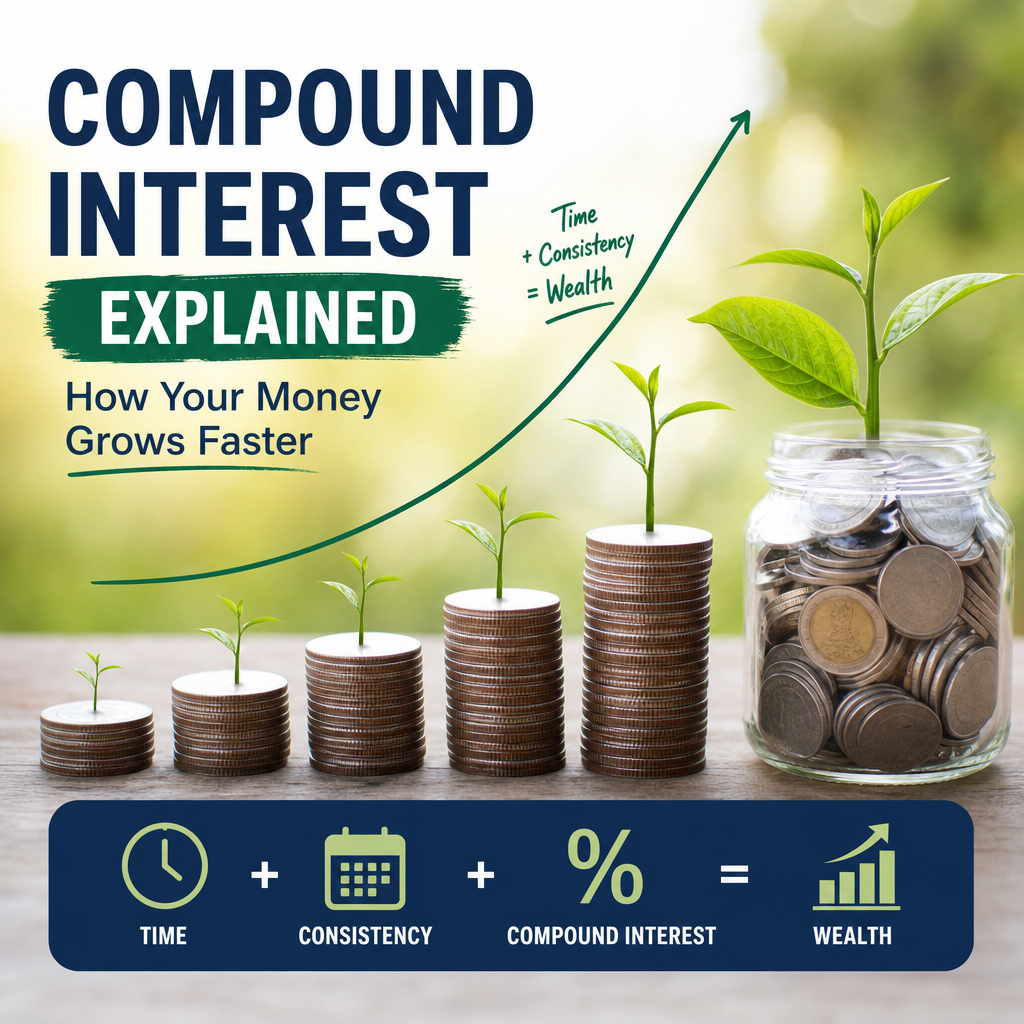
Compound Interest Explained: How Your Money Grows Faster
Compound interest can make your savings grow faster by earning interest on both your original money and the interest it has already earned. The earlier you start, the more time your money has to build on itself and snowball over time.
By: Mary on July 23, 2026
Última atualização em: agosto 3, 2026
Understanding compound interest is one of the simplest ways to make smarter money decisions. Whether you’re saving for an emergency fund, retirement, a home, or your child’s education, compound interest can help your money grow faster over time than simple interest ever could. The idea is easy to grasp, but the long-term impact can be powerful.
If you’ve ever wondered why financial experts talk so much about starting early, this is the reason. Compound interest rewards time, consistency, and patience. The earlier you begin, the more your money has the chance to build on itself.
What Is Compound Interest?
Compound interest is interest earned on both your original money and the interest that has already been added. In other words, your money starts earning money, and then that money starts earning money too.
That’s different from simple interest, which only pays interest on the amount you originally invested or deposited.
Simple Example of Compound Interest
Let’s say you put $1,000 into an account that earns 5% interest annually.
Year 1: You earn $50, bringing the total to $1,050
Year 2: You earn 5% on $1,050, not just the original $1,000
Year 3: You earn interest on an even larger balance
The balance grows a little faster each year because interest keeps getting added to the principal.
How Compound Interest Works Over Time
Compound interest becomes most powerful when time is on your side. At first, the growth may seem slow. But as the account balance increases, each interest payment becomes larger, which can speed up growth.
This is why people often say compound interest has a “snowball effect.” A small snowball rolling downhill picks up more snow and grows larger. Your money works the same way.
The Key Parts of Compound Interest
To understand compound interest, it helps to know the main terms:
Principal: The original amount of money you save or invest
Interest rate: The percentage earned over a set period
Compounding frequency: How often interest is added, such as daily, monthly, quarterly, or annually
Time: The length of time your money stays invested or saved
The more often interest compounds, the more quickly your balance can grow, assuming all other factors stay the same.
Why Time Matters So Much
Time is one of the biggest drivers of compound growth. A person who starts investing at 25 usually has a much bigger advantage than someone who starts at 35, even if the second person contributes more later.
Why? Because the earlier investor gives the money more years to compound.
For example:
A small monthly deposit starting in your 20s can grow significantly by retirement
Waiting just 10 years can reduce long-term growth more than many people expect
Consistency often matters more than investing a large amount all at once
Compound Interest Explained with a Real-Life Savings Example
Let’s look at a practical scenario.
Imagine you save $200 per month in an account earning an average annual return of 6%, compounded monthly.
At first, the growth is mostly driven by your contributions. But over time, the interest starts contributing more and more to the balance. After several years, the growth from compounding can become a meaningful part of your total savings.
This example shows an important lesson: compound interest works best when paired with regular deposits.
The Power of Regular Contributions
You don’t need a huge lump sum to benefit from compounding. Even modest, consistent deposits can make a real difference.
A few helpful habits include:
Setting up automatic transfers to savings or investments
Increasing contributions when your income rises
Reinvesting earnings instead of withdrawing them
Avoiding unnecessary account fees that reduce your returns
Small steps repeated over time can create strong results.
Compound Interest in Savings vs. Investments
Compound interest shows up in both savings accounts and investment accounts, but the experience is a little different in each.
In Savings Accounts
In a savings account, compound interest is usually lower and more predictable. These accounts are designed to protect your money while offering modest growth. They’re useful for:
Emergency funds
Short-term goals
Money you may need soon
The growth is steady, but usually limited compared with investments.
In Investment Accounts
In investment accounts, compounding can be much more powerful because returns may be higher over the long run. This includes:
401(k) plans
Traditional and Roth IRAs
Brokerage accounts
Index funds and mutual funds
With investing, compounding may happen through dividends, capital gains, and reinvested earnings. The tradeoff is risk: investments can rise and fall in value.
Which One Is Better?
Neither is automatically better. It depends on your goal:
Use savings for safety and liquidity
Use investments for long-term growth
Many people benefit from using both. A healthy financial plan often includes an emergency savings fund plus long-term investment accounts.
Why Compound Interest Is So Powerful for Long-Term Goals
Compound interest works best when you can leave money untouched for a long time. That makes it especially useful for long-term goals like retirement planning, education savings, or wealth building.
Retirement Saving
Retirement accounts are one of the best places to benefit from compounding. If you contribute regularly and reinvest earnings, your balance can grow over decades.
Employer matching in a 401(k) can make the effect even stronger because it adds extra money to your account.
Education Savings
A 529 plan can also benefit from compounding when contributions are made early and left to grow. Starting sooner gives the money more time to build value before college expenses arrive.
Building Wealth
Compounding is not just for retirement accounts. It can also help with:
Building a down payment fund
Growing taxable investment accounts
Reinvesting dividends
Increasing the value of your savings over time
The common thread is patience. Wealth building rarely happens overnight, but compound interest makes steady growth more realistic.
What Affects Compound Interest Growth?
Several factors influence how fast your money grows through compounding.
1. Interest Rate or Rate of Return
A higher rate generally means faster growth. Even a small difference in rate can matter a lot over many years.
2. Compounding Frequency
Interest that compounds monthly or daily may grow faster than interest compounded annually, because earnings are added more often.
3. Time Horizon
The longer your money stays invested or saved, the more time it has to compound.
4. Contribution Amounts
Regular deposits increase the principal, which increases future interest or earnings.
5. Fees and Taxes
Costs can slow down growth. Account fees, fund expense ratios, and taxes may reduce what you keep. That’s why low-cost options often matter.
Compound Interest vs. Simple Interest
It helps to compare compound interest and simple interest side by side.
Simple Interest
Simple interest is calculated only on the original principal. It’s straightforward, but growth is limited.
Example:
$1,000 at 5% simple interest earns $50 every year
After 3 years, you would earn $150 total
Compound Interest
Compound interest is calculated on the principal plus accumulated interest.
Example:
$1,000 at 5% compounded annually grows faster than simple interest
Each year, the interest earned increases because the balance is larger
Main Difference
Simple interest is linear. Compound interest is exponential. That’s why compounding can create a bigger gap over time.
How to Make Compound Interest Work for You
You don’t need to be a financial expert to benefit from compounding. A few smart habits can help you get started.
Start Early
The earlier you begin, the more time your money has to grow. Even small amounts can become meaningful when given enough years.
Be Consistent
Regular contributions matter. Set a schedule you can stick with and automate it if possible.
Reinvest Earnings
If your account pays dividends or interest, reinvesting those earnings can strengthen the compounding effect.
Keep Fees Low
Fees reduce the amount left to compound. Look for cost-effective accounts and investments when possible.
Stay Invested Through Market Ups and Downs
For long-term investing, staying invested can help compounding do its job. Emotional reactions to short-term market changes can interrupt growth.
Common Mistakes That Reduce Compound Growth
Compound interest can work in your favor, but a few habits can slow it down.
Withdrawing Too Early
When you take money out too soon, you stop the compounding process and lose future growth potential.
Ignoring Fees
A small fee might not seem like much, but over time it can meaningfully reduce returns.
Waiting Too Long to Start
Delay is one of the biggest missed opportunities in personal finance. The cost of waiting is often greater than people realize.
Only Saving the Minimum
While starting small is better than not starting at all, increasing your contributions over time can make a major difference.
A Simple Rule of Thumb for Everyday Savers
You don’t need complex math to appreciate compound interest. A useful mindset is this:
Save or invest regularly
Leave the money alone as long as your goal allows
Reinvest earnings when possible
Keep costs low
Give it time
That combination is what allows compounding to do its best work.
Compound Interest and Financial Literacy
Learning about compound interest is a key part of building financial literacy. It helps you understand not just how money grows, but how choices today can shape your future.
This knowledge can improve decisions about:
Saving for emergencies
Paying off debt
Investing for retirement
Setting realistic financial goals
The more you understand how money grows, the more confidently you can plan.
Frequently Asked Questions
1. What is compound interest in simple terms?
Compound interest is interest earned on both your original money and the interest already added to it. Over time, this can help your balance grow faster than simple interest.
2. Why is compound interest so important?
Compound interest matters because it can significantly increase the value of savings and investments over time. The earlier you start, the more time your money has to grow.
3. Does compound interest only apply to savings accounts?
No. Compound interest also applies to many investment accounts, including retirement plans and funds that reinvest earnings. It can also apply to debt, which is why credit card balances can grow quickly.
4. How often does compound interest get added?
It depends on the account or investment. Interest may compound daily, monthly, quarterly, or annually. More frequent compounding can lead to faster growth.
5. How can I benefit most from compound interest?
Start early, contribute regularly, reinvest earnings, and keep fees low. Most importantly, give your money time to compound without frequent withdrawals.
Compound interest is one of the most useful concepts in personal finance because it shows how money can grow through time, consistency, and reinvestment. Whether you’re building an emergency fund, saving for a major purchase, or investing for retirement, understanding compound interest can help you make better decisions and avoid missed opportunities.
The main lesson is simple: start as early as you can, contribute as often as you can, and give your money time to work. Even small amounts can grow into something meaningful when compounding has years to do its job. On the other hand, delay, withdrawals, and high fees can weaken the effect.
If you want to improve your financial future, compound interest is a great place to begin. Once you understand how it works, you can use it intentionally to support your goals and build lasting momentum.
Mary S, CFP®, is a Certified Financial Planner with over 12 years of experience in personal finance, retirement planning, and wealth management. She writes educational content that helps readers understand financial concepts and make informed decisions based on reliable information.