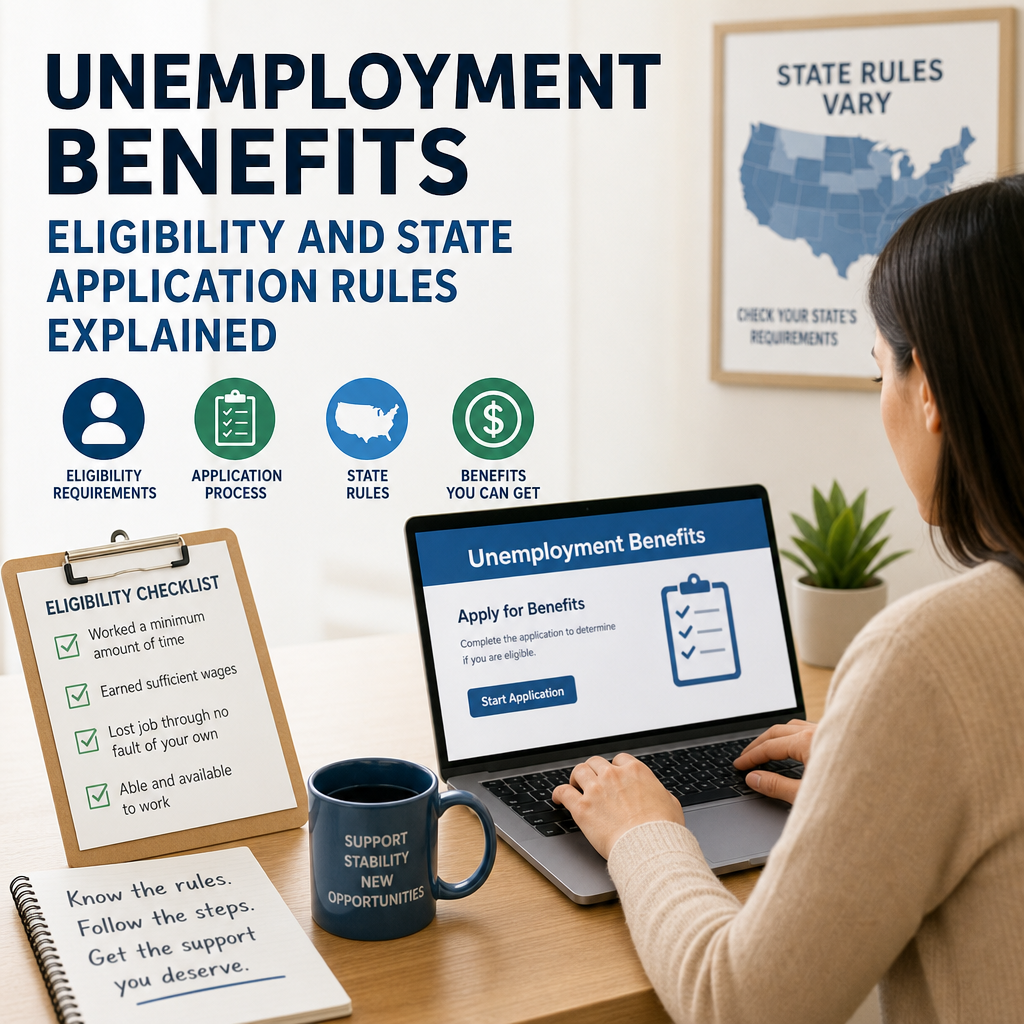
Unemployment Benefits Eligibility and State Application Rules Explained
Unemployment benefits can offer temporary relief when you lose your job, but qualifying isn’t automatic. Learn the basic eligibility requirements and state application rules so you can file correctly and avoid delays.
By: Emilly on July 23, 2026
Última atualização em: agosto 3, 2026
Losing a job can feel overwhelming, especially when bills keep coming and the next paycheck is uncertain. That’s where unemployment benefits can make a real difference. These benefits are designed to provide temporary financial support while you look for new work. But the rules are not the same everywhere, and understanding eligibility and state application rules is essential if you want to avoid delays or denials.
In this guide, we’ll break down how unemployment benefits work, who may qualify, what state agencies usually require, and how to apply successfully. If you’ve recently lost work or think you may need help soon, knowing the basics now can save time and frustration later.
What Are Unemployment Benefits?
Unemployment benefits are payments made by state workforce agencies to eligible workers who lose their jobs through no fault of their own. In most cases, these benefits replace part of your lost wages for a limited time while you search for new employment.
Although states administer the program, unemployment insurance is funded through employer payroll taxes. That means your state’s department of labor or workforce agency handles the claims, reviews eligibility, and issues payments.
What unemployment benefits usually cover
Unemployment benefits are meant to help with short-term financial stability. They are not a full replacement for your income, but they can help with essentials such as:
Rent or mortgage payments
Groceries and utilities
Transportation costs
Job-search expenses
Basic household bills
Some states also offer additional support programs, such as job training or career placement services, which may be connected to your claim.
Basic Eligibility for Unemployment Benefits
While every state has its own rules, most unemployment benefits programs use the same general eligibility standards. You usually must meet all or most of the following requirements.
1. You lost your job through no fault of your own
This is one of the most important rules. In general, you may qualify if you were laid off, your position was eliminated, or your employer reduced staff.
You may not qualify if you were fired for serious misconduct or quit without a good work-related reason. However, some exceptions exist, and state agencies often review these situations case by case.
2. You earned enough wages during your base period
Most states look at your recent work history using a “base period,” which is usually the first four of the last five completed calendar quarters before you file your claim. During that period, you must have earned enough wages to qualify.
States use different wage thresholds, but the idea is the same: you need sufficient recent earnings to show that you were attached to the workforce.
3. You are able, available, and actively seeking work
To keep receiving unemployment benefits, you generally must:
Be physically and mentally able to work
Be available to accept suitable work
Look for work each week
Keep records of your job-search efforts
If you cannot work because of illness, injury, caregiving responsibilities, or school schedules that limit availability, you may not meet this requirement.
4. You meet your state’s ongoing filing rules
Eligibility does not end after your first approval. Most states require you to certify your claim weekly or every two weeks. During certification, you usually confirm:
Whether you worked during the week
Whether you earned any income
Whether you searched for work
Whether you were available for suitable jobs
If you miss a certification deadline, payments may stop until you reopen or reactivate your claim.
How State Application Rules Work
Because unemployment insurance is run by the states, the application process can vary widely. The core steps are similar, but the details depend on where you live.
Start with your state workforce agency
You must apply through the unemployment office in the state where you worked, or in some cases, the state where you earned wages covered by unemployment insurance. Each state has its own online portal, phone system, or local office process.
When you apply, be ready to provide:
Your full legal name
Social Security number
Mailing address and contact information
Employment history for the past 12 to 18 months
Names, addresses, and phone numbers of past employers
The reason you are no longer working
Bank account details for direct deposit, if available
Apply as soon as you become unemployed
Do not wait too long to file. In many states, benefits are not paid retroactively for weeks before your claim begins unless you have a valid reason for delay. If you were laid off, file as soon as possible after your last day of work.
Respond quickly to state requests
After you apply, your state agency may ask for additional documents or clarification. Common requests include:
Proof of identity
Pay stubs
Separation paperwork
Immigration or work authorization documents, if relevant
Job-search records
If you ignore requests, your claim could be delayed or denied.
Watch for employer notices and appeals
Your former employer may also be asked to confirm the reason for your separation. If the employer disputes your claim, the state may schedule a hearing or request more evidence. If your claim is denied, you usually have the right to appeal within a strict deadline.
Common Reasons Claims Are Delayed or Denied
Even if you believe you qualify, small mistakes can affect your case. Understanding common problems can help you avoid them.
Incomplete or incorrect application information
A misspelled employer name, wrong dates, or missing contact information can slow down processing. Double-check every detail before submitting your claim.
Not meeting the base period wage requirement
Some people assume any recent work history is enough, but states often require a minimum amount of wages. If your earnings were too low or too limited, you may not qualify under standard rules.
Quitting without a qualifying reason
If you quit for personal reasons, you may be denied. That said, some resignations are still considered valid if you left for a compelling work-related reason, such as unsafe working conditions, harassment, unpaid wages, or a major change in job duties.
Refusing suitable work
Once you receive unemployment benefits, you generally must accept suitable work if it is offered. Turning down a reasonable job without good cause can affect your eligibility.
Failing to certify or report income
If you work part-time while receiving benefits, you usually must report your earnings. Failing to do so can result in overpayments, penalties, or fraud investigations.
How to Apply for Unemployment Benefits Step by Step
The process is straightforward if you prepare ahead of time. Here’s a practical overview.
1. Gather your documents
Before filing, collect the information your state will likely need:
Photo ID or government-issued identification
Social Security number
Work history for the past 12 to 18 months
Reason for separation from each employer
Bank account or debit card information for payment
Immigration or work authorization documents, if required
2. File your initial claim
Submit your application through your state’s unemployment website or filing system. Many states encourage online filing because it is faster and leaves a record of your submission.
3. Wait for a determination
After processing your claim, the state will send a determination notice explaining whether you qualify, how much you may receive, and how long benefits may last.
4. Certify on schedule
If approved, file your weekly or biweekly certifications on time. This step is essential to keep payments coming.
5. Track your job search
Many states require you to document your work search activities. Keep a simple log with:
Company names
Dates of applications
Job titles
Contact methods
Interview appointments
Follow-up actions
This makes it easier to respond if the state requests proof.
Special Situations That Can Affect Eligibility
Not every unemployment claim fits the standard model. State rules often include exceptions for unique situations.
Part-time workers
If you worked part-time before losing your job, you may still qualify if you earned enough during the base period. Some states also allow partial benefits if you are working reduced hours.
Seasonal workers
Seasonal employment rules vary widely. Some workers in agriculture, education, tourism, or construction may face limits depending on how their jobs are classified under state law.
Gig workers and independent contractors
Traditional unemployment insurance usually does not cover independent contractors, freelancers, or many gig workers. However, special federal programs have existed in certain circumstances, and some states have separate assistance options. Because rules change, check your state agency’s current guidance.
Workers who relocate
If you move to a different state after losing your job, you may still be able to file a claim depending on where you earned wages and which state has jurisdiction. This is called an interstate claim in many cases.
Tips to Strengthen Your Unemployment Claim
A little preparation can improve your chances of a smooth experience.
Keep good records
Save copies of:
Pay stubs
Separation letters
Claim confirmations
Weekly certifications
Job applications
Appeal notices
These records can help if there is a dispute later.
Be honest and consistent
Always give accurate information about why you left your job, whether you worked during a week, and whether you received other income. Inconsistencies can trigger delays or overpayment notices.
Read every notice carefully
State unemployment agencies often send important instructions by mail or online account messages. Missing a deadline can cost you benefits.
Use your state’s official resources
Each state has an unemployment website with up-to-date instructions, filing systems, and FAQ pages. Since rules change, official state guidance is usually the most reliable source.
Understanding Appeals and Overpayment Issues
If your claim is denied, you may be able to appeal. If you are later told you were overpaid, you may also have options.
Appeals
Appeal rights usually come with a time limit, often measured in days, not weeks. If you receive a denial, act quickly. In an appeal, you may need to provide:
Employment records
Pay information
Communication with your employer
Witness statements
A clear explanation of why you qualify
Overpayments
An overpayment happens when you receive more benefits than you should have. This can occur because of:
Reporting errors
State processing mistakes
A later change in eligibility
Failure to report work or income
If you receive an overpayment notice, do not ignore it. Read the letter carefully, verify the amount, and ask whether you can appeal, request a waiver, or set up a repayment plan.
Frequently Asked Questions
1. How long can I receive unemployment benefits?
The length of time you can receive unemployment benefits depends on your state and your earnings history. Many states offer a limited number of weeks of regular benefits. During periods of high unemployment or emergency legislation, additional weeks may be available, but those programs are not permanent.
2. Can I collect unemployment if I was fired?
Maybe. If you were fired for reasons other than misconduct, you may still qualify. State agencies usually look at the facts closely. If the firing was due to poor performance, layoffs, or a business decision, you may be eligible. If it involved serious policy violations, you may be denied.
3. What if I quit my job for a good reason?
Some states allow benefits if you quit for a good cause related to work, such as unsafe conditions, harassment, unpaid wages, or a major change in job duties. Personal reasons alone usually do not qualify. The key is whether the reason meets your state’s legal standard.
4. Do I have to keep looking for work while collecting benefits?
Yes, in most cases you must actively search for work and be able and available to accept a suitable job. States often require weekly job-search activities and proof if asked. Failing to look for work can cause you to lose benefits.
5. Can part-time work affect my unemployment benefits?
Yes. If you earn money while receiving benefits, you usually must report it. Some states reduce your payment based on part-time earnings rather than stopping benefits entirely. Always report income honestly so you avoid overpayments.
Understanding unemployment benefits can make a difficult transition a little easier. The most important things to remember are simple: apply quickly, answer every question honestly, and follow your state’s filing and certification rules closely. Even though the basic framework is similar across the country, state application rules can differ in important ways, including wage requirements, deadlines, job-search expectations, and appeals procedures.
If you recently lost work, take time to gather your documents, review your state’s official guidance, and submit your claim as soon as possible. Staying organized can help you avoid delays and reduce the risk of denied payments or overpayment problems later. Just as important, keep tracking your job search and reading every notice you receive from the unemployment office.
The more familiar you are with the process, the more confident you can be when filing your claim. Use this knowledge as a starting point, then rely on your state agency’s official resources for the most current rules.
Emily A, holds a Master's degree in Public Administration (MPA) and has over 7 years of experience researching federal and state assistance programs. She writes educational content focused on government benefits, public policy, and community resources, using information from official agencies to help readers understand available programs and eligibility requirements.