2026 Global Economic Outlook: Growth, Inflation, and Major Risks
The 2026 global economic outlook is shaping up to be a story of cautious recovery, uneven growth, and persistent uncertainty. After several years marked by inflation shocks, higher interest rates, geopolitical tensions, and supply chain disruptions, the world economy is entering 2026 with more stability than before—but not enough to call the environment risk-free.
Businesses, investors, and policymakers are all asking the same questions: Will growth hold up? Will inflation keep cooling? And which risks could disrupt the recovery? The answer depends on how well major economies balance slower price increases, more selective central bank policy, resilient labor markets, and a still-fragile global trade system.
This article breaks down the 2026 global economic outlook in practical terms, including expected growth trends, inflation dynamics, and the biggest risks to watch.
Understanding the 2026 Global Economic Outlook
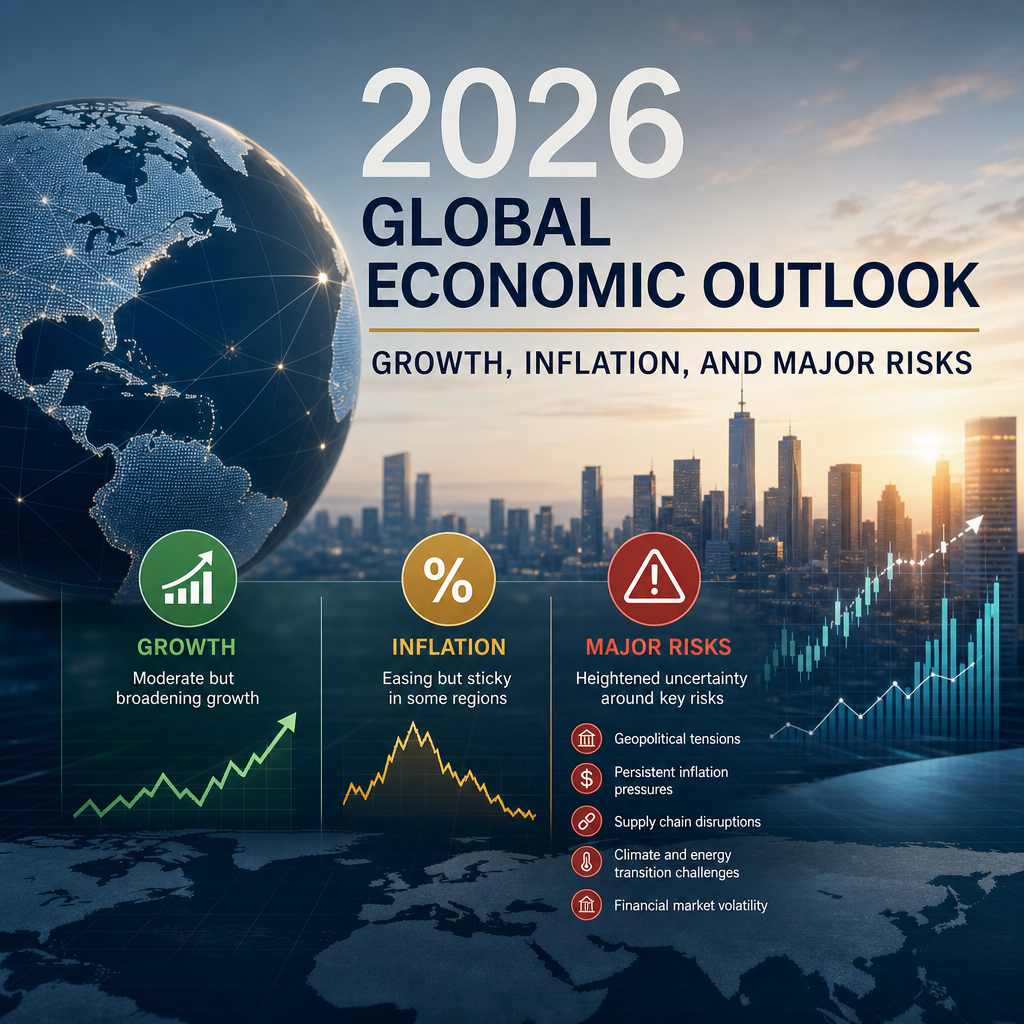
The global economy in 2026 is likely to remain in a transition phase. Many countries have moved past the sharp inflation spikes of earlier years, but the aftereffects still matter. Higher borrowing costs continue to affect housing, consumer spending, and business investment. At the same time, governments are dealing with debt pressures, aging populations, and energy transition costs.
A useful way to think about the 2026 global economic outlook is to separate it into three layers:
- Growth conditions — How fast major economies are expanding.
- Inflation trends — Whether price pressures are becoming more manageable.
- Risk factors — What could derail the recovery.
This framework helps investors and business leaders focus on what matters most instead of reacting to every short-term headline.
Global Growth in 2026: Slow but Broadening
Advanced Economies May Grow Modestly
In 2026, advanced economies such as the United States, the euro area, Japan, and the United Kingdom are expected to continue growing, but likely at a moderate pace. Growth in these regions is being supported by stable employment, cooling inflation, and improving real wages in some sectors.
That said, several factors could keep growth from accelerating too quickly:
- Elevated interest rates are still filtering through the economy
- Consumer spending remains selective
- Business investment is uneven
- Government budgets face tighter constraints
The upside is that many developed economies appear more resilient than they did during past tightening cycles. Strong labor markets and healthier household balance sheets in some countries may help cushion the slowdown.
Emerging Markets May Lead Growth, But Not Uniformly
Emerging markets are likely to remain a major source of global growth in 2026, though performance will vary widely by region. Countries with strong domestic demand, credible monetary policy, and relatively stable political conditions may outperform.
Some economies may benefit from:
- Supply chain diversification
- Digital infrastructure investment
- Rising services exports
- Population growth and urbanization
Others may struggle with currency volatility, capital outflows, food and energy import costs, or political instability. In the 2026 global economic outlook, emerging markets are not one story—they are many.
China and the Global Ripple Effect
China’s economic direction continues to matter for the entire world. Slower property-sector growth, demographic pressures, and weaker consumer confidence have changed China’s pace of expansion compared with earlier decades.
Even so, China remains central to global manufacturing, commodity demand, and trade flows. If domestic demand improves in 2026, it could support exporters across Asia, Latin America, and parts of Africa. If not, weaker Chinese demand could weigh on metals, energy, and industrial supply chains.
Inflation in 2026: Cooling, But Not Gone
Why Inflation May Continue to Ease
The inflation story in 2026 is more favorable than in the peak post-pandemic period. Supply chains have largely normalized, energy prices are less volatile than before, and many central banks have already tightened policy significantly.
As a result, inflation in many countries may continue to trend closer to target ranges. Lower goods-price inflation and softer demand in some sectors could help bring overall price growth down further.
Several forces are helping:
- Improved logistics and inventory management
- Slower demand growth in interest-sensitive sectors
- Easier year-over-year comparisons
- More disciplined wage growth in some industries
Why Inflation May Still Be Sticky
Even with broad progress, inflation may remain stubborn in certain areas. Services inflation, housing-related costs, insurance, healthcare, and wages can all keep headline numbers from falling quickly.
This is important because the 2026 global economic outlook is not just about whether inflation falls—it is about whether it falls enough to restore purchasing power without forcing policymakers into another round of aggressive tightening.
Key sources of stickiness include:
- Labor shortages in some sectors
- Geopolitical energy disruptions
- Food price shocks from climate-related events
- Continued pass-through from earlier cost increases
Central Banks May Stay Careful
Central banks are likely to remain cautious in 2026. If inflation falls too slowly, they may hesitate to cut rates aggressively. If growth weakens faster than expected, they may need to ease policy more quickly.
This balancing act matters for businesses and households. Even modest changes in policy rates can affect mortgages, credit card costs, corporate borrowing, and investment decisions.
Major Risks Shaping the 2026 Global Economic Outlook
1. Geopolitical Tensions and Trade Fragmentation
Geopolitical risk remains one of the biggest threats to the world economy. Conflicts, sanctions, export restrictions, and disputes over strategic industries can raise costs and disrupt trade routes.
The global economy is becoming more fragmented in several ways:
- Countries are diversifying supply chains away from single-source dependence
- Governments are using industrial policy more aggressively
- Trade policy is increasingly linked to national security
- Cross-border investment is becoming more selective
This shift may improve resilience over time, but in the short run it can raise production costs and reduce efficiency.
2. Energy and Commodity Price Shocks
Energy prices remain a major wildcard in the 2026 global economic outlook. Oil, natural gas, and electricity markets can swing quickly if geopolitical tensions rise or weather events disrupt supply.
Commodity-sensitive economies are especially vulnerable. A sudden rise in fuel prices can:
- Lift transportation and manufacturing costs
- Reduce household spending power
- Reignite inflation
- Pressure central banks to keep rates higher for longer
Food prices can also become a problem if climate-related disruptions affect harvests or shipping routes.
3. Slower Growth in China or Other Major Economies
A sharper-than-expected slowdown in a large economy could spill across borders through trade, finance, and confidence channels. Lower demand for goods, raw materials, and capital goods would be felt quickly by exporters.
This risk is especially relevant for countries that rely heavily on:
- Manufacturing exports
- Metal and energy sales
- Tourism receipts
- Foreign direct investment
4. Debt Stress and Financial Instability
High public and private debt remains a structural concern in many economies. Even if inflation declines, borrowing costs may stay high enough to pressure governments, businesses, and households.
Potential flashpoints include:
- Refinancing risk for heavily indebted companies
- Fiscal strain in countries with large deficits
- Commercial real estate weakness
- Banking-sector exposure to struggling borrowers
Financial stress does not have to become a crisis to slow growth. Tighter credit conditions alone can restrain hiring, investment, and consumption.
5. Climate and Weather Shocks
Climate risk is no longer a distant concern. Extreme heat, floods, droughts, and storms can disrupt agriculture, energy systems, insurance markets, and infrastructure. These events can also create inflation spikes in food and energy.
The 2026 global economic outlook must account for climate volatility as a recurring economic factor, not just an environmental issue.
What This Means for Businesses
Planning for Uneven Demand
Businesses should expect a world where growth exists but is not evenly distributed. Some markets will recover faster than others, and some industries will outperform while others remain under pressure.
Smart planning in 2026 means:
- Diversifying customer bases
- Avoiding overdependence on one region or supplier
- Using scenario planning for costs and margins
- Preserving liquidity for sudden changes
Pricing Strategy Matters More Than Ever
As inflation normalizes, companies can no longer rely on broad price increases. Consumers are more price-sensitive, and competition is returning in many sectors. Firms that protect margins in 2026 will likely do so through operational efficiency, product differentiation, and smarter pricing—not just inflation pass-through.
Supply Chain Resilience Is Still a Priority
Even if supply chains are less disrupted than before, resilience still matters. Companies should review vendor concentration, shipping routes, inventory policies, and critical input dependencies.
Practical steps include:
- Mapping key suppliers and backup options
- Testing logistics alternatives
- Monitoring geopolitical exposure
- Building flexibility into contracts
What This Means for Investors
Investors looking at the 2026 global economic outlook should focus less on trying to predict a single outcome and more on identifying resilient themes.
Areas That May Benefit From the Environment
Depending on valuation and policy conditions, some sectors may perform relatively well in a slower-growth, lower-inflation setting:
- Quality large-cap equities with strong balance sheets
- Defensive sectors such as healthcare and consumer staples
- Infrastructure and utility assets with stable cash flows
- Select emerging markets with favorable domestic trends
- Bonds, if inflation continues to cool and yields stabilize
Risks to Watch in Portfolios
Investors should be mindful of:
- Concentration in cyclical sectors
- Exposure to rate-sensitive assets
- Currency volatility
- Geopolitical risk in global holdings
- Overconfidence in a smooth disinflation path
A diversified approach remains one of the most practical defenses in an uncertain environment.
Policy Outlook: A Delicate Balancing Act
Fiscal and monetary policy will both play a major role in 2026. Central banks want to avoid reigniting inflation, while governments must support growth without adding unsustainable debt.
This creates a narrow policy path:
- Too much tightening could weaken growth unnecessarily
- Too much easing could slow disinflation or destabilize markets
- Too much fiscal stimulus could worsen debt concerns
- Too little support could deepen regional inequalities
The best policy outcomes in 2026 will likely come from targeted, credible, and flexible decision-making rather than broad, sweeping intervention.
Frequently Asked Questions
1. What is the main theme of the 2026 global economic outlook?
The main theme is cautious stability. Global growth is likely to continue, inflation should keep easing in many regions, and the biggest challenge will be managing risks such as geopolitics, debt, and supply shocks.
2. Will inflation be fully under control in 2026?
In many economies, inflation is expected to be lower than in recent years, but it may not disappear entirely. Services, housing, wages, and energy can still keep price pressures uneven.
3. Which regions may grow the fastest in 2026?
Many emerging markets may outpace advanced economies, but results will vary widely. Countries with strong domestic demand, stable policy frameworks, and resilient exports may perform better.
4. How will interest rates affect the economy in 2026?
Interest rates will remain important because they influence borrowing, spending, and investment. If inflation keeps falling, central banks may lower rates cautiously. If price pressures persist, rates may stay restrictive longer.
5. What is the biggest downside risk to the global economy in 2026?
The biggest downside risks include geopolitical conflict, trade fragmentation, energy shocks, and a sharper slowdown in a major economy. These events could weaken growth and revive inflation at the same time.
Official Resources
- International Monetary Fund (IMF) – World Economic Outlook
- World Bank – Global Economic Prospects
- Organisation for Economic Co-operation and Development (OECD) – Economic Outlook
- U.S. Federal Reserve – Monetary Policy
- Bureau of Economic Analysis (BEA) – U.S. Economic Accounts
Conclusion
The 2026 global economic outlook points to a world that is improving, but not settling into easy growth. Inflation is likely to continue cooling in many places, yet sticky service costs, energy volatility, and wage pressures could slow progress. Growth may remain positive across much of the world, but the pace will vary sharply by country and region. Advanced economies are likely to expand modestly, while many emerging markets continue to provide more dynamic growth opportunities.
At the same time, the biggest risks are still meaningful. Geopolitical tensions, trade fragmentation, debt stress, climate shocks, and a possible slowdown in major economies could all change the picture quickly. For businesses, investors, and policymakers, the right response is not to assume stability—it is to plan for flexibility, resilience, and multiple scenarios.
If you are tracking the global economy in 2026, focus on the signals that matter most: inflation trends, central bank decisions, trade conditions, and shifts in consumer demand. Those indicators will shape the next phase of the global recovery and help you make smarter decisions in a complex environment.