Global Semiconductor Race and Its Impact on Technology Supply Chains
Semiconductors power nearly every modern device, from smartphones and laptops to cars, medical equipment, and industrial machines. As demand for advanced chips keeps rising, the global semiconductor race has become one of the most important technology and economic stories of our time. It is no longer just about faster processors or smaller devices. It is about who controls innovation, who secures supply, and who can keep global technology supply chains running under pressure.
The semiconductor industry sits at the center of the digital economy. When chip production slows, the effects ripple quickly through electronics, automotive manufacturing, cloud computing, and even national defense. That is why governments, manufacturers, and tech companies are all competing to expand chip capacity, secure raw materials, and reduce dependence on fragile supply routes.
Why the Global Semiconductor Race Matters
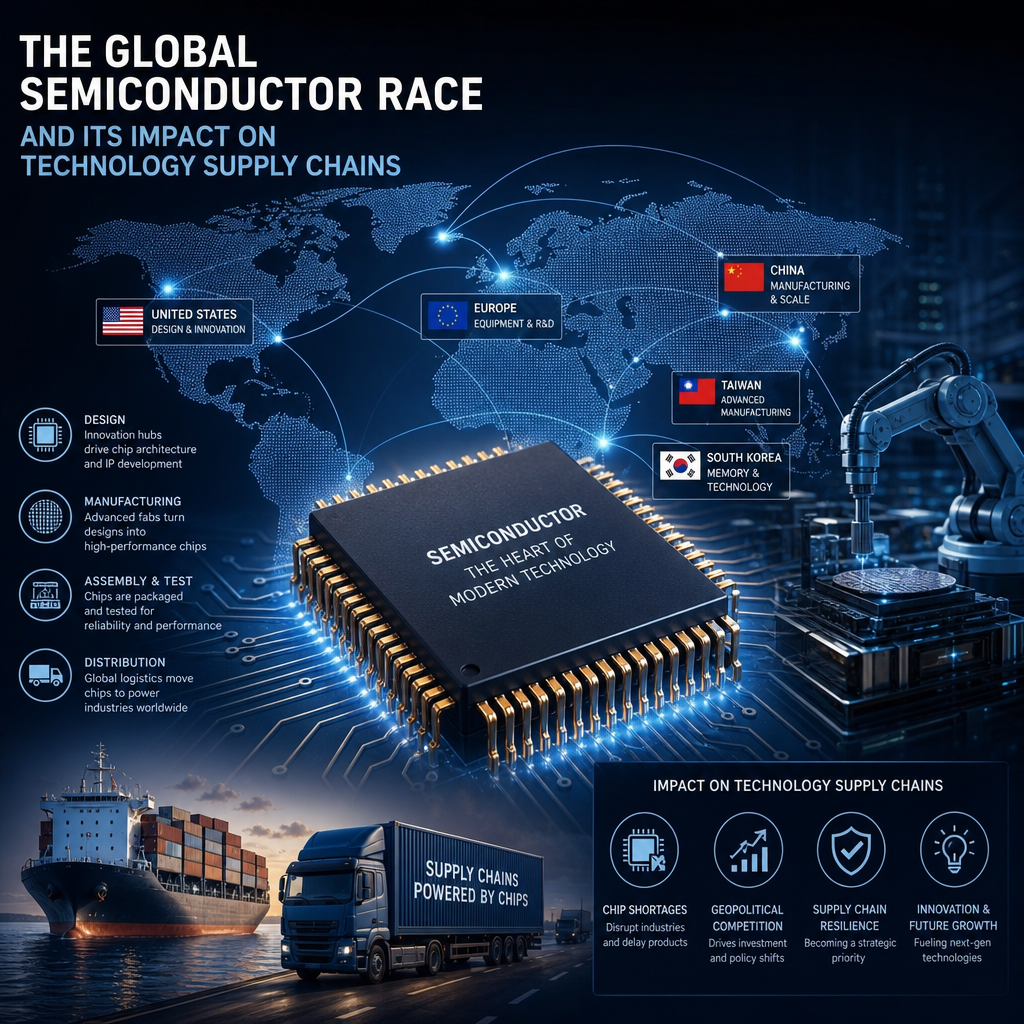
The global semiconductor race is not simply a competition among chipmakers. It is a broader struggle over manufacturing capacity, geopolitical influence, research leadership, and supply chain resilience. The companies and countries that lead in semiconductors often gain strategic advantages across many industries.
Chips are the foundation of modern technology
Semiconductors are essential for:
- Consumer electronics like phones, tablets, and TVs
- Cloud and data center infrastructure
- Electric vehicles and advanced driver-assistance systems
- Industrial automation and robotics
- Telecommunications networks, including 5G
- Healthcare devices and diagnostic tools
- Military and aerospace systems
Because chips are embedded in so many products, shortages or delays can affect everything from product launches to public infrastructure.
Supply chains depend on a few critical nodes
The semiconductor supply chain is highly specialized. A single chip may require:
- Raw materials such as silicon, rare gases, and specialty chemicals
- Design software and intellectual property
- Advanced manufacturing equipment
- Fabrication in a foundry
- Packaging, testing, and assembly
- Distribution to device makers and retailers
Each step may involve different countries and companies. That makes the system efficient in normal conditions, but vulnerable to disruption.
The Global Semiconductor Race and Technology Supply Chains
The global semiconductor race directly affects technology supply chains because chip production is concentrated in a relatively small number of regions and companies. When one part of that system slows down, manufacturers far downstream can face delays, higher costs, and redesign challenges.
Concentration creates both efficiency and risk
For years, the semiconductor sector optimized for cost and scale by concentrating advanced manufacturing in a few locations. This model helped lower prices and improve specialization, but it also created major dependency risks.
A supply chain can become fragile when:
- One region produces a large share of advanced chips
- One company dominates a critical process
- Logistics depend on long international shipping routes
- Natural disasters, trade restrictions, or political tensions interrupt production
This is why companies now focus more on resilience, not just efficiency.
The impact on consumer devices
When chip supply tightens, consumer electronics makers often feel it first. Even a shortage of one component can delay final assembly. Companies may have to:
- Redesign products to use available chips
- Delay launches
- Prioritize high-margin products
- Increase inventory buffers
For consumers, the result can be fewer choices, higher prices, and longer waits for the latest devices.
The impact on automotive and industrial sectors
The automotive industry has become especially dependent on semiconductors. Modern vehicles use chips for engine control, infotainment, safety systems, battery management, and connectivity. Industrial firms rely on chips for sensors, automation systems, and control software.
Unlike smartphones, many of these products use long-life components that are difficult to replace quickly. A chip shortage in these sectors can halt production lines and delay shipments for months.
What Is Driving the Global Semiconductor Race?
Several forces are accelerating the global semiconductor race and reshaping technology supply chains.
1. Surging demand for advanced computing
Artificial intelligence, cloud services, high-performance computing, and edge devices all require more powerful and specialized chips. Data centers need advanced processors and memory. AI applications increase demand for GPUs, accelerators, and specialized architectures.
This demand is pushing chipmakers to invest in:
- Smaller process nodes
- More advanced packaging
- Better power efficiency
- Custom silicon designs
2. Geopolitical competition
Semiconductors have become a strategic asset. Governments see domestic chip production as critical to economic security and technological independence. As a result, countries are funding local manufacturing, offering tax incentives, and tightening export controls on advanced tools or chip technologies.
These moves can help build domestic capacity, but they also add complexity to global sourcing decisions.
3. Supply chain fragility exposed by recent disruptions
Recent years revealed how vulnerable global manufacturing can be. Pandemic-related disruptions, transportation bottlenecks, trade disputes, and energy shocks all highlighted the risk of overreliance on a narrow supplier base. Companies are now rethinking just-in-time inventory strategies and building more redundancy into their supply chains.
4. The race for domestic manufacturing
Many governments want more semiconductor fabs, packaging plants, and materials facilities within their borders. Building domestic capacity takes time, highly skilled labor, and major capital investment, but it can reduce exposure to external disruptions.
How Chip Manufacturing Shapes Supply Chain Strategy
Semiconductor manufacturing is one of the most complex production processes in the world. It requires extreme precision, advanced equipment, and constant quality control.
Fabrication is only one part of the puzzle
People often focus on fabs, but the broader ecosystem matters just as much. A strong supply chain also depends on:
- Equipment suppliers
- Chemical and material providers
- Design firms
- Assembly and test facilities
- Logistics networks
- Skilled engineers and technicians
If any one of these areas falls behind, output can slow.
Advanced nodes are not the whole market
While advanced chips get most of the attention, mature-node semiconductors remain critical for many products. These chips power appliances, vehicles, sensors, and industrial devices. During shortages, the lack of mature-node capacity can be just as disruptive as the shortage of cutting-edge chips.
This is one reason supply chain leaders now take a more balanced view of risk. They are not only watching the newest logic chips. They are also tracking memory, analog, power management, and specialized components.
Packaging has become a strategic bottleneck
Chip packaging and testing are gaining new importance. As chips become more complex, advanced packaging helps improve performance and efficiency. But packaging capacity can be limited, creating another potential bottleneck in the supply chain.
Companies are increasingly investing in:
- Chiplet architectures
- Heterogeneous integration
- Advanced interconnects
- Localized test and assembly capabilities

Strategies Companies Use to Build Resilient Semiconductor Supply Chains
To manage risk in the global semiconductor race, companies are changing how they source, design, and plan for chips.
Diversifying suppliers
Many companies are reducing dependence on a single foundry, assembly site, or region. Supplier diversification can include:
- Multi-sourcing critical components
- Qualifying alternative chips early
- Using regional manufacturing hubs
- Developing backup packaging and testing partners
This approach takes planning, but it can prevent production stoppages.
Designing flexibility into products
Hardware teams are now creating products that can tolerate component substitutions more easily. That may involve:
- Using pin-compatible parts
- Standardizing boards
- Building modular designs
- Keeping firmware adaptable to different chip variants
The more flexible a design is, the easier it becomes to respond to shortages.
Improving visibility across the supply chain
A resilient semiconductor strategy depends on data. Companies are investing in systems that track:
- Supplier lead times
- Inventory levels
- Geopolitical exposure
- Transportation delays
- Manufacturing capacity
Better visibility helps teams act before a problem becomes a shutdown.
Building strategic inventory
For years, many industries minimized inventory to reduce costs. Now, some firms are holding more safety stock for critical chips. This does not mean overstocking everything. It means identifying the parts that would cause the most damage if delayed and making sure replacement options exist.
Regional Competition in the Semiconductor Industry
The semiconductor landscape is becoming more regionalized, even though it remains globally interconnected.
Asia remains central
Taiwan, South Korea, Japan, China, and other Asian economies play a major role in chip fabrication, memory production, materials, and electronics assembly. Their infrastructure, experience, and supplier ecosystems make them hard to replace quickly.
North America is rebuilding capacity
The United States has expanded support for domestic chip production, research, and equipment development. This effort aims to strengthen innovation and reduce supply chain exposure. However, building fabs and supplier ecosystems takes time, and a domestic strategy still depends on global inputs.
Europe is focusing on strategic autonomy
European countries are also investing in semiconductor capacity to support automotive, industrial, and energy systems. The goal is to improve resilience and ensure access to chips for critical sectors.
New hubs are emerging
Countries in Southeast Asia, India, and the Middle East are pursuing semiconductor investments as well. Some focus on assembly and testing, while others aim to enter manufacturing or design. These shifts may gradually diversify the global supply network.
The Role of Policy in the Semiconductor Race
Public policy now plays a major role in chip strategy. Governments influence investment decisions through incentives, export rules, talent development, and trade policy.
Incentives can accelerate capacity
Tax credits, grants, and public-private partnerships can make large semiconductor projects more viable. These policies are often intended to:
- Attract fab investment
- Support research and development
- Strengthen workforce pipelines
- Localize key supply chain steps
Export controls and trade restrictions add complexity
When governments restrict access to certain technologies or equipment, companies must adapt their sourcing and market strategies. This can reshape global trade flows and influence where future investment goes.
Workforce development is essential
Semiconductor manufacturing and design require highly trained workers. Engineers, materials scientists, technicians, and supply chain specialists are all in demand. Without investment in education and training, new capacity can be difficult to sustain.
What Businesses Should Watch Next
The global semiconductor race will continue to shape technology supply chains for years. Businesses that depend on chips should pay attention to several trends.
Key questions to monitor
- Where are critical chips manufactured?
- Which suppliers provide packaging and testing?
- How exposed is the business to single-source components?
- Are product designs flexible enough to handle substitutions?
- What regulations or export controls may affect procurement?
- How much lead time is required to secure future supply?
Practical steps for supply chain teams
- Map semiconductor dependencies across products.
- Rank components by business criticality.
- Qualify alternate suppliers before shortages occur.
- Work with engineering to improve design flexibility.
- Track policy changes in major manufacturing regions.
- Invest in forecasting tools that connect procurement and production.
These steps do not eliminate risk, but they can reduce the chance of major disruption.
Frequently Asked Questions
What is the global semiconductor race?
The global semiconductor race refers to competition among countries and companies to lead in chip design, manufacturing, packaging, and related technologies. It includes efforts to secure supply chains, build domestic fabs, and develop advanced chip capabilities.
Why are semiconductors so important to supply chains?
Semiconductors are used in almost every modern electronic product. If chip supply is delayed, it can slow manufacturing for phones, computers, cars, industrial equipment, and more. Because chips are deeply embedded in products, shortages can ripple across many industries.
Which parts of the semiconductor supply chain are most vulnerable?
Common weak points include advanced fabrication, packaging and testing, specialized materials, and logistics. Dependence on a single supplier or region can make these areas especially vulnerable to disruption.
How can companies reduce semiconductor supply chain risk?
Companies can diversify suppliers, design products with more flexibility, hold strategic inventory for critical components, and improve visibility into demand and lead times. Working closely with engineering and procurement teams also helps reduce exposure.
Will more local chip manufacturing solve supply chain problems?
Local manufacturing can improve resilience, but it is not a complete solution. Semiconductor production depends on a global network of tools, materials, skills, and logistics. A stronger supply chain usually comes from diversification, not total self-sufficiency.
Official Resources
- U.S. Department of Commerce – CHIPS for America
- National Institute of Standards and Technology (NIST)
- Semiconductor Industry Association
- OECD – Semiconductor Supply Chains
- European Commission – European Chips Act
Conclusion
The global semiconductor race is reshaping how technology is designed, manufactured, and delivered around the world. Chips are no longer just another component in a product line; they are a strategic resource that influences economic performance, innovation, and national security. As demand rises for AI hardware, connected devices, electric vehicles, and industrial automation, the pressure on semiconductor supply chains will only grow.
For businesses, the key lesson is clear: resilience matters as much as efficiency. Companies that map their chip dependencies, diversify suppliers, and design for flexibility will be better prepared for future disruptions. Policymakers, meanwhile, face the challenge of expanding capacity without losing the global cooperation that has made the semiconductor industry so powerful in the first place.
The future of technology supply chains will be shaped by who can balance speed, scale, and stability. Understanding the semiconductor landscape is no longer optional. It is a practical necessity for any organization that depends on modern electronics. By staying informed and planning ahead, businesses can navigate this changing environment with greater confidence and less risk.