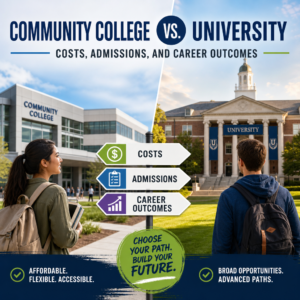
Community College vs. University: Costs, Admissions, and Career Outcomes
When comparing community college vs. university, the biggest differences often come down to affordability, admissions requirements, and the career path you want to follow. Understanding how each option fits your goals can help you choose the smartest and most cost-effective route.
By: Jennifer on July 24, 2026
Choosing between community college vs. university is one of the biggest education decisions many students and families face. The right path depends on your goals, your budget, your academic readiness, and the kind of career you want to build. For some students, community college offers an affordable and flexible start. For others, a university provides the full college experience, specialized majors, and a direct route into certain professions.
There is no single “best” option for everyone. Instead, the smartest choice is the one that aligns with your needs today and your plans for tomorrow. In this guide, we’ll compare community college vs. university in terms of costs, admissions, transfer options, and career outcomes so you can make an informed decision.
What Is the Difference Between Community College and University?
At a basic level, community colleges and universities both provide postsecondary education, but they serve different purposes and student needs.
Community College
Community colleges typically offer:
Associate degrees
Career and technical certificates
Transfer programs for students who plan to continue at a four-year school
Flexible schedules, including evening, weekend, and online classes
Many community colleges focus on accessibility, workforce training, and lower tuition. They often serve local students and offer smaller class sizes than large universities.
University
Universities usually offer:
Bachelor’s degrees
Master’s and doctoral programs
Research opportunities
A wider range of majors, minors, and specialized academic programs
Universities often have a broader campus life, athletic programs, student organizations, and more extensive academic resources. They may also require more selective admissions, depending on the school.
Community College vs. University: Cost Differences
For most students, cost is the most immediate and practical difference in the community college vs. university debate.
Tuition and Fees
Community colleges generally charge much lower tuition than four-year universities. While exact pricing varies by state and institution, community college is often the more affordable option for earning college credit or completing an associate degree.
University costs can be much higher because students may pay for:
Higher tuition
Campus housing
Meal plans
Student activity fees
Transportation and parking
Additional academic program costs
Hidden and Indirect Costs
When comparing the total price of attendance, don’t focus only on tuition. Consider:
Books and supplies
Housing
Food
Technology requirements
Health insurance
Lost income from reduced work hours
A student attending community college while living at home may save a significant amount compared with a student paying for a traditional four-year residential university experience.
Financial Aid Options
Both community colleges and universities may offer:
Federal financial aid
State grants
Scholarships
Work-study opportunities
Student loans
However, lower tuition at community college can reduce the need to borrow. That can make a major difference in long-term financial health. Graduating with less debt often gives students more flexibility after school, especially if they’re entering a lower-paying field or considering graduate education later.
Admissions: How Hard Is It to Get In?
Admissions policies are another major difference in the community college vs. university comparison.
Community College Admissions
Many community colleges have open or broad admissions policies. That usually means:
A high school diploma or equivalent is required
Placement tests may be used for math and English
Some programs have prerequisites
Admission is often less competitive than at four-year universities
This makes community college a practical choice for students who want a smoother transition into higher education, need academic support, or want time to improve study habits.
University Admissions
University admissions can range from moderately selective to highly competitive. Requirements may include:
High school GPA
Standardized test scores, depending on the school
Essays or personal statements
Letters of recommendation
Extracurricular activities
Portfolio or audition for certain programs
Selective universities often evaluate the whole student, not just grades. That can be a good fit for students with strong academic records, leadership experience, or clear career goals. But it can also feel intimidating for students who need a more gradual path into college.
Which Option Is Easier to Start?
If your goal is to begin college with fewer barriers, community college is usually the easier entry point. If your goal is to enroll directly in a specific bachelor’s program at a highly ranked school, university admissions may be more demanding.
Academic Experience: Classes, Support, and Campus Life
The classroom experience can feel very different depending on whether you choose community college or university.
Class Size and Teaching Style
Community colleges often have:
Smaller classes
More direct interaction with instructors
A stronger focus on foundational coursework
A practical, career-oriented approach
Universities may offer:
Large lecture halls for introductory courses
More research-focused faculty
Greater depth in major-specific classes
More opportunities for advanced study
Students who benefit from close guidance and a structured environment may prefer community college. Students who are ready for a larger academic setting may thrive at a university.
Student Support Services
Both types of schools can offer support, but the range and depth may differ.
Common services include:
Academic advising
Tutoring
Writing centers
Career counseling
Disability support
Mental health resources
Community colleges may provide especially hands-on advising for transfer and workforce training. Universities may offer broader services, but students often need to navigate a larger system.
Campus Experience
Universities usually provide a more traditional residential college experience with dorms, athletics, clubs, and campus events. Community colleges tend to be more commuter-focused, which may suit students who work, care for family members, or prefer to stay local.
If the classic campus experience matters to you, a university may be more appealing. If flexibility and convenience matter more, community college can be a strong fit.
Transfer Pathways: A Smart Middle Ground
One of the biggest advantages in the community college vs. university decision is that you do not always have to choose just one path forever.
Starting at Community College and Transferring
Many students complete general education requirements at a community college and then transfer to a four-year university. This route can offer several benefits:
Lower upfront cost
Time to adjust to college-level work
Opportunity to improve GPA before transferring
Clearer career direction before choosing a major
This strategy works especially well for students who are unsure about their major or want to save money without sacrificing the possibility of a bachelor’s degree.
What to Watch For
If you plan to transfer, keep these steps in mind:
Meet with an academic advisor early.
Check articulation agreements between schools.
Confirm which credits will transfer.
Choose courses that align with your intended major.
Keep grades strong to remain competitive.
Not all credits transfer equally, so planning matters. Students who map out their path from the beginning usually save time and avoid costly mistakes.
Career Outcomes: Which Choice Leads to Better Jobs?
Career outcomes depend on your field, your experience, and your skills—not just the type of school you attend. That said, community college and university can lead to different career opportunities.
Careers That Often Align with Community College
Community colleges are especially valuable for careers that require an associate degree, certificate, or short-term training, such as:
Dental hygiene
Nursing and allied health
Paralegal studies
Information technology support
Automotive technology
HVAC and skilled trades
Medical coding and billing
These programs are often designed with employers in mind and can lead to relatively quick entry into the workforce.
Careers That Often Require a University Degree
A university is often the better choice for careers that require a bachelor’s degree or beyond, such as:
Engineering
Teaching
Accounting
Social work
Business management
Psychology
Public health
Many scientific and research-based roles
Some professions also require graduate study after a bachelor’s degree, including medicine, law, and clinical psychology.
Experience Matters, Too
Employers often care about more than the name of your school. Internships, certifications, job experience, communication skills, and technical ability can all make a major difference.
For example:
A community college student in an IT certificate program may land a help desk role quickly.
A university student in business may need internships and networking to stand out.
A transfer student who combines community college savings with university networking may get the best of both worlds.
Which Option Is Better for Different Types of Students?
The best choice in the community college vs. university discussion depends on your personal situation.
Community College May Be a Better Fit If You:
Want to save money
Need a flexible schedule
Are unsure about your major
Prefer smaller classes
Want to improve your academic confidence
Plan to earn a certificate or associate degree
Need to stay close to home
University May Be a Better Fit If You:
Need a bachelor’s degree for your chosen career
Want a residential campus experience
Are ready for a more competitive admissions process
Value research opportunities and specialized programs
Want access to a large alumni network
Are prepared for higher costs or have strong financial aid
How to Decide Between Community College and University
If you’re still unsure, use these questions to guide your decision:
What career do I want?
Some careers require a bachelor’s degree, while others do not.
How much can I afford?
Compare total cost, not just tuition.
Am I academically ready for a four-year university?
If not, community college can be a strong starting point.
Do I want to live on campus?
If yes, university may be the better fit.
Would I benefit from a transfer plan?
Starting at community college and moving to a university can be a cost-effective strategy.
A good decision is not always the most prestigious one. It is the one that moves you forward with the least stress and the most confidence.
Practical Examples of Each Path
Example 1: The Cost-Conscious Student
Maria wants to become a registered nurse. She begins at a community college, completes prerequisite coursework, and earns an associate degree in nursing. She enters the workforce sooner and with less debt, then later decides to pursue a bachelor’s degree while working.
Example 2: The Transfer Student
Jordan is undecided about his major. He starts at community college, takes general education courses, and discovers an interest in accounting. After two years, he transfers to a university and completes his bachelor’s degree in business.
Example 3: The Direct University Student
Alyssa knows she wants to become a civil engineer. Since the degree requires a bachelor’s program and access to specialized labs, she enrolls directly at a university to stay on track for her career.
These examples show that the right path depends on your goals, not on a one-size-fits-all rule.
Frequently Asked Questions
1. Is community college worth it if I plan to transfer later?
Yes. Community college can be a very smart first step if you plan to transfer. It may allow you to complete general education courses at a lower cost while deciding on a major. The key is to work closely with advisors and confirm that your credits will transfer to your target university.
2. Does attending community college hurt my career opportunities?
Not necessarily. Many employers care most about your skills, training, and experience. Community college can lead directly to strong careers in healthcare, trades, IT, and other fields. If a job requires a bachelor’s degree, you can still use community college as a launch point before transferring.
3. Is university always better than community college?
No. University is better for some students and some careers, but community college is often the better choice for affordability, flexibility, and career-focused training. The “better” option depends on your goals, finances, and learning style.
4. Can I get financial aid at both community college and university?
Yes. Federal and state financial aid, scholarships, and loans are available at both. Because community college usually costs less, financial aid may stretch further and reduce the need to borrow.
5. What should I consider besides cost?
Look at your career goals, admissions requirements, transfer options, campus environment, class size, and support services. Also consider whether you want to live on campus, commute, or work while attending school.
When comparing community college vs. university, the most important thing to remember is that both can lead to meaningful education and career success. Community college often offers lower costs, easier admissions, flexible scheduling, and practical career training. University usually provides broader degree options, a fuller campus experience, and a direct path to careers that require a bachelor’s degree or higher.
For many students, the best choice is not either/or. It may be community college first, then a university transfer. For others, starting at a university makes sense from day one. The right decision depends on your goals, budget, academic readiness, and preferred learning environment.
Take time to compare total costs, transfer pathways, and career requirements before you enroll. With a clear plan, either route can help you build a strong future. The key is choosing the path that fits your life now while keeping your long-term goals in sight.
Jennifer, M.Ed., holds a degree in Higher Education Administration, with
a focus on U.S. college financial aid, admissions policy, and student
support systems. She researches and writes about scholarships, federal
aid programs, and the college planning process to help students and
families make informed, well-supported decisions.