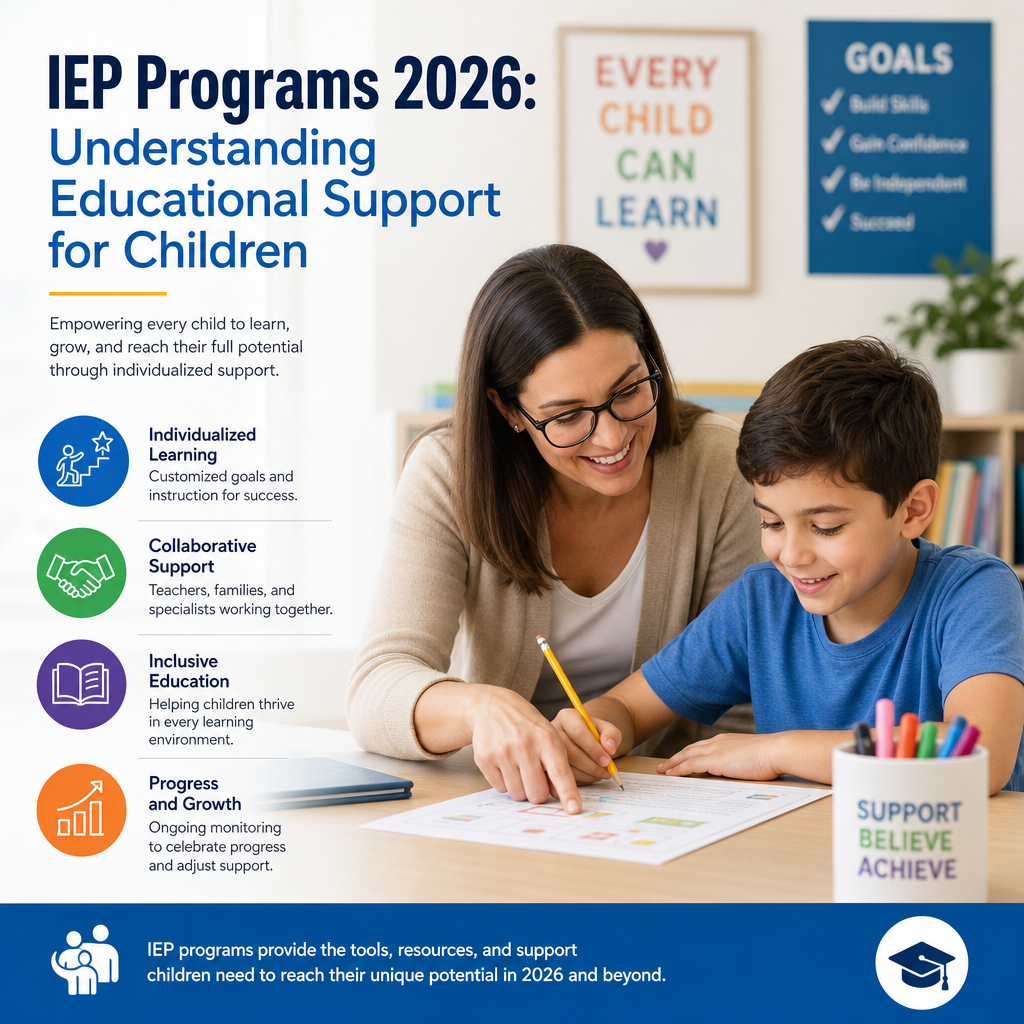
IEP programs 2026 help families understand how individualized goals, specialized instruction, and classroom supports can give children the tools they need to thrive. This guide explains eligibility, the evaluation process, family involvement, and what to expect from an effective IEP.
By: Jennifer on July 22, 2026
Última atualização em: agosto 3, 2026
Every child learns differently. Some students need extra time, specialized instruction, assistive technology, or behavioral support to participate fully in school. An Individualized Education Program, commonly called an IEP, is one of the primary tools schools use to organize and provide that support.
As families prepare for the 2026 school year, understanding how IEP programs work can help parents, caregivers, and educators make informed decisions. An IEP is more than a document listing accommodations. It is a legally guided plan that connects a child’s learning needs with measurable goals, services, classroom supports, and progress monitoring.
This guide explains the basics of IEP programs in 2026, including eligibility, the evaluation process, common services, family participation, and ways to support a child’s success.
What Is an IEP?
An IEP is a written education plan developed for a student who qualifies for special education services under the Individuals with Disabilities Education Act, or IDEA. The plan is created by a team that typically includes:
The child’s parent or guardian
General education teacher
Special education teacher
School representative or administrator
School psychologist or evaluation specialist
Related-service professionals, when appropriate
The student, when participation is suitable
The IEP explains how a disability affects a child’s education and identifies the specialized instruction and services needed to address those effects.
For example, a student with dyslexia may need explicit reading instruction, audiobooks, and additional time for written assignments. A student with autism may benefit from visual schedules, social communication instruction, sensory supports, and structured transitions. Another student with a physical disability may require occupational therapy, accessible technology, or classroom mobility assistance.
The goal is not to lower expectations. Instead, an effective IEP provides access to learning while helping the student make meaningful progress.
Who May Qualify for an IEP in 2026?
Eligibility depends on two main factors:
The child has a disability recognized under IDEA.
The disability affects the child’s educational performance or ability to benefit from instruction, creating a need for specially designed instruction.
IDEA recognizes several disability categories, including:
Autism
Specific learning disability
Speech or language impairment
Other health impairment
Emotional disturbance
Intellectual disability
Orthopedic impairment
Visual impairment
Hearing impairment
Deaf-blindness
Traumatic brain injury
Multiple disabilities
Developmental delay, where permitted by state rules
A diagnosis alone does not automatically guarantee an IEP. For instance, a medical diagnosis of attention-deficit/hyperactivity disorder may support an evaluation, but the school must also determine whether the condition substantially affects learning and requires special education.
Some students who do not qualify for an IEP may receive support through a Section 504 Plan. A 504 Plan generally provides accommodations, such as preferential seating or extended test time, but does not necessarily include specialized instruction.
The IEP Evaluation Process
The process usually begins with a concern about the child’s academic, behavioral, communication, developmental, or physical needs.
1. Referral or Request for Evaluation
A parent, teacher, doctor, or school professional may request an evaluation. Parents should make requests in writing and keep copies of all correspondence. The request can describe:
The child’s areas of difficulty
Strategies already attempted
Relevant medical or developmental information
Academic or behavioral changes
Specific concerns about access to instruction
A school may agree to evaluate, ask for additional information, or decline the request. If the school refuses, it should generally provide an explanation and information about parent rights.
2. Parent Consent
Before an initial evaluation, the school typically must obtain informed parental consent. Consent for evaluation does not automatically mean consent for special education placement. Those are separate decisions.
3. Comprehensive Evaluation
A proper evaluation should examine all areas connected to the suspected disability. Depending on the child’s needs, this may include:
Academic achievement
Cognitive processing
Speech and language
Social and emotional functioning
Behavior
Motor skills
Vision and hearing
Medical or developmental history
Assistive technology needs
Schools should use multiple sources of information rather than relying on a single test score. Classroom work, teacher observations, parent input, interviews, and standardized assessments may all be relevant.
4. Eligibility Meeting
After testing is completed, the team reviews the results and decides whether the child meets eligibility requirements. Parents are full members of this team and should receive evaluation reports before the meeting whenever possible.
If the child qualifies, the team develops an IEP. If the child does not qualify, the school may discuss other interventions, general education supports, or a 504 evaluation.
Essential Parts of an IEP
A complete IEP should be individualized and specific. Common sections include the following.
Present Levels of Performance
This section describes what the child currently knows and can do. It may address reading, mathematics, writing, communication, behavior, organization, physical development, and independent living skills.
Strong present-level statements use concrete information. For example:
When given a fourth-grade passage, Maya reads 85 words per minute with 90% accuracy. She answers literal comprehension questions independently but needs prompts to identify the main idea.”
This is more useful than a general statement such as “Maya struggles with reading.
Annual Goals
Goals describe what the student is expected to accomplish during the IEP year. They should be measurable and connected to the child’s needs.
A measurable reading goal might state:
“By May 2027, when given a grade-level passage, Maya will identify the main idea and two supporting details with at least 80% accuracy across four consecutive assessments.”
Good goals usually identify:
The skill being addressed
The conditions or materials involved
The expected level of performance
How progress will be measured
The expected timeframe
Special Education and Related Services
The IEP identifies the services the school will provide. These may include:
Specialized reading or mathematics instruction
Speech-language therapy
Occupational therapy
Physical therapy
Counseling
Behavioral support
Orientation and mobility services
Nursing or health services
Assistive technology support
Travel training or transition services
The plan should state the frequency, duration, location, and beginning and ending dates of services. Vague wording can make it difficult for families to know what support the child should receive.
Accommodations and Modifications
Accommodations change how a student accesses or demonstrates learning without necessarily changing the academic standard. Examples include:
Extended time
Small-group testing
Text-to-speech software
Preferential seating
Frequent breaks
Written and verbal directions
Graphic organizers
Speech-to-text tools
Reduced-distraction settings
Alternative response formats
Modifications change what a student is expected to learn or demonstrate. For example, a student may work on simplified curriculum standards or alternate assignments. Because modifications can affect graduation requirements and future opportunities, families should understand their impact.
Least Restrictive Environment
IDEA requires schools to educate students with disabilities alongside nondisabled peers to the greatest extent appropriate. This is known as the least restrictive environment, or LRE.
Placement options may include:
General education classroom with accommodations
General education classroom with specialized support
Part-time resource room instruction
Special education classroom
Specialized program
Homebound or hospital instruction in limited circumstances
Placement should be based on the child’s individual needs, not on disability labels or administrative convenience.
Progress Reporting
The IEP should explain how and when parents will receive updates. Progress reports may be sent with report cards or at other scheduled intervals.
Reports should provide meaningful information, such as current performance toward each goal, rather than simply stating “making progress.” If a child is not progressing as expected, the team may need to adjust instruction, services, goals, or accommodations.
Family Participation in IEP Meetings
Parents and guardians play an essential role in the IEP process. They know the child’s history, strengths, interests, communication style, and daily challenges.
Before a meeting, families can:
Review recent evaluations and schoolwork
Write down concerns and priorities
Identify successful strategies used at home
Ask for an agenda or draft IEP
Prepare questions about services and placement
Invite a knowledgeable support person, where allowed
Consider the child’s own preferences and goals
During the meeting, parents can ask for clear explanations of unfamiliar terms and request that concerns be recorded in the meeting notes. They do not have to agree immediately to every proposal. Families should receive a copy of the finalized IEP and understand the process for resolving disagreements.
A collaborative approach is usually most effective. The purpose of the meeting is to create a practical plan that supports the student, not simply to complete paperwork.
IEP Technology and Support Trends in 2026
By 2026, technology will continue to play a growing role in educational support. Digital tools can help students access text, organize assignments, communicate, and demonstrate knowledge.
Examples include:
Screen readers
Text-to-speech and speech-to-text applications
Digital graphic organizers
Adaptive keyboards
Communication devices
Digital calendars and task-management tools
Interactive reading programs
Online progress-monitoring systems
Technology should be selected based on the student’s needs, not because a particular product is popular. The IEP should identify how the tool will be used, who will provide training, and how the school will ensure access across classrooms and settings.
Artificial intelligence may also appear in educational platforms, but schools and families should consider privacy, accuracy, accessibility, and the importance of human instruction. Technology should supplement qualified educators rather than replace individualized teaching and professional judgment.
Reviewing and Updating an IEP
IEPs are generally reviewed at least once each year. A review may address:
Progress toward annual goals
Current academic and functional performance
Continued eligibility
Effectiveness of accommodations
Service delivery
Assistive technology
Behavioral or communication needs
Changes in placement
Transition planning
Parents can request an IEP meeting when concerns arise. A child’s plan may need review after a major change in performance, health, behavior, communication, or school placement.
For older students, transition planning becomes especially important. The team may discuss postsecondary education, employment, independent living, career interests, self-advocacy, and community participation. Students should gradually learn to understand their disability, describe needed supports, and participate in educational decisions.
Practical Example of an IEP Support Plan
Consider a sixth-grade student who has a specific learning disability in reading comprehension. The evaluation shows that the student understands material better when it is read aloud but has difficulty decoding unfamiliar words and organizing written responses.
An appropriate IEP might include:
Specialized reading instruction four times per week
Text-to-speech access for grade-level science and social studies materials
Explicit instruction in main idea, summarizing, and vocabulary
Extended time on reading-heavy assignments
Graphic organizers for written responses
A measurable comprehension goal
Progress monitoring every two weeks
Parent updates each grading period
This plan connects the evaluation results to specific instruction and accommodations. It also gives the team a way to determine whether the supports are working.
Tips for a Successful IEP in 2026
Families and educators can strengthen the process by focusing on practical, consistent communication.
Keep records of evaluations, meeting notes, progress reports, and correspondence.
Ask for measurable descriptions instead of general statements.
Focus on the child’s strengths as well as areas of need.
Make sure accommodations are used consistently across subjects.
Monitor whether services are delivered as written.
Share information about strategies that work at home.
Teach older students to participate in their own meetings.
Review technology needs regularly.
Request a meeting when the current plan is no longer effective.
Build a positive relationship with teachers and service providers.
Frequently Asked Questions (FAQ)
1. What is an IEP program?
An Individualized Education Program (IEP) is a personalized education plan designed for eligible students with disabilities. It outlines the student’s learning goals, special education services, accommodations, and the support they need to succeed in school.
2. Who qualifies for an IEP in 2026?
Students may qualify if they have a disability recognized under the Individuals with Disabilities Education Act (IDEA) and require specialized instruction to make meaningful progress in their education. Eligibility is determined through a formal evaluation conducted by the school.
3. How is an IEP different from a 504 Plan?
An IEP provides specialized instruction and individualized educational goals, while a 504 Plan focuses on accommodations that help students access the general education curriculum without requiring specialized instruction.
4. How often is an IEP reviewed?
An IEP is reviewed at least once every year. However, parents, teachers, or school staff can request a meeting at any time if changes to the student’s educational needs arise.
5. Can parents participate in creating an IEP?
Yes. Parents are essential members of the IEP team and have the right to attend meetings, share concerns, suggest goals, review proposed services, and approve or challenge parts of the plan.
6. What services can be included in an IEP?
Depending on the student’s needs, an IEP may include services such as speech therapy, occupational therapy, physical therapy, counseling, behavioral support, assistive technology, transportation, or specialized classroom instruction.
7. Can an IEP change during the school year?
Yes. If a student’s needs change or the current plan is not effective, the IEP team can meet to revise goals, accommodations, or services at any point during the school year.
8. What rights do parents have if they disagree with the school?
Parents have legal rights, including requesting additional evaluations, mediation, due process hearings, or independent educational evaluations if they disagree with eligibility decisions or the services provided.
9. Does an IEP continue after high school?
An IEP generally remains in effect until the student graduates with a regular high school diploma or reaches the maximum age for special education services under state law, which is often age 21.
10. What should families expect from IEP programs in 2026?
Families can expect schools to continue emphasizing personalized learning, collaboration between educators and parents, increased use of educational technology, and regular progress monitoring to better support each student’s academic and developmental needs.
Conclusion
IEP programs in 2026 remain an important way to help children with disabilities access meaningful education. A strong IEP identifies a student’s current abilities, sets measurable goals, provides appropriate instruction and services, and explains how progress will be monitored.
The most effective plans are individualized, practical, and collaborative. When families, students, educators, and specialists work together, an IEP can become more than a compliance document—it can serve as a clear roadmap for learning, independence, and long-term success.
Jennifer, M.Ed., holds a degree in Higher Education Administration, with
a focus on U.S. college financial aid, admissions policy, and student
support systems. She researches and writes about scholarships, federal
aid programs, and the college planning process to help students and
families make informed, well-supported decisions.