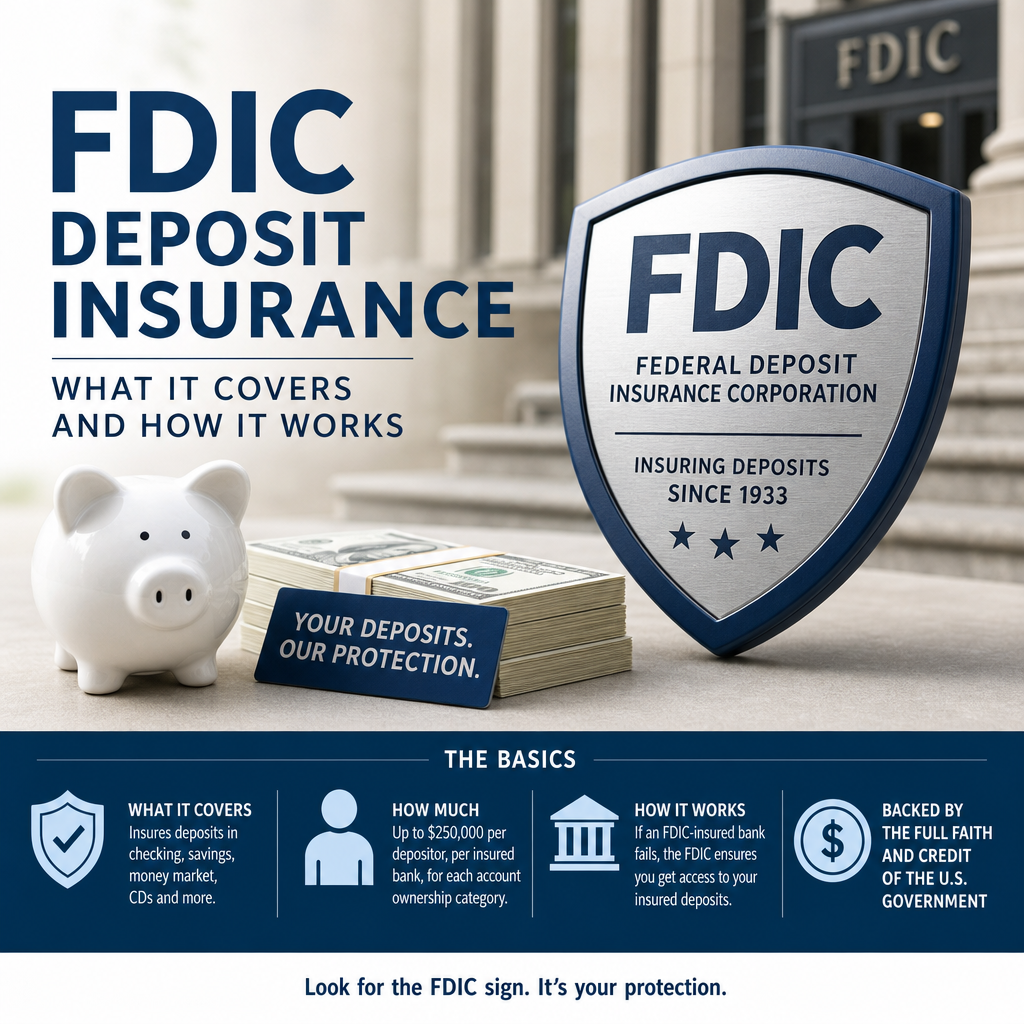
FDIC Deposit Insurance: What It Covers and How It Works
FDIC deposit insurance helps protect eligible money in bank accounts if an FDIC-insured institution fails, but it doesn’t cover every financial product. Knowing what’s included—and the limits that apply—can help you keep your savings safer and better organized.
By: Mary on July 23, 2026
Última atualização em: agosto 3, 2026
When you keep money in a bank, you want to know it’s protected. That’s where FDIC deposit insurance comes in. For many everyday savers, it’s one of the most important safety nets in the U.S. banking system. It helps protect eligible deposits if an FDIC-insured bank fails, giving customers peace of mind about the money they rely on for bills, savings goals, and short-term cash needs.
But FDIC deposit insurance is often misunderstood. Some people assume every financial product is covered. Others don’t realize coverage limits apply by account ownership category. Understanding how it works can help you make smarter decisions about where to keep your money and how to structure accounts for the protection you want.
What Is FDIC Deposit Insurance?
The Federal Deposit Insurance Corporation, or FDIC, is a U.S. government agency created to maintain confidence in the banking system. One of its core roles is providing FDIC deposit insurance for eligible deposits held at member banks.
If an FDIC-insured bank fails, the FDIC works to protect depositors up to the insurance limit. In most cases, insured depositors do not lose money on covered funds. This system helps reduce panic during bank trouble and supports stability across the financial system.
Why FDIC Insurance Matters
FDIC deposit insurance matters because it protects the money most people use every day, including:
Checking account balances
Savings account balances
Money market deposit accounts
Certificates of deposit, or CDs
Certain cashier’s checks and money orders issued by insured banks
It does not protect against every type of loss, and that distinction is important.
What FDIC Deposit Insurance Covers
FDIC insurance covers only certain deposit products held at an FDIC-insured bank or savings institution. If the institution is insured, your eligible deposits are protected up to the standard coverage limits.
Covered Deposit Accounts
The most common covered accounts include:
Checking accounts
Savings accounts
Money market deposit accounts
Certificates of deposit (CDs)
Negotiable order of withdrawal, or NOW, accounts
Cashier’s checks and money orders issued by the bank
If money is sitting in one of these deposit accounts, it is generally protected by FDIC insurance as long as the bank is insured and the account is eligible.
What Is Not Covered
FDIC deposit insurance does not cover investments or losses tied to market performance. Common non-covered products include:
Stocks
Bonds
Mutual funds
Exchange-traded funds (ETFs)
Annuities
Life insurance policies
Crypto assets held through a bank
Safe deposit box contents
It also does not cover losses due to fraud, theft, or bad investment decisions in the same way deposit insurance covers bank failure. Those issues may be handled through other legal or institutional protections, but not through FDIC insurance itself.
How FDIC Deposit Insurance Works
At a basic level, FDIC deposit insurance works by protecting depositors if an insured bank fails. Coverage is automatic for eligible accounts at insured institutions, so you do not need to apply for it or pay a fee.
Step 1: The Bank Must Be FDIC-Insured
Not every financial company is an FDIC-insured bank. Before opening an account, verify that the institution is covered. FDIC insurance applies only to deposits held at FDIC-insured banks and savings associations.
Step 2: Coverage Applies by Ownership Category
The FDIC does not just look at account balances. It also considers ownership category, which affects how much insurance applies. Examples of ownership categories include:
Single accounts
Joint accounts
Certain retirement accounts
Revocable trust accounts
Irrevocable trust accounts
Business accounts
Government accounts
This means the same person may have separate coverage amounts in different ownership categories.
Step 3: The Standard Insurance Limit Applies
The standard FDIC insurance limit is $250,000 per depositor, per insured bank, per ownership category. If your deposits in a given category at one insured bank stay within that amount, they are generally fully insured.
For example:
One person with a single checking account and a single savings account at the same bank shares one combined coverage limit for that ownership category.
Two co-owners on a joint account may receive coverage based on how the account is structured.
Retirement account coverage is calculated separately from single or joint accounts.
Step 4: The FDIC Pays Insured Deposits Quickly
If a bank fails, the FDIC typically steps in and either transfers insured deposits to another insured bank or sends depositors payment for covered amounts. The goal is to give depositors access to insured money as quickly as possible.
Understanding the $250,000 Coverage Limit
The most widely cited rule in FDIC deposit insurance is the $250,000 limit, but that number can be more flexible than it first appears.
Per Depositor, Per Bank, Per Ownership Category
This phrase is key. It means coverage is calculated separately for each:
Depositor
Insured bank
Ownership category
So if you have money in different ownership categories, you may receive more than $250,000 in total protection at one bank.
Example of Single Account Coverage
If one person has:
$150,000 in a savings account
$75,000 in a checking account
at the same bank, both accounts are combined because they share the same single ownership category. Total coverage needed is $225,000, which is within the $250,000 limit.
Example of Separate Ownership Categories
If that same person also has:
$200,000 in a single account
$200,000 in a retirement account
the accounts may be insured separately because retirement accounts fall under a different category. In that case, both could be fully covered if each category remains within its own limit.
Special FDIC Coverage Rules to Know
Some account types have additional rules that can change how much protection applies. Knowing these rules can help you avoid surprises.
Joint Accounts
Joint accounts are owned by two or more people. FDIC insurance typically calculates coverage based on the number of co-owners and their equal ownership interests, as long as the account meets FDIC requirements.
This can allow joint accounts to receive more total coverage than single accounts, but only if the ownership structure is valid and properly documented.
Revocable Trust Accounts
Revocable trust accounts, often used for estate planning, can qualify for separate coverage depending on the number of beneficiaries and other FDIC rules. These accounts are common in living trusts and payable-on-death arrangements.
Because the details can get complex, account owners should review how beneficiaries are listed and how the trust is structured.
Business Accounts
Business deposits are usually covered separately from personal accounts if the business is a distinct legal entity. That can be helpful for small business owners who keep operating cash in checking or savings accounts.
Retirement Accounts
Certain retirement deposits held at FDIC-insured institutions, such as some IRA deposits, are covered in a separate ownership category. However, not all retirement-related investments are FDIC-insured. Coverage applies to the deposit account itself, not to market-based assets inside a retirement plan.
Common Mistakes People Make
Many depositors assume they are fully protected without checking the details. A few common mistakes can leave money uninsured.
Assuming All Accounts at One Bank Are Separately Covered
A checking account and savings account held by the same person at the same bank usually count together in the same ownership category. The coverage limit applies to the combined total.
Confusing a Bank With a Brokerage or Fintech App
Some apps let you hold cash-like balances, but the provider may not be the actual FDIC-insured bank. In some cases, deposit insurance depends on how funds are programmatically placed at partner banks. Always verify the structure.
Forgetting About Interest
Interest can push a balance above the limit, especially in CDs. A balance that was once fully insured may become partially uninsured as interest accrues.
Overlooking Multiple Accounts at the Same Institution
It is easy to forget about old CDs, dormant savings accounts, or money market accounts opened years ago. These all count toward the same coverage category if they are owned by the same person at the same bank.
How to Check Whether Your Deposits Are Protected
You do not need to guess. A few simple steps can help you confirm your coverage.
1. Confirm the Institution Is FDIC-Insured
Look for the FDIC member bank label or use the FDIC’s official BankFind tool.
2. Identify the Ownership Category
Determine whether the account is:
Single
Joint
Trust
Retirement
Business
Another eligible category
3. Add Up Balances by Category
Combine all deposits you own in the same category at the same bank. Include checking, savings, CDs, and money market deposit accounts.
4. Compare the Total to the Coverage Limit
If the total stays at or below the insurance limit for that category, your deposits are generally fully insured.
5. Recheck After Major Changes
Coverage can change after:
Opening new accounts
Adding co-owners
Rolling over CDs
Receiving large deposits
Moving funds between banks
Practical Ways to Maximize FDIC Deposit Insurance
You do not need complicated strategies to use FDIC deposit insurance well. For most people, the goal is simply to keep deposits within insured limits.
Spread Funds Across Insured Banks
If you have more than $250,000 in one ownership category, moving excess funds to another FDIC-insured bank may increase protection.
Use Different Ownership Categories Carefully
Some savers may benefit from separate categories such as joint accounts or retirement deposits. However, account structure should reflect real ownership and estate-planning goals, not just insurance strategy.
Keep a Running Balance
Large CDs, business reserves, and temporary cash holdings can add up fast. A simple spreadsheet or banking app note can help you track totals by bank and ownership category.
Ask Questions Before Opening New Accounts
Before you move money, ask the bank how the account is titled and how it affects FDIC coverage. That small step can prevent unintentional uninsured balances.
FDIC Insurance vs. SIPC Protection
People sometimes confuse FDIC deposit insurance with investor protection. They are not the same thing.
FDIC Protects Deposits
FDIC insurance covers eligible bank deposits if a bank fails.
SIPC Protects Certain Brokerage Assets
The Securities Investor Protection Corporation, or SIPC, helps protect customer assets held by certain brokerage firms if the broker fails. It does not insure against market losses, and it does not cover bank deposits in the way FDIC insurance does.
If your money is in a bank account, look for FDIC insurance. If it is in a brokerage account, you may be dealing with SIPC coverage or other protections.
Why FDIC Deposit Insurance Still Matters Today
Even with modern banking apps, digital wallets, and online-only banks, FDIC deposit insurance remains a core part of consumer protection. It helps people keep funds in insured institutions without fearing that a bank failure will wipe out covered balances.
That protection supports everyday banking habits:
Paying bills from checking accounts
Storing emergency funds in savings
Parking short-term cash in CDs
Running small businesses with deposit accounts
Keeping retirement deposits in eligible bank products
For most consumers, the main takeaway is simple: if the account is eligible and the institution is FDIC-insured, deposit insurance provides an important layer of safety.
Frequently Asked Questions
1. Is FDIC deposit insurance automatic?
Yes. If you place eligible deposits at an FDIC-insured bank, coverage is automatic. You do not need to enroll or pay for it separately.
2. Does FDIC insurance cover online banks?
Yes, if the online bank is an FDIC-insured bank or savings association. Always verify the institution itself, not just the app or brand name you see on your phone.
3. Are joint accounts covered twice as much?
Joint accounts can receive separate coverage based on the number of co-owners and how the account is structured. That does not mean every joint account automatically gets twice the coverage in every situation, so the account details matter.
4. What happens if my bank fails?
If your bank fails, the FDIC generally works to transfer your insured deposits to another bank or pays you directly for covered funds. In most cases, insured depositors regain access to their money quickly.
5. Are credit union accounts covered by the FDIC?
No. Credit unions are typically insured by the National Credit Union Administration through the NCUSIF, not the FDIC. The protection is similar in purpose, but it comes from a different agency.
FDIC deposit insurance is one of the simplest and most valuable protections available to bank customers, but it only works well when you understand the rules. It covers eligible deposit accounts at FDIC-insured banks, not investments or every type of financial product. The standard limit is $250,000 per depositor, per insured bank, per ownership category, which means account structure matters as much as the balance itself.
For everyday savers, the smartest approach is straightforward: verify that your bank is insured, know how your accounts are titled, and track balances by ownership category. That extra attention can help you avoid unintentional gaps in coverage, especially if you hold large balances, multiple accounts, or specialized deposit products like trust or retirement accounts.
In a financial world that changes quickly, FDIC deposit insurance remains a dependable safeguard. Whether you are building an emergency fund, managing business cash, or simply choosing where to keep your checking account, understanding this protection gives you more confidence and control. Take a few minutes to review your accounts now, and you’ll be better prepared if you ever need the security FDIC coverage is designed to provide.
Mary S, CFP®, is a Certified Financial Planner with over 12 years of experience in personal finance, retirement planning, and wealth management. She writes educational content that helps readers understand financial concepts and make informed decisions based on reliable information.