The Expanding Global Space Economy: Satellites, Launches, and Competition
The global space economy is no longer a niche industry reserved for government agencies and a few private pioneers. It now includes commercial satellite services, reusable launch vehicles, broadband internet constellations, Earth observation platforms, space manufacturing, and a growing list of startups and national programs competing for a share of the market. What was once mainly about exploration has become a fast-moving economic ecosystem with real-world impacts on communications, defense, logistics, agriculture, disaster response, and even financial services.
As access to orbit becomes more affordable and satellite technology becomes more capable, the global space economy is expanding in both size and complexity. Companies and governments are racing to build better satellites, increase launch frequency, secure spectrum rights, and establish leadership in a market that is increasingly strategic. Understanding this shift helps explain why space now matters far beyond science fiction.
What Is the Global Space Economy?
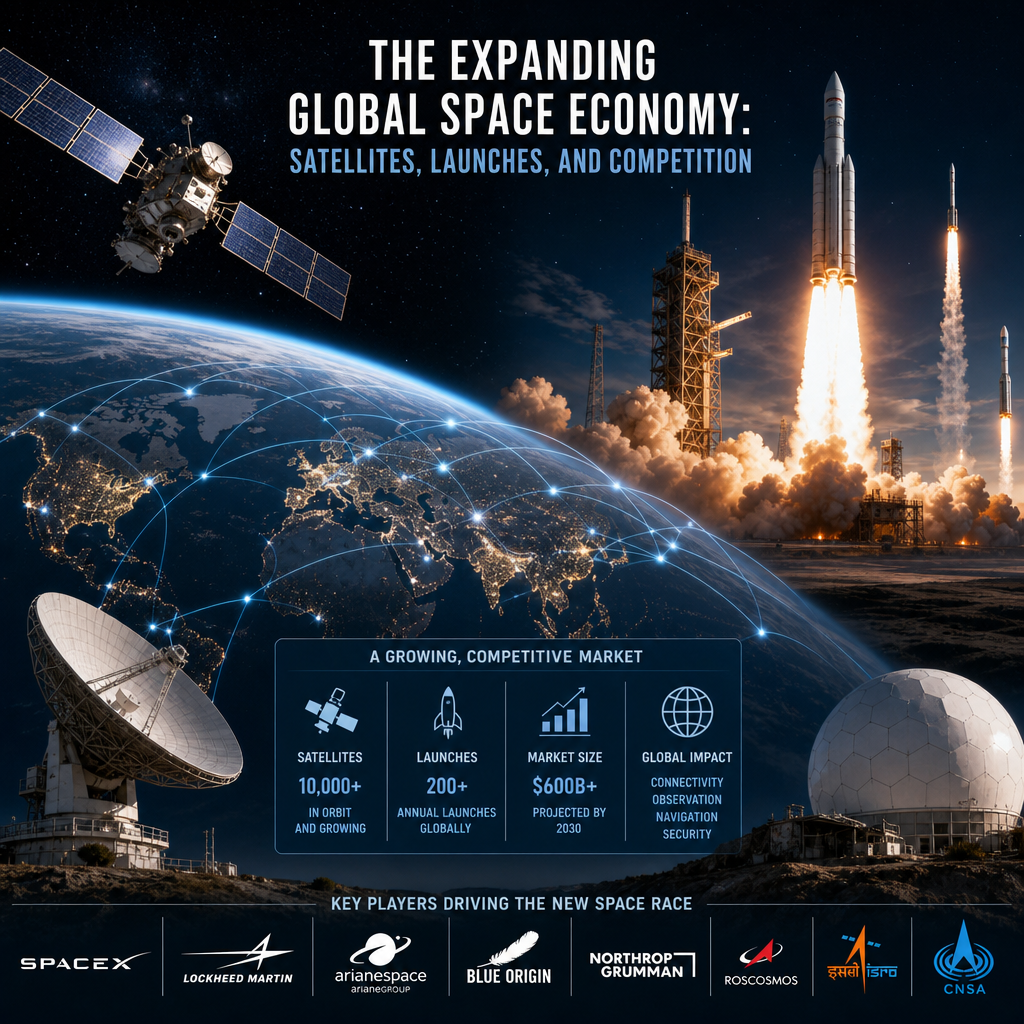
The global space economy includes all the commercial and public activities that depend on space-based infrastructure and services. That covers everything from building rockets and satellites to providing satellite-enabled communications, navigation, weather forecasting, and imagery analysis.
Core segments of the space economy
The industry generally includes:
- Satellite manufacturing: Designing and building spacecraft for communications, Earth observation, defense, and science
- Launch services: Sending satellites and cargo into orbit using rockets
- Satellite operations: Tracking, managing, and maintaining spacecraft
- Downstream services: Delivering data and services to users on Earth, such as GPS, internet access, and weather insights
- Ground infrastructure: Antennas, data centers, control systems, and user terminals
These segments are interconnected. A company may build a satellite, launch it, operate it, and sell the data it generates. That vertical integration has become a major competitive advantage.
Why the industry is growing
Several forces are driving growth in the global space economy:
- Smaller and cheaper satellites are easier to deploy.
- Reusable rockets are reducing launch costs and increasing cadence.
- Governments are spending more on space for security and resilience.
- Private companies are creating new commercial applications for space data.
- Global demand for connectivity and real-time information keeps rising.
In short, space is becoming more accessible, and that opens the door to new business models.
Satellites: The Backbone of the Global Space Economy
Satellites are at the center of the global space economy. They support telecommunications, internet access, navigation, climate monitoring, defense, and scientific research. Without satellites, much of modern digital life would slow down or fail completely.
The rise of small satellites and mega-constellations
Traditional satellites were large, expensive, and built for long missions. Today, many companies use small satellites and mega-constellations of dozens, hundreds, or even thousands of spacecraft working together.
This model offers several benefits:
- Faster development cycles
- Lower production costs
- More flexible deployment
- Redundancy if one satellite fails
- Frequent data refreshes for Earth imaging and connectivity
A famous example is low Earth orbit broadband networks, which aim to provide internet access in areas where fiber or cell towers are difficult to deploy. These systems show how satellite technology is moving from specialized use cases into everyday infrastructure.
Practical uses of satellite data
Satellite services are no longer limited to government or defense clients. Businesses and local agencies now use them for tasks such as:
- Monitoring crop health
- Tracking shipping routes
- Assessing wildfire damage
- Mapping urban growth
- Supporting emergency response after storms or earthquakes
For example, an agricultural company may use satellite imagery to spot water stress in fields before it becomes visible from the ground. That kind of insight can improve yields and reduce waste.
Launches: The Engine of Expansion
If satellites are the backbone of the global space economy, launches are the engine that keeps it moving. Every spacecraft needs a ride to orbit, and launch providers now play a crucial role in determining cost, access, and speed to deployment.
The impact of reusable rockets
Reusable launch systems have changed the economics of space access. Instead of discarding a rocket after one flight, companies can recover and reuse major components. This helps lower costs and increase launch frequency.
The broader effect is significant:
- More affordable satellite deployment
- Faster replacement of failed assets
- Greater flexibility for commercial customers
- More competition among launch providers
As a result, launch is no longer dominated by a few legacy contractors. New entrants and established players alike are pushing for efficiency, reliability, and market share.
Launch cadence and market competition
Launch cadence matters because satellite operators want reliable access to orbit on a schedule that matches business needs. A provider that can launch frequently and predictably has an edge, especially when supporting large constellations.
This has led to intense competition among:
- Commercial launch companies
- National space agencies
- Defense-oriented launch programs
- International providers expanding into global markets
For customers, this competition can mean better pricing and more options. For providers, it means constant pressure to innovate, improve reliability, and reduce turnaround time.
The challenge of launch bottlenecks
Even with more launch vehicles available, bottlenecks still exist. These include:
- Limited launch site availability
- Supply chain constraints
- Regulatory approvals
- Weather delays
- Orbital congestion and scheduling conflicts
The result is that launch capacity remains a strategic asset. Countries and companies that can offer dependable launch services hold an important position in the global space economy.
Competition Is Reshaping the Global Space Economy
Competition is one of the defining features of the modern global space economy. It is not just a race among companies. It is also a contest among nations seeking technological leadership, economic opportunity, and strategic influence.
Commercial rivalry
Private companies are competing across nearly every layer of the space stack. Some focus on launch. Others build satellites, provide ground systems, sell analytics, or offer integrated space-as-a-service platforms.
Common competitive themes include:
- Lowering cost per kilogram to orbit
- Improving payload capacity
- Scaling manufacturing
- Securing government contracts
- Winning broadband and Earth observation customers
Companies that can combine technical capability with efficient operations often move fastest. In many cases, speed to market matters just as much as engineering excellence.
National space strategies
Countries are also investing heavily in space to strengthen communications, navigation, defense, and industrial capacity. National space programs often support domestic suppliers, research institutions, and commercial startups.
This can create several advantages:
- Greater independence from foreign systems
- Stronger domestic innovation ecosystems
- More resilient infrastructure
- Better positioning in global standards and regulation
In the current environment, space is both an economic sector and a geopolitical arena.
The role of international partnerships
Despite the competition, international cooperation remains important. Many missions involve cross-border collaboration, shared launch arrangements, or joint research. Partnerships can reduce risk and expand market access.
Examples of collaboration include:
- Shared Earth science missions
- Multinational satellite networks
- Cooperative launch agreements
- Joint standards for orbital sustainability
The global space economy thrives when competition and cooperation balance each other well.
New Business Models Emerging in Space
The expansion of the global space economy is not only about more satellites and launches. It is also about new ways of doing business.
Space-as-a-service
Some companies now offer turnkey solutions rather than single hardware products. This can include:
- Satellite hosting
- End-to-end mission management
- Data subscription services
- Ground segment support
- Integrated launch and operations packages
For customers, this lowers the barrier to entry. Instead of building an entire space program, a business can purchase access to specific capabilities.
Data analytics and downstream services
The fastest-growing value often comes after the satellite is in orbit. Raw imagery and signals become useful when processed into actionable insights.
Downstream applications include:
- Supply chain monitoring
- Insurance risk analysis
- Environmental compliance
- Telecommunications planning
- Maritime tracking
This is where many companies find recurring revenue and long-term customer relationships. A satellite may be the asset, but the data is often the product.
Defense and dual-use applications
Many space technologies serve both civilian and military purposes. These dual-use systems can support communication, surveillance, navigation, and resilience in crisis situations.
Because of that, governments often treat space infrastructure as critical infrastructure. That status influences procurement, export rules, and investment priorities.
Regulation, Spectrum, and Orbital Sustainability
As the global space economy grows, so do the policy challenges. More activity in orbit creates more need for coordination, oversight, and long-term sustainability.
Spectrum rights and coordination
Satellites depend on access to radio frequencies, and those frequencies must be carefully managed to avoid interference. Spectrum allocation is a major issue for broadband constellations and other communication systems.
Operators must navigate:
- National licensing requirements
- International coordination
- Interference prevention
- Priority rights and filings
Spectrum is not just a technical matter. It is a major commercial and diplomatic issue.
Orbital debris and congestion
With more satellites in orbit, the risk of collisions and debris also rises. That makes sustainability a core concern for the industry.
Best practices include:
- Designing satellites for controlled deorbiting
- Tracking objects more accurately
- Sharing collision alerts
- Improving end-of-life disposal plans
- Using maneuvering capability to avoid debris
A crowded orbital environment threatens everyone’s assets. Responsible operators understand that long-term growth depends on keeping space usable.
Licensing and oversight
Governments regulate launches, satellite operations, frequency use, and export controls. While regulation can slow some projects, it also creates predictability and safety.
Companies that understand the legal environment are better positioned to scale. Compliance is not optional in this sector; it is part of doing business.
Investment Trends and Market Dynamics
The global space economy attracts investors because it combines advanced technology, infrastructure, and recurring service revenue. But like any high-capital sector, it also carries risk.
What investors look for
Investors tend to favor businesses with:
- Clear customer demand
- Scalable manufacturing
- Differentiated technology
- Strong regulatory strategy
- A path to repeatable revenue
Models that rely only on hardware sales can be harder to sustain than those with recurring service contracts or data subscriptions.
The capital intensity challenge
Building satellites, rockets, and supporting infrastructure requires significant upfront capital. That can create pressure to prove performance early and maintain discipline on spending.
Startups in this space often need to balance ambition with realism. A great concept is not enough. They need manufacturing, testing, launch access, insurance, and a market ready to buy.
Market consolidation and specialization
As the sector matures, some areas may consolidate while others become more specialized. Large firms may dominate launch or broadband constellations, while niche companies focus on components, sensors, or analytics.
That combination of scale and specialization is a hallmark of a developing industrial ecosystem.
What the Future of the Global Space Economy Looks Like
The next phase of the global space economy will likely be defined by integration, resilience, and broader participation.
Likely trends ahead
Expect continued growth in:
- Satellite broadband
- Earth observation services
- In-orbit servicing and refueling
- Space-based intelligence and analytics
- Lunar infrastructure and cislunar logistics
- Better debris management and space traffic coordination
As the industry expands, more sectors on Earth will depend on space systems for daily operations.
Broader access and more participants
Lower costs are allowing more countries, universities, startups, and regional firms to enter the market. That democratization could drive innovation and new forms of competition.
At the same time, the industry will need to solve hard problems around regulation, congestion, security, and sustainability. Growth will only last if the ecosystem remains reliable and trusted.
Frequently Asked Questions
What is the global space economy?
The global space economy includes all commercial and public activities connected to space, such as satellite manufacturing, launch services, communications, Earth observation, navigation, and downstream data services. It also includes supporting infrastructure like ground stations and mission operations.
Why are satellites so important to the space economy?
Satellites power many essential services on Earth, including internet access, GPS navigation, weather forecasting, defense communications, and environmental monitoring. They are the main platform that makes the global space economy useful in everyday life.
How have reusable rockets changed the industry?
Reusable rockets have helped lower launch costs and increase launch frequency. That has made it easier for companies to deploy satellites, replace older systems, and compete in a market where access to orbit is a major advantage.
What are mega-constellations?
Mega-constellations are large groups of satellites working together in orbit, often in low Earth orbit, to provide services like broadband internet or continuous Earth imaging. They are a major growth area in the global space economy.
What is the biggest challenge facing the space economy today?
One of the biggest challenges is sustainability. As more satellites are launched, the risk of orbital congestion, debris, and interference increases. The industry must balance growth with responsible operations to keep space usable for the future.
Official Resources
- NASA Space Economy and Commercial Space
- Federal Communications Commission (Satellite Licensing)
- U.S. Department of Commerce – Office of Space Commerce
- European Space Agency
- United Nations Office for Outer Space Affairs
Conclusion
The global space economy is entering a defining era. Satellites are becoming smaller, smarter, and more numerous. Launch services are becoming more competitive and more reusable. Governments and private companies alike are treating space as critical infrastructure, not just a scientific frontier. That shift is creating new opportunities in communications, Earth observation, navigation, data analytics, and defense.
At the same time, the industry faces real challenges. Orbital debris, spectrum coordination, launch bottlenecks, and regulatory complexity all require careful management. The winners in this environment will be the organizations that combine innovation with reliability, and speed with responsibility.
For businesses, policymakers, and investors, the message is clear: space is now part of the global economy in a practical, measurable way. The companies and countries that understand the stakes, build resilient systems, and plan for long-term sustainability will shape the future of this rapidly expanding frontier.